

6.7 New Codes from Old
159
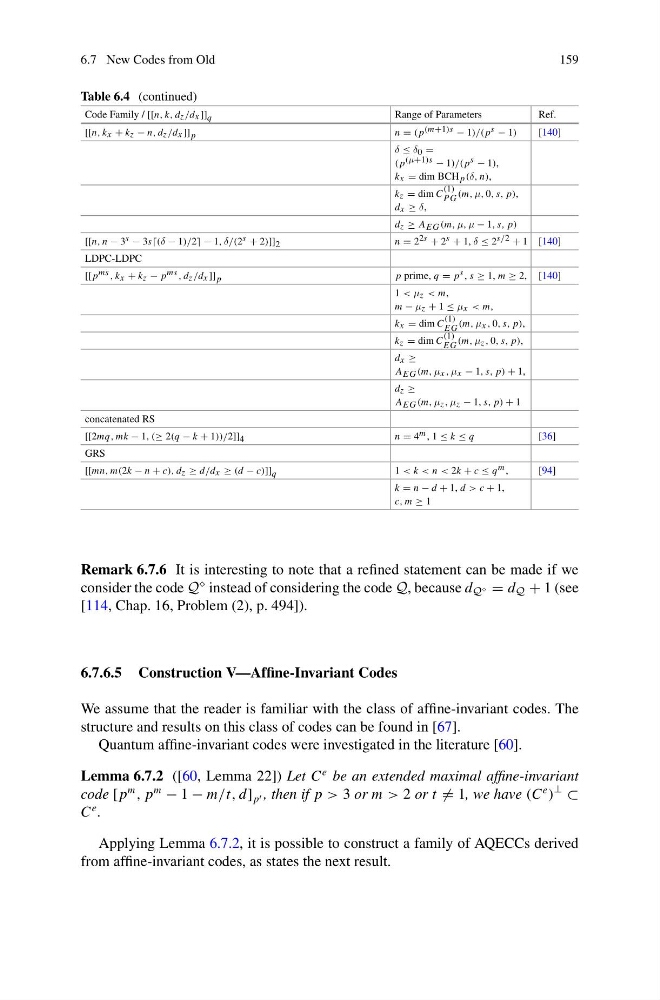
Table 6.4 (continued)
Code Family / [[n, k, d z /d x ]] q
Range of Parameters
Ref.
[[n, k x + k z − n, d z /d x ]] p
n = ( p (m+1)s − 1)/( p s − 1)
[140]
δ ≤ δ 0 =
( p (μ+1)s − 1)/( p s − 1),
k x = dim BCH p (δ, n),
k z = dim C
(1)
PG (m, μ, 0, s, p),
d x ≥ δ,
d z ≥ A EG (m, μ, μ − 1, s, p)
[[n, n − 3 s − 3s(δ − 1)/2 − 1, δ/(2 s + 2)]] 2
n = 2 2s + 2 s + 1, δ ≤ 2 s/2 + 1 [140]
LDPC-LDPC
[[ p ms , k x + k z − p ms , d z /d x ]] p
p prime, q = p s , s ≥ 1, m ≥ 2, [140]
1 < μ z < m,
m − μ z + 1 ≤ μ x < m,
k x = dim C
(1)
EG (m, μ x , 0, s, p),
k z = dim C
(1)
EG (m, μ z , 0, s, p),
d x ≥
A EG (m, μ x , μ x − 1, s, p) + 1,
d z ≥
A EG (m, μ z , μ z − 1, s, p) + 1
concatenated RS
[[2mq, mk − 1, (≥ 2(q − k + 1))/2]] 4
n = 4 m , 1 ≤ k ≤ q
[36]
GRS
[[mn, m(2k − n + c), d z ≥ d/d x ≥ (d − c)]] q
1 < k < n < 2k + c ≤ q m ,
[94]
k = n − d + 1, d > c + 1,
c, m ≥ 1
Remark 6.7.6 It is interesting to note that a refined statement can be made if we
consider the code Q
instead of considering the code Q, because d Q = d Q + 1 (see
[114, Chap. 16, Problem (2), p. 494]).
6.7.6.5 Construction V—Affine-Invariant Codes
We assume that the reader is familiar with the class of affine-invariant codes. The
structure and results on this class of codes can be found in [67].
Quantum affine-invariant codes were investigated in the literature [60].
Lemma 6.7.2 ([60, Lemma 22]) Let C
e be an extended maximal affine-invariant
code [ p
m
, p
m
− 1 − m/t, d] p t , then if p > 3 or m > 2 or t = 1, we have (C
e
)
⊥
⊂
C
e .
Applying Lemma 6.7.2, it is possible to construct a family of AQECCs derived
from affine-invariant codes, as states the next result.
159
Table 6.4 (continued)
Code Family / [[n, k, d z /d x ]] q
Range of Parameters
Ref.
[[n, k x + k z − n, d z /d x ]] p
n = ( p (m+1)s − 1)/( p s − 1)
[140]
δ ≤ δ 0 =
( p (μ+1)s − 1)/( p s − 1),
k x = dim BCH p (δ, n),
k z = dim C
(1)
PG (m, μ, 0, s, p),
d x ≥ δ,
d z ≥ A EG (m, μ, μ − 1, s, p)
[[n, n − 3 s − 3s(δ − 1)/2 − 1, δ/(2 s + 2)]] 2
n = 2 2s + 2 s + 1, δ ≤ 2 s/2 + 1 [140]
LDPC-LDPC
[[ p ms , k x + k z − p ms , d z /d x ]] p
p prime, q = p s , s ≥ 1, m ≥ 2, [140]
1 < μ z < m,
m − μ z + 1 ≤ μ x < m,
k x = dim C
(1)
EG (m, μ x , 0, s, p),
k z = dim C
(1)
EG (m, μ z , 0, s, p),
d x ≥
A EG (m, μ x , μ x − 1, s, p) + 1,
d z ≥
A EG (m, μ z , μ z − 1, s, p) + 1
concatenated RS
[[2mq, mk − 1, (≥ 2(q − k + 1))/2]] 4
n = 4 m , 1 ≤ k ≤ q
[36]
GRS
[[mn, m(2k − n + c), d z ≥ d/d x ≥ (d − c)]] q
1 < k < n < 2k + c ≤ q m ,
[94]
k = n − d + 1, d > c + 1,
c, m ≥ 1
Remark 6.7.6 It is interesting to note that a refined statement can be made if we
consider the code Q
instead of considering the code Q, because d Q = d Q + 1 (see
[114, Chap. 16, Problem (2), p. 494]).
6.7.6.5 Construction V—Affine-Invariant Codes
We assume that the reader is familiar with the class of affine-invariant codes. The
structure and results on this class of codes can be found in [67].
Quantum affine-invariant codes were investigated in the literature [60].
Lemma 6.7.2 ([60, Lemma 22]) Let C
e be an extended maximal affine-invariant
code [ p
m
, p
m
− 1 − m/t, d] p t , then if p > 3 or m > 2 or t = 1, we have (C
e
)
⊥
⊂
C
e .
Applying Lemma 6.7.2, it is possible to construct a family of AQECCs derived
from affine-invariant codes, as states the next result.