

11 Ranking of Natural Wastewater Treatment Techniques …
93
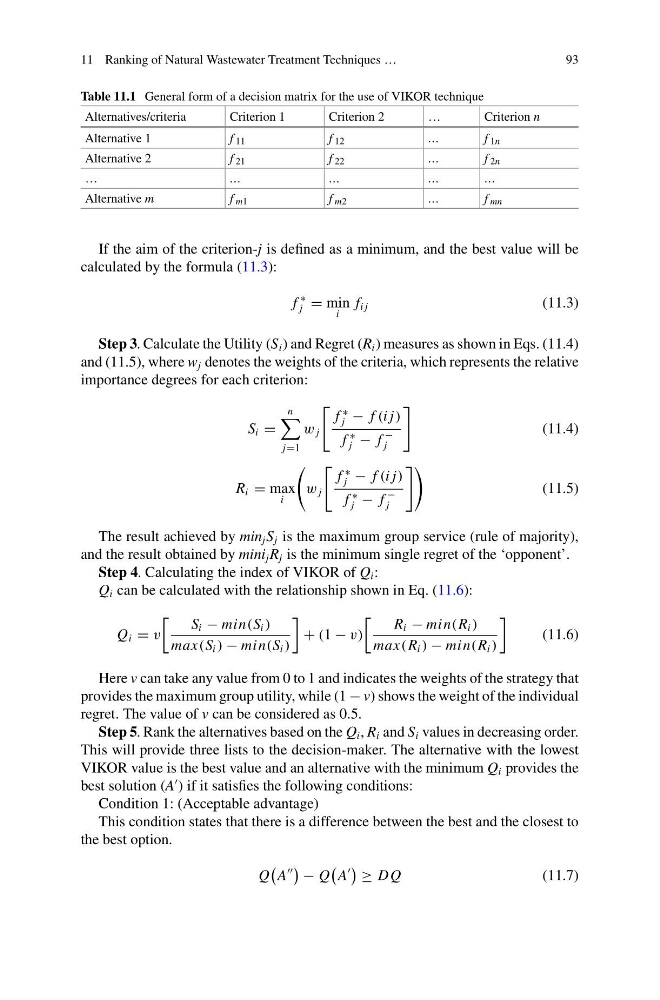
Table 11.1 General form of a decision matrix for the use of VIKOR technique
Alternatives/criteria
Criterion 1
Criterion 2
…
Criterion n
Alternative 1
f 11
f 12
…
f 1n
Alternative 2
f 21
f 22
…
f 2n
…
…
…
…
…
Alternative m
f m1
f m2
…
f mn
If the aim of the criterion-j is defined as a minimum, and the best value will be
calculated by the formula (11.3):
f
∗
j = min
i
f i j
(11.3)
Step 3. Calculate the Utility (S i ) and Regret (R i ) measures as shown in Eqs. (11.4)
and (11.5), where w j denotes the weights of the criteria, which represents the relative
importance degrees for each criterion:
S i =
n
j=1
w j
f
∗
j − f (i j)
f
∗
j − f
−
j
(11.4)
R i = max
i
w j
f
∗
j − f (i j)
f
∗
j − f
−
j
(11.5)
The result achieved by min j S j is the maximum group service (rule of majority),
and the result obtained by mini j R j is the minimum single regret of the ‘opponent’.
Step 4. Calculating the index of VIKOR of Q i :
Q i can be calculated with the relationship shown in Eq. (11.6):
Q i = v
S i − min(S i )
max(S i ) − min(S i )
+ (1 − v)
R i − min(R i )
max(R i ) − min(R i )
(11.6)
Here v can take any value from 0 to 1 and indicates the weights of the strategy that
provides the maximum group utility, while (1 − v) shows the weight of the individual
regret. The value of v can be considered as 0.5.
Step 5. Rank the alternatives based on the Q i , R i and S i values in decreasing order.
This will provide three lists to the decision-maker. The alternative with the lowest
VIKOR value is the best value and an alternative with the minimum Q i provides the
best solution (A
) if it satisfies the following conditions:
Condition 1: (Acceptable advantage)
This condition states that there is a difference between the best and the closest to
the best option.
Q
A
− Q
A
≥ D Q
(11.7)
93
Table 11.1 General form of a decision matrix for the use of VIKOR technique
Alternatives/criteria
Criterion 1
Criterion 2
…
Criterion n
Alternative 1
f 11
f 12
…
f 1n
Alternative 2
f 21
f 22
…
f 2n
…
…
…
…
…
Alternative m
f m1
f m2
…
f mn
If the aim of the criterion-j is defined as a minimum, and the best value will be
calculated by the formula (11.3):
f
∗
j = min
i
f i j
(11.3)
Step 3. Calculate the Utility (S i ) and Regret (R i ) measures as shown in Eqs. (11.4)
and (11.5), where w j denotes the weights of the criteria, which represents the relative
importance degrees for each criterion:
S i =
n
j=1
w j
f
∗
j − f (i j)
f
∗
j − f
−
j
(11.4)
R i = max
i
w j
f
∗
j − f (i j)
f
∗
j − f
−
j
(11.5)
The result achieved by min j S j is the maximum group service (rule of majority),
and the result obtained by mini j R j is the minimum single regret of the ‘opponent’.
Step 4. Calculating the index of VIKOR of Q i :
Q i can be calculated with the relationship shown in Eq. (11.6):
Q i = v
S i − min(S i )
max(S i ) − min(S i )
+ (1 − v)
R i − min(R i )
max(R i ) − min(R i )
(11.6)
Here v can take any value from 0 to 1 and indicates the weights of the strategy that
provides the maximum group utility, while (1 − v) shows the weight of the individual
regret. The value of v can be considered as 0.5.
Step 5. Rank the alternatives based on the Q i , R i and S i values in decreasing order.
This will provide three lists to the decision-maker. The alternative with the lowest
VIKOR value is the best value and an alternative with the minimum Q i provides the
best solution (A
) if it satisfies the following conditions:
Condition 1: (Acceptable advantage)
This condition states that there is a difference between the best and the closest to
the best option.
Q
A
− Q
A
≥ D Q
(11.7)