

92
T. Gichamo et al.
located on the trench. In this treatment technique, water purification processes are
operated by allowing wastewater to infiltrate through the soil profile, hence, it could
effectively remove biochemical oxygen demand and organic carbon (Ouyang et al.
2015).
11.3 Methodology
11.3.1 VlseKriterijumska Optimizcija I Kaompromisno
Resenje (VIKOR)
Visekntenjumska Optimizacija I Kompromisno Resenje (VIKOR) is the Multicriteria Optimization tool that could compromise the solution to the ideal solution.
The idea of compromising the solution was first introduced by (Yu 1973) and the
theory and applications were developed and published in 1980 (Duckstein and Opricovic 1980). The VIKOR method is a multi-criteria decision making analysis, and like
any other method of analysis, there are some steps to follow to solve problems. This
method can be considered linear normalization. The basic concept here is defining
the positive and negative ideal points in the solution space. VIKOR is an effective
decision-making tool especially when the decision-maker does not have an ability
or clear evidence to prefer among the given alternatives at the beginning of system
design. Unlike the TOPSIS method, which will also be discussed in this issue determines a solution with the shortest distance from the ideal solution and the farthest
distance from the negative ideal solution the VIKOR method does not consider the
relative importance of the distances. The primary assumption behind VIKOR is each
alternative should be evaluated based on the given criteria and ranked based on relative closeness to the ideal solution and the measure of final rank by multiple criteria
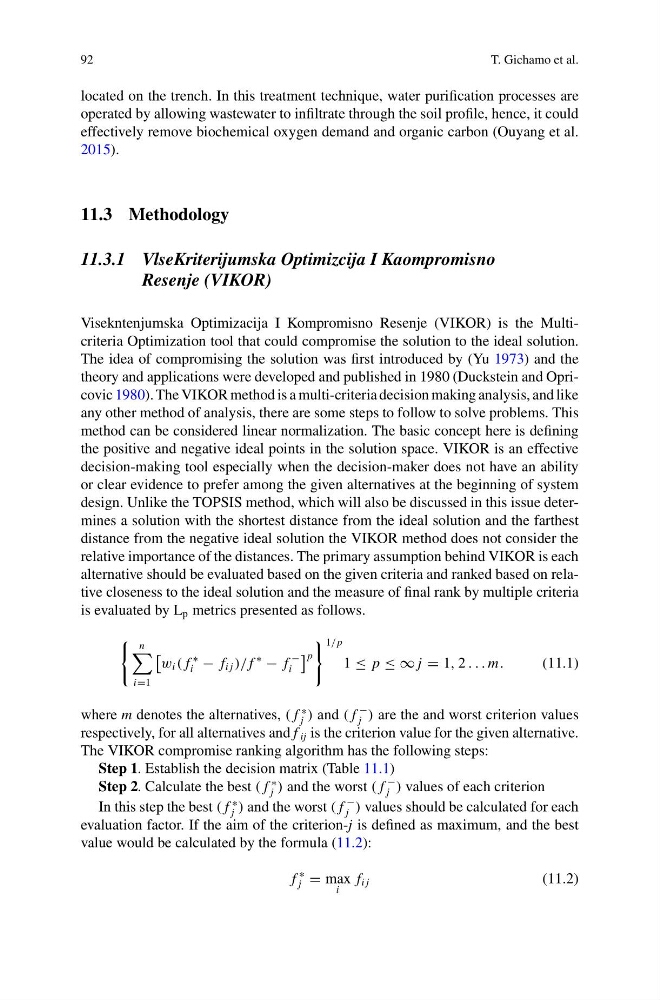
is evaluated by L p metrics presented as follows.
n
i=1
w i ( f
∗
i − f i j )/ f
∗
− f
−
i
p
1/ p
1 ≤ p ≤ ∞ j = 1, 2 . . . m.
(11.1)
where m denotes the alternatives, ( f
∗
j ) and ( f
−
j ) are the and worst criterion values
respectively, for all alternatives and f ij is the criterion value for the given alternative.
The VIKOR compromise ranking algorithm has the following steps:
Step 1. Establish the decision matrix (Table 11.1)
Step 2. Calculate the best ( f
∗
j ) and the worst ( f
−
j ) values of each criterion
In this step the best ( f
∗
j ) and the worst ( f
−
j ) values should be calculated for each
evaluation factor. If the aim of the criterion-j is defined as maximum, and the best
value would be calculated by the formula (11.2):
f
∗
j = max
i
f i j
(11.2)
T. Gichamo et al.
located on the trench. In this treatment technique, water purification processes are
operated by allowing wastewater to infiltrate through the soil profile, hence, it could
effectively remove biochemical oxygen demand and organic carbon (Ouyang et al.
2015).
11.3 Methodology
11.3.1 VlseKriterijumska Optimizcija I Kaompromisno
Resenje (VIKOR)
Visekntenjumska Optimizacija I Kompromisno Resenje (VIKOR) is the Multicriteria Optimization tool that could compromise the solution to the ideal solution.
The idea of compromising the solution was first introduced by (Yu 1973) and the
theory and applications were developed and published in 1980 (Duckstein and Opricovic 1980). The VIKOR method is a multi-criteria decision making analysis, and like
any other method of analysis, there are some steps to follow to solve problems. This
method can be considered linear normalization. The basic concept here is defining
the positive and negative ideal points in the solution space. VIKOR is an effective
decision-making tool especially when the decision-maker does not have an ability
or clear evidence to prefer among the given alternatives at the beginning of system
design. Unlike the TOPSIS method, which will also be discussed in this issue determines a solution with the shortest distance from the ideal solution and the farthest
distance from the negative ideal solution the VIKOR method does not consider the
relative importance of the distances. The primary assumption behind VIKOR is each
alternative should be evaluated based on the given criteria and ranked based on relative closeness to the ideal solution and the measure of final rank by multiple criteria
is evaluated by L p metrics presented as follows.
n
i=1
w i ( f
∗
i − f i j )/ f
∗
− f
−
i
p
1/ p
1 ≤ p ≤ ∞ j = 1, 2 . . . m.
(11.1)
where m denotes the alternatives, ( f
∗
j ) and ( f
−
j ) are the and worst criterion values
respectively, for all alternatives and f ij is the criterion value for the given alternative.
The VIKOR compromise ranking algorithm has the following steps:
Step 1. Establish the decision matrix (Table 11.1)
Step 2. Calculate the best ( f
∗
j ) and the worst ( f
−
j ) values of each criterion
In this step the best ( f
∗
j ) and the worst ( f
−
j ) values should be calculated for each
evaluation factor. If the aim of the criterion-j is defined as maximum, and the best
value would be calculated by the formula (11.2):
f
∗
j = max
i
f i j
(11.2)