

44
B. Uzun and D. Uzun Ozsahin
Keywords Decision making · Multi criteria decision making · Compromise
solution · VIKOR
7.1 Introduction
VIKOR is a multi-criteria decision making model which was first developed by Yu
(1973) and widely used at the present time. This method is used for ranking and
selection of a set of alternatives by considering different criteria’s. In this method,
the multi-criteria ranking index is introduced depending on the specific measure of
closeness to the ideal solution (Zhicheng et al. 2019). VIKOR gives multi-criteria
optimization and compromises solution to a complex problem. This method can be
considered linear normalization.
The main part of the VIKOR is defining the positive and negative ideal points of
the alternatives. VIKOR method, like any other method of MCDM analysis it follows
some steps for the solution of a particular problem.
The VIKOR technique has turned into quite important multi-criteria decision
making techniques because of its simplicity in calculation and accuracy in solutions.
VIKOR provides the decision maker achieve the best decision and take an action
by selecting and ranking options from decision matrix, and it also provides the
compromise solution to the related problem where the conflicting criteria arise. It
provides the compromise ranking list comprising peculiar measure starting from the
closest solution to the ideal solution. However, some of its hybrid combinations, such
as comprehensive VIKOR, fuzzy VIKOR, regret theory-based VIKOR, modified
VIKOR and interval VIKOR techniques have also been recently established, keeping
in notice the nature of multi criteria decision making analysis and the decision maker’s
requiement (Ali Jahan 2011).
7.2 Mathematical Framework of the VIKOR Method
The VIKOR technique has the following steps (Sayadi et al. 2009):
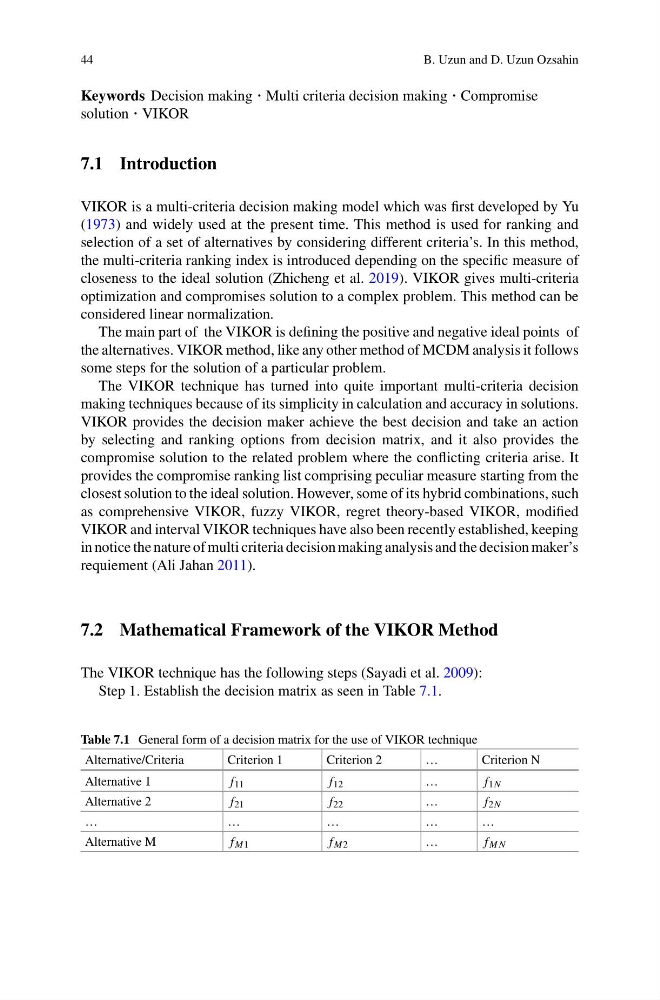
Step 1. Establish the decision matrix as seen in Table 7.1.
Table 7.1 General form of a decision matrix for the use of VIKOR technique
Alternative/Criteria
Criterion 1
Criterion 2
…
Criterion N
Alternative 1
f 11
f 12
…
f 1N
Alternative 2
f 21
f 22
…
f 2N
…
…
…
…
…
Alternative M
f M1
f M2
…
f M N
B. Uzun and D. Uzun Ozsahin
Keywords Decision making · Multi criteria decision making · Compromise
solution · VIKOR
7.1 Introduction
VIKOR is a multi-criteria decision making model which was first developed by Yu
(1973) and widely used at the present time. This method is used for ranking and
selection of a set of alternatives by considering different criteria’s. In this method,
the multi-criteria ranking index is introduced depending on the specific measure of
closeness to the ideal solution (Zhicheng et al. 2019). VIKOR gives multi-criteria
optimization and compromises solution to a complex problem. This method can be
considered linear normalization.
The main part of the VIKOR is defining the positive and negative ideal points of
the alternatives. VIKOR method, like any other method of MCDM analysis it follows
some steps for the solution of a particular problem.
The VIKOR technique has turned into quite important multi-criteria decision
making techniques because of its simplicity in calculation and accuracy in solutions.
VIKOR provides the decision maker achieve the best decision and take an action
by selecting and ranking options from decision matrix, and it also provides the
compromise solution to the related problem where the conflicting criteria arise. It
provides the compromise ranking list comprising peculiar measure starting from the
closest solution to the ideal solution. However, some of its hybrid combinations, such
as comprehensive VIKOR, fuzzy VIKOR, regret theory-based VIKOR, modified
VIKOR and interval VIKOR techniques have also been recently established, keeping
in notice the nature of multi criteria decision making analysis and the decision maker’s
requiement (Ali Jahan 2011).
7.2 Mathematical Framework of the VIKOR Method
The VIKOR technique has the following steps (Sayadi et al. 2009):
Step 1. Establish the decision matrix as seen in Table 7.1.
Table 7.1 General form of a decision matrix for the use of VIKOR technique
Alternative/Criteria
Criterion 1
Criterion 2
…
Criterion N
Alternative 1
f 11
f 12
…
f 1N
Alternative 2
f 21
f 22
…
f 2N
…
…
…
…
…
Alternative M
f M1
f M2
…
f M N