

40
B. Uzun et al.
The ranking results also can be obtained by decision-maker ‘s expectations in the
PROMETHEE methods by suggesting several potential extensions for each criterion.
So we can use the notion of preferred strength to incorporate various extensions to
the notion to criteria. The main feature of the PROMETHEE methods is that the
decision-maker will find every possible extension very clear and easily understood.
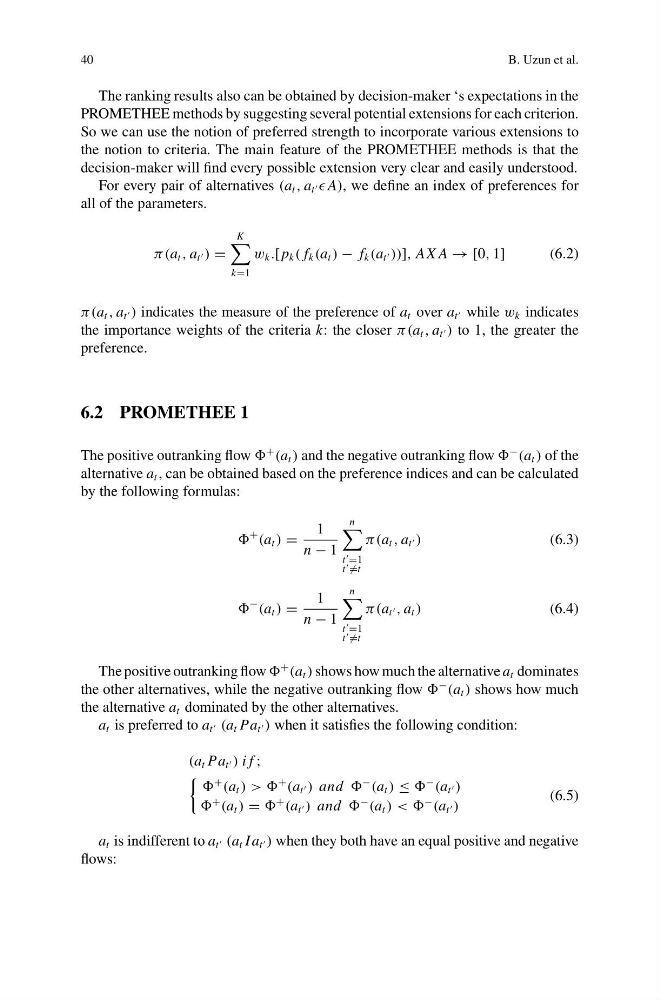
For every pair of alternatives (a t , a t A), we define an index of preferences for
all of the parameters.
π (a t , a t ) =
K
k=1
w k .[ p k ( f k (a t ) − f k (a t ))], AX A → [0, 1]
(6.2)
π (a t , a t ) indicates the measure of the preference of a t over a t while w k indicates
the importance weights of the criteria k: the closer π(a t , a t ) to 1, the greater the
preference.
6.2 PROMETHEE 1
The positive outranking flow
+
(a t ) and the negative outranking flow
−
(a t ) of the
alternative a t , can be obtained based on the preference indices and can be calculated
by the following formulas:
+
(a t ) =
1
n − 1
n
t
=1
t
=t
π (a t , a t )
(6.3)
−
(a t ) =
1
n − 1
n
t
=1
t
=t
π (a t , a t )
(6.4)
The positive outranking flow
+
(a t ) shows how much the alternative a t dominates
the other alternatives, while the negative outranking flow
−
(a t ) shows how much
the alternative a t dominated by the other alternatives.
a t is preferred to a t (a t Pa t ) when it satisfies the following condition:
(a t Pa t ) i f ;
+
(a t ) > >
+
(a t ) and
−
(a t ) ≤
−
(a t )
+
(a t ) =
+
(a t ) and
−
(a t ) < <
−
(a t )
(6.5)
a t is indifferent to a t (a t I a t ) when they both have an equal positive and negative
flows:
B. Uzun et al.
The ranking results also can be obtained by decision-maker ‘s expectations in the
PROMETHEE methods by suggesting several potential extensions for each criterion.
So we can use the notion of preferred strength to incorporate various extensions to
the notion to criteria. The main feature of the PROMETHEE methods is that the
decision-maker will find every possible extension very clear and easily understood.
For every pair of alternatives (a t , a t A), we define an index of preferences for
all of the parameters.
π (a t , a t ) =
K
k=1
w k .[ p k ( f k (a t ) − f k (a t ))], AX A → [0, 1]
(6.2)
π (a t , a t ) indicates the measure of the preference of a t over a t while w k indicates
the importance weights of the criteria k: the closer π(a t , a t ) to 1, the greater the
preference.
6.2 PROMETHEE 1
The positive outranking flow
+
(a t ) and the negative outranking flow
−
(a t ) of the
alternative a t , can be obtained based on the preference indices and can be calculated
by the following formulas:
+
(a t ) =
1
n − 1
n
t
=1
t
=t
π (a t , a t )
(6.3)
−
(a t ) =
1
n − 1
n
t
=1
t
=t
π (a t , a t )
(6.4)
The positive outranking flow
+
(a t ) shows how much the alternative a t dominates
the other alternatives, while the negative outranking flow
−
(a t ) shows how much
the alternative a t dominated by the other alternatives.
a t is preferred to a t (a t Pa t ) when it satisfies the following condition:
(a t Pa t ) i f ;
+
(a t ) > >
+
(a t ) and
−
(a t ) ≤
−
(a t )
+
(a t ) =
+
(a t ) and
−
(a t ) < <
−
(a t )
(6.5)
a t is indifferent to a t (a t I a t ) when they both have an equal positive and negative
flows: