

206
S. Sözen et al.
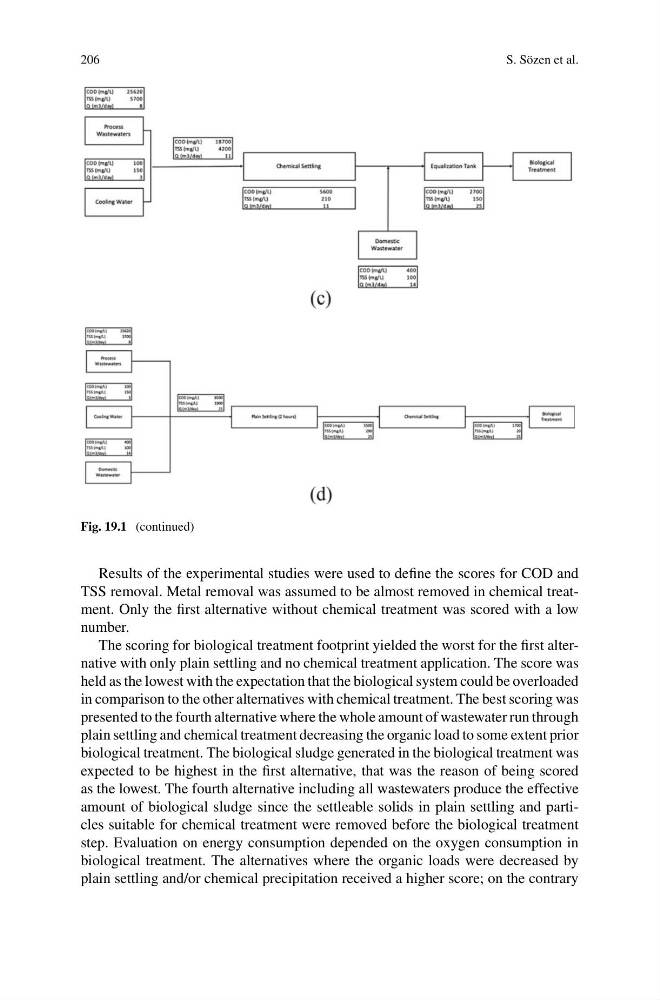
Fig. 19.1 (continued)
Results of the experimental studies were used to define the scores for COD and
TSS removal. Metal removal was assumed to be almost removed in chemical treatment. Only the first alternative without chemical treatment was scored with a low
number.
The scoring for biological treatment footprint yielded the worst for the first alternative with only plain settling and no chemical treatment application. The score was
held as the lowest with the expectation that the biological system could be overloaded
in comparison to the other alternatives with chemical treatment. The best scoring was
presented to the fourth alternative where the whole amount of wastewater run through
plain settling and chemical treatment decreasing the organic load to some extent prior
biological treatment. The biological sludge generated in the biological treatment was
expected to be highest in the first alternative, that was the reason of being scored
as the lowest. The fourth alternative including all wastewaters produce the effective
amount of biological sludge since the settleable solids in plain settling and particles suitable for chemical treatment were removed before the biological treatment
step. Evaluation on energy consumption depended on the oxygen consumption in
biological treatment. The alternatives where the organic loads were decreased by
plain settling and/or chemical precipitation received a higher score; on the contrary
S. Sözen et al.
Fig. 19.1 (continued)
Results of the experimental studies were used to define the scores for COD and
TSS removal. Metal removal was assumed to be almost removed in chemical treatment. Only the first alternative without chemical treatment was scored with a low
number.
The scoring for biological treatment footprint yielded the worst for the first alternative with only plain settling and no chemical treatment application. The score was
held as the lowest with the expectation that the biological system could be overloaded
in comparison to the other alternatives with chemical treatment. The best scoring was
presented to the fourth alternative where the whole amount of wastewater run through
plain settling and chemical treatment decreasing the organic load to some extent prior
biological treatment. The biological sludge generated in the biological treatment was
expected to be highest in the first alternative, that was the reason of being scored
as the lowest. The fourth alternative including all wastewaters produce the effective
amount of biological sludge since the settleable solids in plain settling and particles suitable for chemical treatment were removed before the biological treatment
step. Evaluation on energy consumption depended on the oxygen consumption in
biological treatment. The alternatives where the organic loads were decreased by
plain settling and/or chemical precipitation received a higher score; on the contrary