

204
S. Sözen et al.
Table 19.4 Performance of chemical treatment for different alternatives
Alternatives
FeCl 3
FeSO 4
Dosage
(mg/L)
COD
removal
(%)
TSS
removal
(%)
Dosage
(mg/L)
COD
removal
(%)
TSS
removal
(%)
2. Alternative
500
60
80
500
65
82
600
62
82
600
68
85
700
63
85
700
70
90
800
65
87
800
71
90
3. Alternative
1200 a
68
90
–
–
–
1200 b
70
95
–
–
–
4. Alternative
500
61
84
500
63
85
600
63
85
600
65
88
700
64
88
700
65
90
800
67
90
800
70
95
a With 3 mg/L nonionic polyelectrolyte
b With 1 mg/L anionic polyelectrolyte
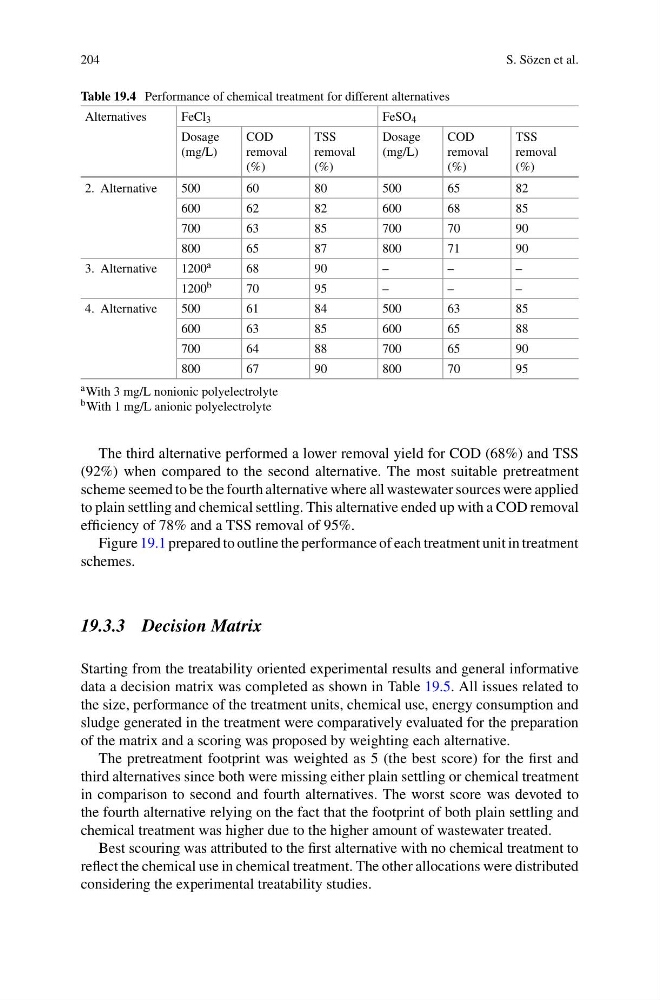
The third alternative performed a lower removal yield for COD (68%) and TSS
(92%) when compared to the second alternative. The most suitable pretreatment
scheme seemed to be the fourth alternative where all wastewater sources were applied
to plain settling and chemical settling. This alternative ended up with a COD removal
efficiency of 78% and a TSS removal of 95%.
Figure 19.1 prepared to outline the performance of each treatment unit in treatment
schemes.
19.3.3 Decision Matrix
Starting from the treatability oriented experimental results and general informative
data a decision matrix was completed as shown in Table 19.5. All issues related to
the size, performance of the treatment units, chemical use, energy consumption and
sludge generated in the treatment were comparatively evaluated for the preparation
of the matrix and a scoring was proposed by weighting each alternative.
The pretreatment footprint was weighted as 5 (the best score) for the first and
third alternatives since both were missing either plain settling or chemical treatment
in comparison to second and fourth alternatives. The worst score was devoted to
the fourth alternative relying on the fact that the footprint of both plain settling and
chemical treatment was higher due to the higher amount of wastewater treated.
Best scouring was attributed to the first alternative with no chemical treatment to
reflect the chemical use in chemical treatment. The other allocations were distributed
considering the experimental treatability studies.
S. Sözen et al.
Table 19.4 Performance of chemical treatment for different alternatives
Alternatives
FeCl 3
FeSO 4
Dosage
(mg/L)
COD
removal
(%)
TSS
removal
(%)
Dosage
(mg/L)
COD
removal
(%)
TSS
removal
(%)
2. Alternative
500
60
80
500
65
82
600
62
82
600
68
85
700
63
85
700
70
90
800
65
87
800
71
90
3. Alternative
1200 a
68
90
–
–
–
1200 b
70
95
–
–
–
4. Alternative
500
61
84
500
63
85
600
63
85
600
65
88
700
64
88
700
65
90
800
67
90
800
70
95
a With 3 mg/L nonionic polyelectrolyte
b With 1 mg/L anionic polyelectrolyte
The third alternative performed a lower removal yield for COD (68%) and TSS
(92%) when compared to the second alternative. The most suitable pretreatment
scheme seemed to be the fourth alternative where all wastewater sources were applied
to plain settling and chemical settling. This alternative ended up with a COD removal
efficiency of 78% and a TSS removal of 95%.
Figure 19.1 prepared to outline the performance of each treatment unit in treatment
schemes.
19.3.3 Decision Matrix
Starting from the treatability oriented experimental results and general informative
data a decision matrix was completed as shown in Table 19.5. All issues related to
the size, performance of the treatment units, chemical use, energy consumption and
sludge generated in the treatment were comparatively evaluated for the preparation
of the matrix and a scoring was proposed by weighting each alternative.
The pretreatment footprint was weighted as 5 (the best score) for the first and
third alternatives since both were missing either plain settling or chemical treatment
in comparison to second and fourth alternatives. The worst score was devoted to
the fourth alternative relying on the fact that the footprint of both plain settling and
chemical treatment was higher due to the higher amount of wastewater treated.
Best scouring was attributed to the first alternative with no chemical treatment to
reflect the chemical use in chemical treatment. The other allocations were distributed
considering the experimental treatability studies.