

17 Comparative Analysis of Flexible Pavement Design Methods …
179
Table 17.1 Linguistic fuzzy
scale
Linguistic scale for
evaluation
Triangular fuzzy
scale
Priority ratings of
criteria
Very high (VH)
0.75, 1, 1
Thickness,
environmental,
base CBR
Important (H)
0.5, 0.75, 1
Pavement
performance
Medium (M)
0.25, 0.50, 0.75
High traffic,
subbase CBR,
Low (L)
0, 0.25, 0.5
Design life
Very low (VL)
0, 0, 0.25
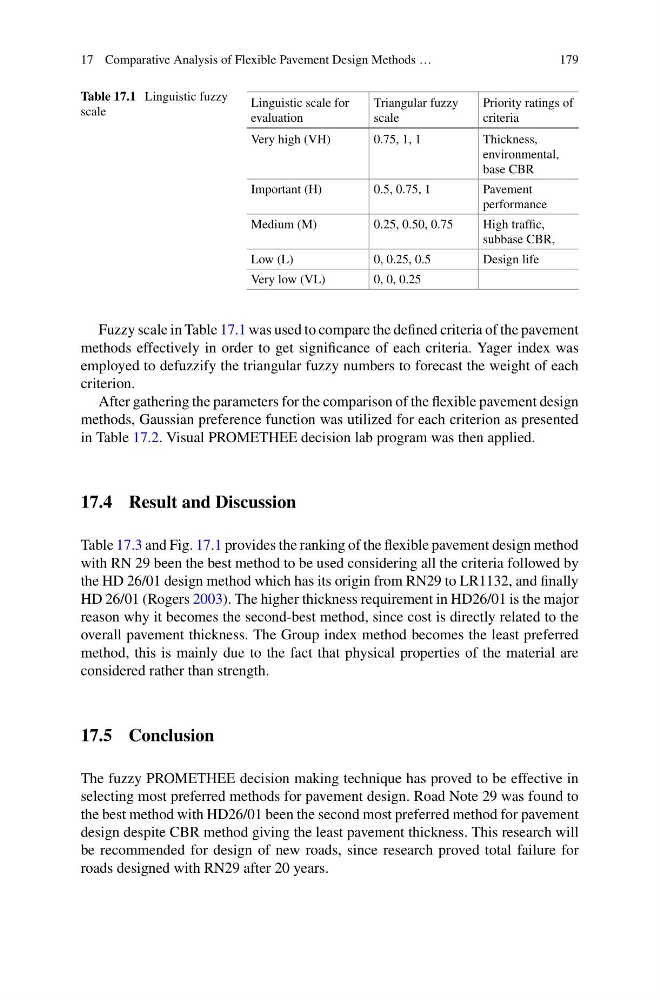
Fuzzy scale in Table 17.1 was used to compare the defined criteria of the pavement
methods effectively in order to get significance of each criteria. Yager index was
employed to defuzzify the triangular fuzzy numbers to forecast the weight of each
criterion.
After gathering the parameters for the comparison of the flexible pavement design
methods, Gaussian preference function was utilized for each criterion as presented
in Table 17.2. Visual PROMETHEE decision lab program was then applied.
17.4 Result and Discussion
Table 17.3 and Fig. 17.1 provides the ranking of the flexible pavement design method
with RN 29 been the best method to be used considering all the criteria followed by
the HD 26/01 design method which has its origin from RN29 to LR1132, and finally
HD 26/01 (Rogers 2003). The higher thickness requirement in HD26/01 is the major
reason why it becomes the second-best method, since cost is directly related to the
overall pavement thickness. The Group index method becomes the least preferred
method, this is mainly due to the fact that physical properties of the material are
considered rather than strength.
17.5 Conclusion
The fuzzy PROMETHEE decision making technique has proved to be effective in
selecting most preferred methods for pavement design. Road Note 29 was found to
the best method with HD26/01 been the second most preferred method for pavement
design despite CBR method giving the least pavement thickness. This research will
be recommended for design of new roads, since research proved total failure for
roads designed with RN29 after 20 years.
179
Table 17.1 Linguistic fuzzy
scale
Linguistic scale for
evaluation
Triangular fuzzy
scale
Priority ratings of
criteria
Very high (VH)
0.75, 1, 1
Thickness,
environmental,
base CBR
Important (H)
0.5, 0.75, 1
Pavement
performance
Medium (M)
0.25, 0.50, 0.75
High traffic,
subbase CBR,
Low (L)
0, 0.25, 0.5
Design life
Very low (VL)
0, 0, 0.25
Fuzzy scale in Table 17.1 was used to compare the defined criteria of the pavement
methods effectively in order to get significance of each criteria. Yager index was
employed to defuzzify the triangular fuzzy numbers to forecast the weight of each
criterion.
After gathering the parameters for the comparison of the flexible pavement design
methods, Gaussian preference function was utilized for each criterion as presented
in Table 17.2. Visual PROMETHEE decision lab program was then applied.
17.4 Result and Discussion
Table 17.3 and Fig. 17.1 provides the ranking of the flexible pavement design method
with RN 29 been the best method to be used considering all the criteria followed by
the HD 26/01 design method which has its origin from RN29 to LR1132, and finally
HD 26/01 (Rogers 2003). The higher thickness requirement in HD26/01 is the major
reason why it becomes the second-best method, since cost is directly related to the
overall pavement thickness. The Group index method becomes the least preferred
method, this is mainly due to the fact that physical properties of the material are
considered rather than strength.
17.5 Conclusion
The fuzzy PROMETHEE decision making technique has proved to be effective in
selecting most preferred methods for pavement design. Road Note 29 was found to
the best method with HD26/01 been the second most preferred method for pavement
design despite CBR method giving the least pavement thickness. This research will
be recommended for design of new roads, since research proved total failure for
roads designed with RN29 after 20 years.