

Topics in Current Chemistry (2018) 376:44
1 3
Lobry et al. reported the preparation of polymeric nanoparticles through the photopolymerization in a microreactor [36]. In their work, the reaction mixture consisting of acrylate and thiol-ene miniemulsions was introduced into the microreactor
by a syringe pump, and the light source was a 280-nm or 360-nm UV fluorescent
lamp emitting photons and providing an estimated irradiance of 3 mW cm
−2
. It was
claimed that the molecular weight of polymer nanoparticles was easily controlled by
the droplet size, temperature, and residence time in the microreactor.
Hartmann et al. reported two complimentary strategies for the preparation of
carbohydrate-functionalized sequence-defined oligo(amidoamine)s by the thiol-ene
photochemical coupling in a microreactor [181]. The first strategy was the synthesis of poly/oligo(amidoamines) from various olefins on a solid support followed
by conjugation to unprotected thiocarbohydrates. The thiol-ene photochemical
coupling reaction was then carried out in a Teflon AF-2400 capillary microreactor
with 254-nm UV illumination provided by a low-pressure In/Hg lamp to prepare a
sequence-defined carbohydrate-functionalized poly/oligo(amidoamine). This strategy laid on its advantages on that the complete functionalization of all reaction sites
on the poly/oligo(amidoamine)s backbone led to a defined homologous sequence in
a step. The other strategy was that an fluorenylmethyloxycarbonyl (Fmoc)-protected
glycosylated building block was prepared by using the thiol-ene coupling in a FEP
capillary microreactor with 366-nm illumination provided by a medium-pressure Hg
lamp (UV 450 immersion lamp 5 in. arc, radial lead, 7825-34 from Ace Glass), then
the obtained solid product from the first step was used to synthesize carbohydratefunctionalized sequence-defined oligo(amidoamine). The advantage of this latter
strategy was that it facilitated large-scale synthesis and the heterogeneous sequence
control of different carbohydrates along the oligomeric framework. Both of these
strategies took advantage of short photon transport path length of microreactors and
no additional radical initiators were utilized.
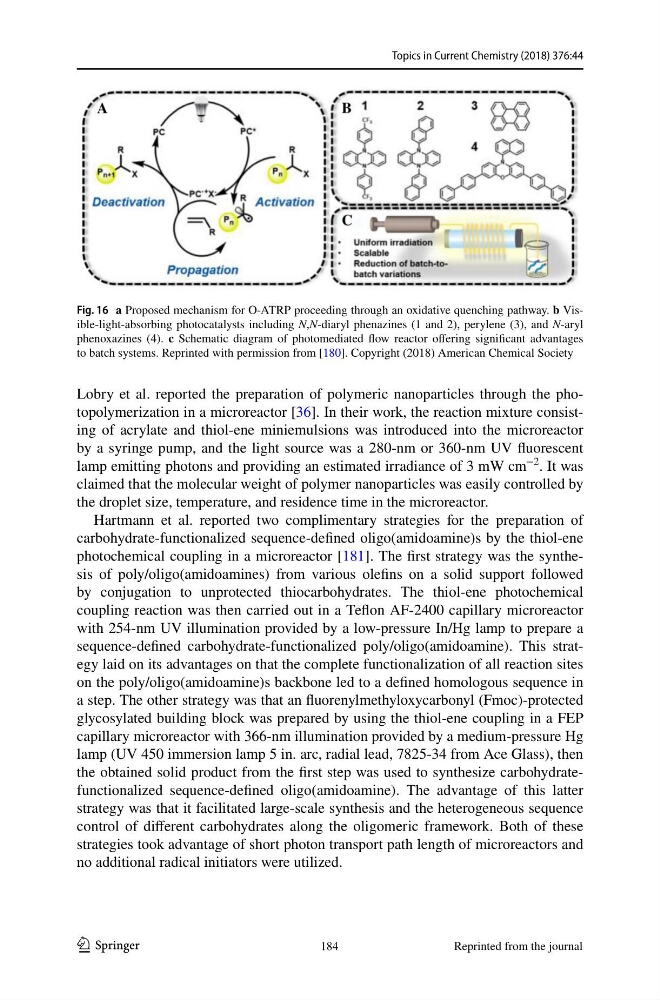
Fig. 16 a Proposed mechanism for O-ATRP proceeding through an oxidative quenching pathway. b Visible-light-absorbing photocatalysts including N,N-diaryl phenazines (1 and 2), perylene (3), and N-aryl
phenoxazines (4). c Schematic diagram of photomediated flow reactor offering significant advantages
to batch systems. Reprinted with permission from [180]. Copyright (2018) American Chemical Society
184
Reprinted from the journal
1 3
Lobry et al. reported the preparation of polymeric nanoparticles through the photopolymerization in a microreactor [36]. In their work, the reaction mixture consisting of acrylate and thiol-ene miniemulsions was introduced into the microreactor
by a syringe pump, and the light source was a 280-nm or 360-nm UV fluorescent
lamp emitting photons and providing an estimated irradiance of 3 mW cm
−2
. It was
claimed that the molecular weight of polymer nanoparticles was easily controlled by
the droplet size, temperature, and residence time in the microreactor.
Hartmann et al. reported two complimentary strategies for the preparation of
carbohydrate-functionalized sequence-defined oligo(amidoamine)s by the thiol-ene
photochemical coupling in a microreactor [181]. The first strategy was the synthesis of poly/oligo(amidoamines) from various olefins on a solid support followed
by conjugation to unprotected thiocarbohydrates. The thiol-ene photochemical
coupling reaction was then carried out in a Teflon AF-2400 capillary microreactor
with 254-nm UV illumination provided by a low-pressure In/Hg lamp to prepare a
sequence-defined carbohydrate-functionalized poly/oligo(amidoamine). This strategy laid on its advantages on that the complete functionalization of all reaction sites
on the poly/oligo(amidoamine)s backbone led to a defined homologous sequence in
a step. The other strategy was that an fluorenylmethyloxycarbonyl (Fmoc)-protected
glycosylated building block was prepared by using the thiol-ene coupling in a FEP
capillary microreactor with 366-nm illumination provided by a medium-pressure Hg
lamp (UV 450 immersion lamp 5 in. arc, radial lead, 7825-34 from Ace Glass), then
the obtained solid product from the first step was used to synthesize carbohydratefunctionalized sequence-defined oligo(amidoamine). The advantage of this latter
strategy was that it facilitated large-scale synthesis and the heterogeneous sequence
control of different carbohydrates along the oligomeric framework. Both of these
strategies took advantage of short photon transport path length of microreactors and
no additional radical initiators were utilized.
Fig. 16 a Proposed mechanism for O-ATRP proceeding through an oxidative quenching pathway. b Visible-light-absorbing photocatalysts including N,N-diaryl phenazines (1 and 2), perylene (3), and N-aryl
phenoxazines (4). c Schematic diagram of photomediated flow reactor offering significant advantages
to batch systems. Reprinted with permission from [180]. Copyright (2018) American Chemical Society
184
Reprinted from the journal