

1 3
Topics in Current Chemistry (2018) 376:44
control over the chain length of the polymer after all the initiator was used up via
a photoiniferter mechanism for this photoRAFT process.
Corrigan et al. achieved controllable molecular weight distributions in a continuous-flow microreactor for the photoinduced electron/energy transfer-reversible addition–fragmentation chain-transfer (PET–RAFT) polymerization under
visible light (red, green, or blue light) irradiation [179]. The polymerized monomer was N,N′-dimethylacrylamide (DMAm), 2-(((dodecylthio)-carbonothioyl)
thio)propanoic acid (DTPA) was selected at the RAFT agent, the catalyst was
5,10,15,20-tetraphenyl-21H,23H-porphine zinc (ZnTPP), and the solvent was
dimethyl sulfoxide (DMSO). High control over the molecular weight distributions
was realized by adjusting the residence times of the reactant streams, the chemical concentrations, and the intensity and wavelength of the light source.
Ramsey et al. carried out photoinduced organocatalyzed atom transfer radical
polymerization of diverse methacrylate monomers in continuous-flow capillary
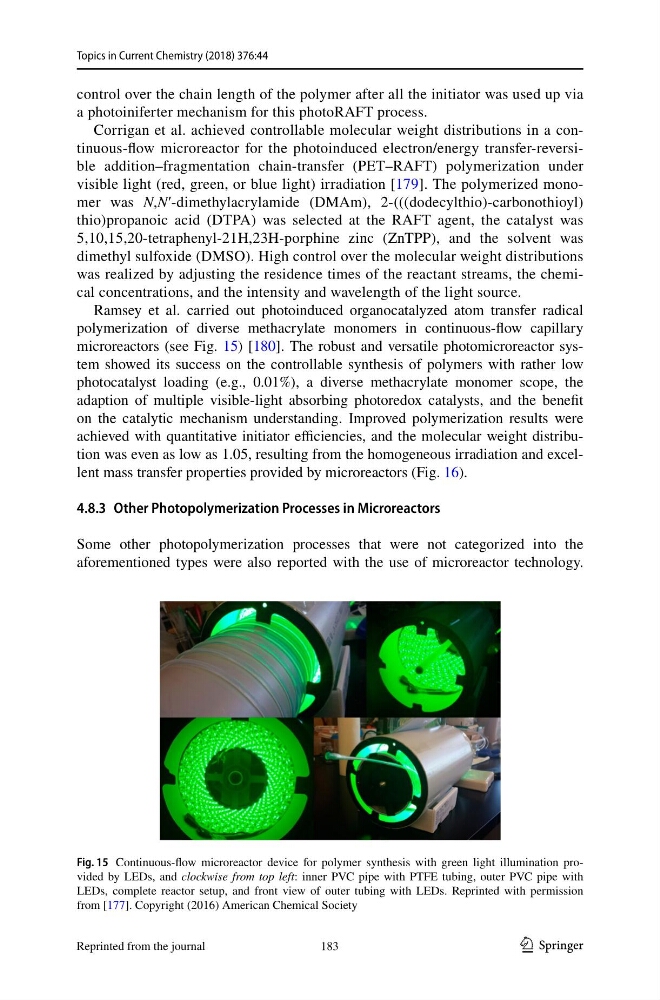
microreactors (see Fig. 15) [180]. The robust and versatile photomicroreactor system showed its success on the controllable synthesis of polymers with rather low
photocatalyst loading (e.g., 0.01%), a diverse methacrylate monomer scope, the
adaption of multiple visible-light absorbing photoredox catalysts, and the benefit
on the catalytic mechanism understanding. Improved polymerization results were
achieved with quantitative initiator efficiencies, and the molecular weight distribution was even as low as 1.05, resulting from the homogeneous irradiation and excellent mass transfer properties provided by microreactors (Fig. 16).
4.8.3 Other Photopolymerization Processes in Microreactors
Some other photopolymerization processes that were not categorized into the
aforementioned types were also reported with the use of microreactor technology.
Fig. 15 Continuous-flow microreactor device for polymer synthesis with green light illumination provided by LEDs, and clockwise from top left: inner PVC pipe with PTFE tubing, outer PVC pipe with
LEDs, complete reactor setup, and front view of outer tubing with LEDs. Reprinted with permission
from [177]. Copyright (2016) American Chemical Society
183
Reprinted from the journal
Topics in Current Chemistry (2018) 376:44
control over the chain length of the polymer after all the initiator was used up via
a photoiniferter mechanism for this photoRAFT process.
Corrigan et al. achieved controllable molecular weight distributions in a continuous-flow microreactor for the photoinduced electron/energy transfer-reversible addition–fragmentation chain-transfer (PET–RAFT) polymerization under
visible light (red, green, or blue light) irradiation [179]. The polymerized monomer was N,N′-dimethylacrylamide (DMAm), 2-(((dodecylthio)-carbonothioyl)
thio)propanoic acid (DTPA) was selected at the RAFT agent, the catalyst was
5,10,15,20-tetraphenyl-21H,23H-porphine zinc (ZnTPP), and the solvent was
dimethyl sulfoxide (DMSO). High control over the molecular weight distributions
was realized by adjusting the residence times of the reactant streams, the chemical concentrations, and the intensity and wavelength of the light source.
Ramsey et al. carried out photoinduced organocatalyzed atom transfer radical
polymerization of diverse methacrylate monomers in continuous-flow capillary
microreactors (see Fig. 15) [180]. The robust and versatile photomicroreactor system showed its success on the controllable synthesis of polymers with rather low
photocatalyst loading (e.g., 0.01%), a diverse methacrylate monomer scope, the
adaption of multiple visible-light absorbing photoredox catalysts, and the benefit
on the catalytic mechanism understanding. Improved polymerization results were
achieved with quantitative initiator efficiencies, and the molecular weight distribution was even as low as 1.05, resulting from the homogeneous irradiation and excellent mass transfer properties provided by microreactors (Fig. 16).
4.8.3 Other Photopolymerization Processes in Microreactors
Some other photopolymerization processes that were not categorized into the
aforementioned types were also reported with the use of microreactor technology.
Fig. 15 Continuous-flow microreactor device for polymer synthesis with green light illumination provided by LEDs, and clockwise from top left: inner PVC pipe with PTFE tubing, outer PVC pipe with
LEDs, complete reactor setup, and front view of outer tubing with LEDs. Reprinted with permission
from [177]. Copyright (2016) American Chemical Society
183
Reprinted from the journal