

1 3
Topics in Current Chemistry (2018) 376:44
reported that a second-generation Hoveyda–Grubbs metathesis catalyst could be
successfully immobilized on pellet and powder by the evaporation of toluene solution based on the physisorption phenomena, and the activity was truly maintained
under heterogeneous conditions. Continuous-flow polymerization of cyclooctene,
1-octene or other cyclic olefins was realized with the use of a quartz tube, and the
catalytic efficiency was found to reach up to at least 4000 TON (turnover number,
the number of substrate moles that a mole of catalyst can convert before becoming
inactivated) [155]. Skowerski et al. conducted the heterogeneous olefin metathesis
in a tube-in-tube microreactor by packing the solid catalyst (silicon-supported nitrosubstituted Hoveyda catalyst and else) in the annulus space between the inner and
outer tubes. A vacuum pump continuously and efficiently removed the by-product
ethylene during the reaction, hence improving yield and selectivity [156].
4.7.4 Channel Clogging Issue Solved by Heterogeneous Operations
While continuous-flow polymerization has drawn increasing attention, there are still
some arguments for its industrial application potential. The main reason is that the
reaction mixture flowing through a continuous-flow reactor would get viscous during the polymerization, resulting in high pressure drop and uncontrollable adhesion
layer, even leading to blocking, thus limiting its use in industry for steady operations.
To avoid the channel clogging issue, control over process factors such as lowering the monomer concentration, increasing the reaction temperature, and lowering
the designed molecular weight of the polymer product can be applied to reduce the
flow resistance. Flowing highly viscous fluids in microreactors deserves engineering
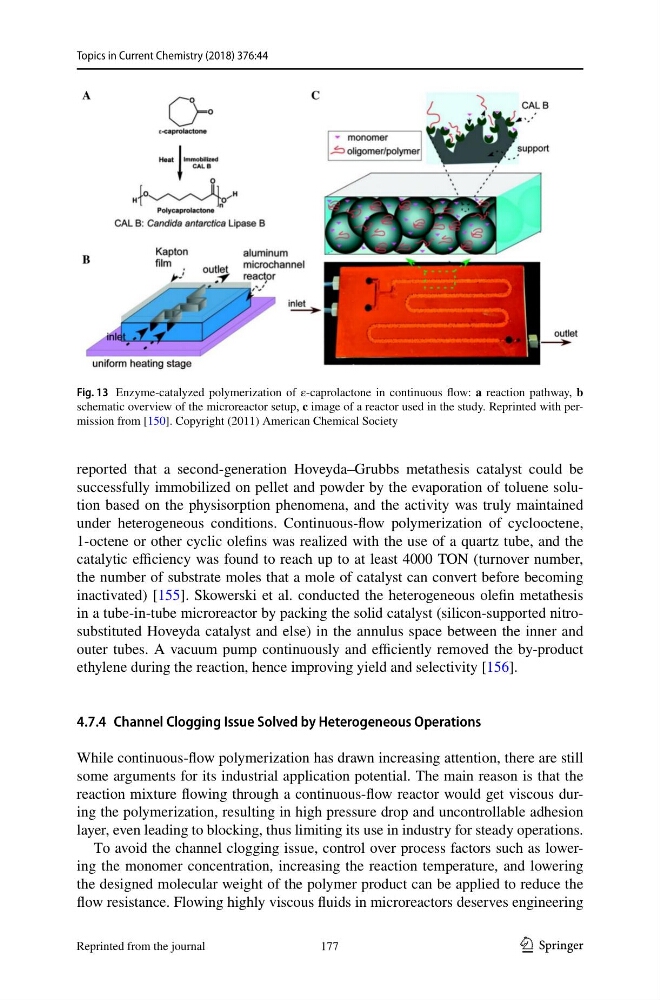
Fig. 13 Enzyme-catalyzed polymerization of ε-caprolactone in continuous flow: a reaction pathway, b
schematic overview of the microreactor setup, c image of a reactor used in the study. Reprinted with permission from [150]. Copyright (2011) American Chemical Society
177
Reprinted from the journal
Topics in Current Chemistry (2018) 376:44
reported that a second-generation Hoveyda–Grubbs metathesis catalyst could be
successfully immobilized on pellet and powder by the evaporation of toluene solution based on the physisorption phenomena, and the activity was truly maintained
under heterogeneous conditions. Continuous-flow polymerization of cyclooctene,
1-octene or other cyclic olefins was realized with the use of a quartz tube, and the
catalytic efficiency was found to reach up to at least 4000 TON (turnover number,
the number of substrate moles that a mole of catalyst can convert before becoming
inactivated) [155]. Skowerski et al. conducted the heterogeneous olefin metathesis
in a tube-in-tube microreactor by packing the solid catalyst (silicon-supported nitrosubstituted Hoveyda catalyst and else) in the annulus space between the inner and
outer tubes. A vacuum pump continuously and efficiently removed the by-product
ethylene during the reaction, hence improving yield and selectivity [156].
4.7.4 Channel Clogging Issue Solved by Heterogeneous Operations
While continuous-flow polymerization has drawn increasing attention, there are still
some arguments for its industrial application potential. The main reason is that the
reaction mixture flowing through a continuous-flow reactor would get viscous during the polymerization, resulting in high pressure drop and uncontrollable adhesion
layer, even leading to blocking, thus limiting its use in industry for steady operations.
To avoid the channel clogging issue, control over process factors such as lowering the monomer concentration, increasing the reaction temperature, and lowering
the designed molecular weight of the polymer product can be applied to reduce the
flow resistance. Flowing highly viscous fluids in microreactors deserves engineering
Fig. 13 Enzyme-catalyzed polymerization of ε-caprolactone in continuous flow: a reaction pathway, b
schematic overview of the microreactor setup, c image of a reactor used in the study. Reprinted with permission from [150]. Copyright (2011) American Chemical Society
177
Reprinted from the journal