

Topics in Current Chemistry (2018) 376:44
1 3
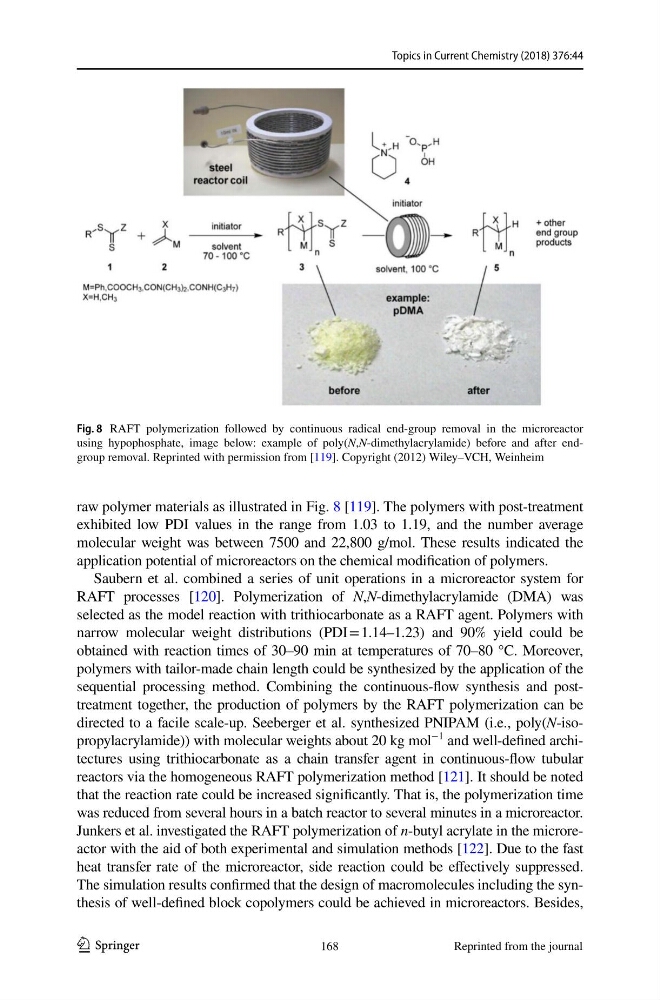
raw polymer materials as illustrated in Fig. 8 [119]. The polymers with post-treatment
exhibited low PDI values in the range from 1.03 to 1.19, and the number average
molecular weight was between 7500 and 22,800 g/mol. These results indicated the
application potential of microreactors on the chemical modification of polymers.
Saubern et al. combined a series of unit operations in a microreactor system for
RAFT processes [120]. Polymerization of N,N-dimethylacrylamide (DMA) was
selected as the model reaction with trithiocarbonate as a RAFT agent. Polymers with
narrow molecular weight distributions (PDI = 1.14–1.23) and 90% yield could be
obtained with reaction times of 30–90 min at temperatures of 70–80 °C. Moreover,
polymers with tailor-made chain length could be synthesized by the application of the
sequential processing method. Combining the continuous-flow synthesis and posttreatment together, the production of polymers by the RAFT polymerization can be
directed to a facile scale-up. Seeberger et al. synthesized PNIPAM (i.e., poly(N-isopropylacrylamide)) with molecular weights about 20 kg mol
−1
and well-defined architectures using trithiocarbonate as a chain transfer agent in continuous-flow tubular
reactors via the homogeneous RAFT polymerization method [121]. It should be noted
that the reaction rate could be increased significantly. That is, the polymerization time
was reduced from several hours in a batch reactor to several minutes in a microreactor.
Junkers et al. investigated the RAFT polymerization of n-butyl acrylate in the microreactor with the aid of both experimental and simulation methods [122]. Due to the fast
heat transfer rate of the microreactor, side reaction could be effectively suppressed.
The simulation results confirmed that the design of macromolecules including the synthesis of well-defined block copolymers could be achieved in microreactors. Besides,
Fig. 8 RAFT polymerization followed by continuous radical end-group removal in the microreactor
using hypophosphate, image below: example of poly(N,N-dimethylacrylamide) before and after endgroup removal. Reprinted with permission from [119]. Copyright (2012) Wiley–VCH, Weinheim
168
Reprinted from the journal
1 3
raw polymer materials as illustrated in Fig. 8 [119]. The polymers with post-treatment
exhibited low PDI values in the range from 1.03 to 1.19, and the number average
molecular weight was between 7500 and 22,800 g/mol. These results indicated the
application potential of microreactors on the chemical modification of polymers.
Saubern et al. combined a series of unit operations in a microreactor system for
RAFT processes [120]. Polymerization of N,N-dimethylacrylamide (DMA) was
selected as the model reaction with trithiocarbonate as a RAFT agent. Polymers with
narrow molecular weight distributions (PDI = 1.14–1.23) and 90% yield could be
obtained with reaction times of 30–90 min at temperatures of 70–80 °C. Moreover,
polymers with tailor-made chain length could be synthesized by the application of the
sequential processing method. Combining the continuous-flow synthesis and posttreatment together, the production of polymers by the RAFT polymerization can be
directed to a facile scale-up. Seeberger et al. synthesized PNIPAM (i.e., poly(N-isopropylacrylamide)) with molecular weights about 20 kg mol
−1
and well-defined architectures using trithiocarbonate as a chain transfer agent in continuous-flow tubular
reactors via the homogeneous RAFT polymerization method [121]. It should be noted
that the reaction rate could be increased significantly. That is, the polymerization time
was reduced from several hours in a batch reactor to several minutes in a microreactor.
Junkers et al. investigated the RAFT polymerization of n-butyl acrylate in the microreactor with the aid of both experimental and simulation methods [122]. Due to the fast
heat transfer rate of the microreactor, side reaction could be effectively suppressed.
The simulation results confirmed that the design of macromolecules including the synthesis of well-defined block copolymers could be achieved in microreactors. Besides,
Fig. 8 RAFT polymerization followed by continuous radical end-group removal in the microreactor
using hypophosphate, image below: example of poly(N,N-dimethylacrylamide) before and after endgroup removal. Reprinted with permission from [119]. Copyright (2012) Wiley–VCH, Weinheim
168
Reprinted from the journal