

1 3
Topics in Current Chemistry (2018) 376:44
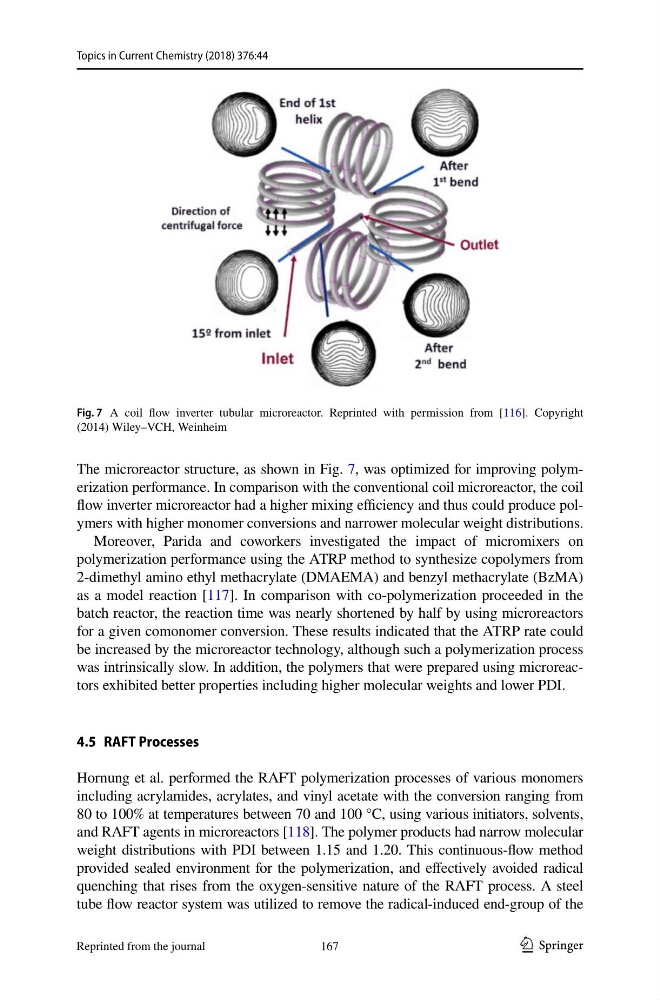
The microreactor structure, as shown in Fig. 7, was optimized for improving polymerization performance. In comparison with the conventional coil microreactor, the coil
flow inverter microreactor had a higher mixing efficiency and thus could produce polymers with higher monomer conversions and narrower molecular weight distributions.
Moreover, Parida and coworkers investigated the impact of micromixers on
polymerization performance using the ATRP method to synthesize copolymers from
2-dimethyl amino ethyl methacrylate (DMAEMA) and benzyl methacrylate (BzMA)
as a model reaction [117]. In comparison with co-polymerization proceeded in the
batch reactor, the reaction time was nearly shortened by half by using microreactors
for a given comonomer conversion. These results indicated that the ATRP rate could
be increased by the microreactor technology, although such a polymerization process
was intrinsically slow. In addition, the polymers that were prepared using microreactors exhibited better properties including higher molecular weights and lower PDI.
4.5 RAFT Processes
Hornung et al. performed the RAFT polymerization processes of various monomers
including acrylamides, acrylates, and vinyl acetate with the conversion ranging from
80 to 100% at temperatures between 70 and 100 °C, using various initiators, solvents,
and RAFT agents in microreactors [118]. The polymer products had narrow molecular
weight distributions with PDI between 1.15 and 1.20. This continuous-flow method
provided sealed environment for the polymerization, and effectively avoided radical
quenching that rises from the oxygen-sensitive nature of the RAFT process. A steel
tube flow reactor system was utilized to remove the radical-induced end-group of the
Fig. 7 A coil flow inverter tubular microreactor. Reprinted with permission from [116]. Copyright
(2014) Wiley–VCH, Weinheim
167
Reprinted from the journal
Topics in Current Chemistry (2018) 376:44
The microreactor structure, as shown in Fig. 7, was optimized for improving polymerization performance. In comparison with the conventional coil microreactor, the coil
flow inverter microreactor had a higher mixing efficiency and thus could produce polymers with higher monomer conversions and narrower molecular weight distributions.
Moreover, Parida and coworkers investigated the impact of micromixers on
polymerization performance using the ATRP method to synthesize copolymers from
2-dimethyl amino ethyl methacrylate (DMAEMA) and benzyl methacrylate (BzMA)
as a model reaction [117]. In comparison with co-polymerization proceeded in the
batch reactor, the reaction time was nearly shortened by half by using microreactors
for a given comonomer conversion. These results indicated that the ATRP rate could
be increased by the microreactor technology, although such a polymerization process
was intrinsically slow. In addition, the polymers that were prepared using microreactors exhibited better properties including higher molecular weights and lower PDI.
4.5 RAFT Processes
Hornung et al. performed the RAFT polymerization processes of various monomers
including acrylamides, acrylates, and vinyl acetate with the conversion ranging from
80 to 100% at temperatures between 70 and 100 °C, using various initiators, solvents,
and RAFT agents in microreactors [118]. The polymer products had narrow molecular
weight distributions with PDI between 1.15 and 1.20. This continuous-flow method
provided sealed environment for the polymerization, and effectively avoided radical
quenching that rises from the oxygen-sensitive nature of the RAFT process. A steel
tube flow reactor system was utilized to remove the radical-induced end-group of the
Fig. 7 A coil flow inverter tubular microreactor. Reprinted with permission from [116]. Copyright
(2014) Wiley–VCH, Weinheim
167
Reprinted from the journal