

1 3
Topics in Current Chemistry (2019) 377:1
a Ni‑Cu catalyst operated at 240 °C under atmospheric pressure. 99% conversion
was reported for both cyclohexanol and HMF. DMF and phenol were obtained with
selectivities of 99% and 98%, respectively. The catalyst remained stable for 160 h
of operation, despite mild catalyst leaching [115]. Aliphatic alcohols were reported
to be efficient reductants too. i‑PrOH provided DMF in 72% yield at 180 °C and
25 bar of counterpressure over a Pd/Fe 2 O 3 catalyst [116]. 1,4‑Butanediol (4) gave
DMF in 72% yield using a catalyst based on copper nanoparticles dispersed in AlO x
and under conditions of 220 °C and 16 bar. γ‑Butyrolactone (20) was concomitantly
formed through 1,4‑butanediol lactonization (see Sect. 2.1.4) [117].
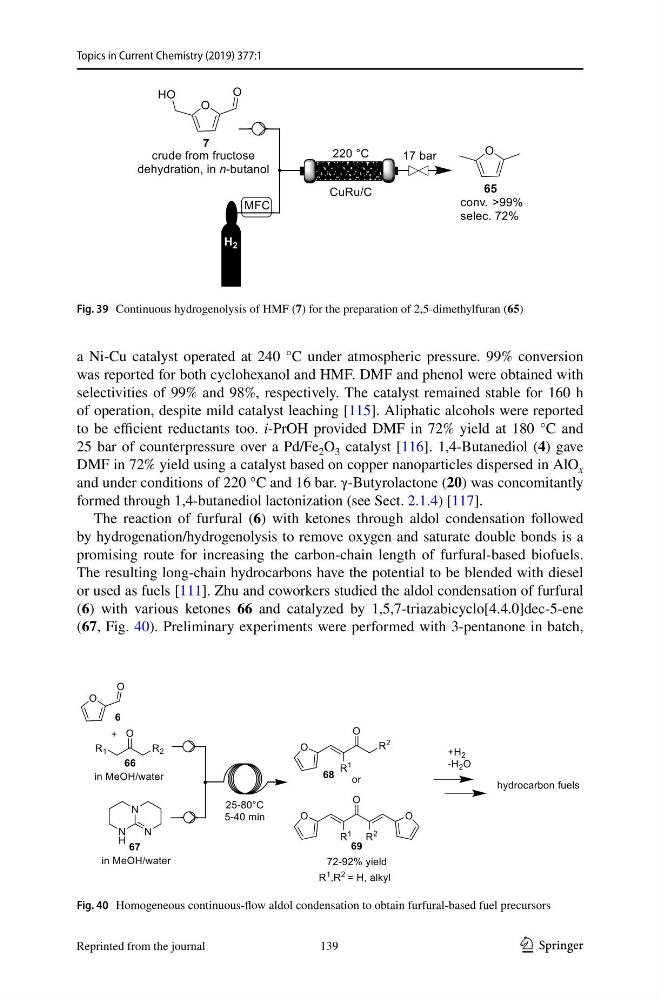
The reaction of furfural (6) with ketones through aldol condensation followed
by hydrogenation/hydrogenolysis to remove oxygen and saturate double bonds is a
promising route for increasing the carbon‑chain length of furfural‑based biofuels.
The resulting long‑chain hydrocarbons have the potential to be blended with diesel
or used as fuels [111]. Zhu and coworkers studied the aldol condensation of furfural
(6) with various ketones 66 and catalyzed by 1,5,7‑triazabicyclo[4.4.0]dec‑5‑ene
(67, Fig. 40). Preliminary experiments were performed with 3‑pentanone in batch,
Fig. 39 Continuous hydrogenolysis of HMF (7) for the preparation of 2,5‑dimethylfuran (65)
Fig. 40 Homogeneous continuous‑flow aldol condensation to obtain furfural‑based fuel precursors
139
Reprinted from the journal
Topics in Current Chemistry (2019) 377:1
a Ni‑Cu catalyst operated at 240 °C under atmospheric pressure. 99% conversion
was reported for both cyclohexanol and HMF. DMF and phenol were obtained with
selectivities of 99% and 98%, respectively. The catalyst remained stable for 160 h
of operation, despite mild catalyst leaching [115]. Aliphatic alcohols were reported
to be efficient reductants too. i‑PrOH provided DMF in 72% yield at 180 °C and
25 bar of counterpressure over a Pd/Fe 2 O 3 catalyst [116]. 1,4‑Butanediol (4) gave
DMF in 72% yield using a catalyst based on copper nanoparticles dispersed in AlO x
and under conditions of 220 °C and 16 bar. γ‑Butyrolactone (20) was concomitantly
formed through 1,4‑butanediol lactonization (see Sect. 2.1.4) [117].
The reaction of furfural (6) with ketones through aldol condensation followed
by hydrogenation/hydrogenolysis to remove oxygen and saturate double bonds is a
promising route for increasing the carbon‑chain length of furfural‑based biofuels.
The resulting long‑chain hydrocarbons have the potential to be blended with diesel
or used as fuels [111]. Zhu and coworkers studied the aldol condensation of furfural
(6) with various ketones 66 and catalyzed by 1,5,7‑triazabicyclo[4.4.0]dec‑5‑ene
(67, Fig. 40). Preliminary experiments were performed with 3‑pentanone in batch,
Fig. 39 Continuous hydrogenolysis of HMF (7) for the preparation of 2,5‑dimethylfuran (65)
Fig. 40 Homogeneous continuous‑flow aldol condensation to obtain furfural‑based fuel precursors
139
Reprinted from the journal