

Topics in Current Chemistry (2019) 377:1
1 3
counterpressure. Quantitative conversion and a combined yield of > 90% for 63
and 64 were mostly maintained for 80 h of operation.
4.3 Derivatives of HMF and Furfural
2‑Methylfuran (MF, 18) and 2,5‑dimethylfuran (DMF, 65) are prepared through
the hydrogenolysis of furfural (6) and hydroxymethylfurfural (7), respectively.
They have been highlighted as promising biofuels: they have energy densities
(28.5–29.3 MJ/L) that are higher than that of ethanol (21 MJ/L) and slightly inferior
to that of gasoline (31.9 MJ/L) and they show excellent properties for use as fuels
and fuel additives. However, experts have stated that the production of 18 and 65
is still too challenging and thus expensive to make them commercially viable [111,
112].
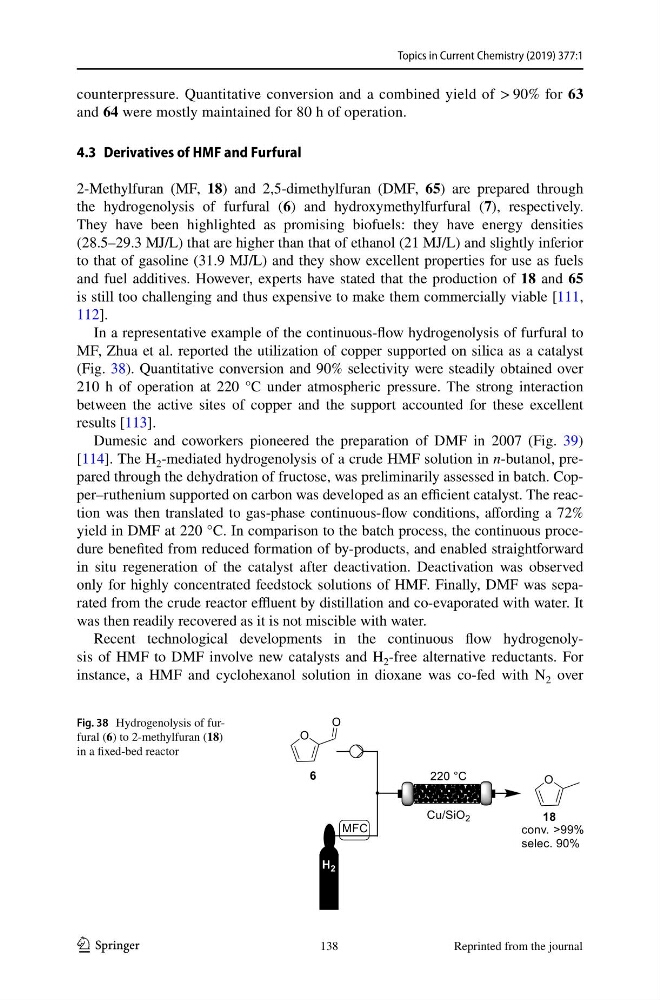
In a representative example of the continuous‑flow hydrogenolysis of furfural to
MF, Zhua et al. reported the utilization of copper supported on silica as a catalyst
(Fig. 38). Quantitative conversion and 90% selectivity were steadily obtained over
210 h of operation at 220 °C under atmospheric pressure. The strong interaction
between the active sites of copper and the support accounted for these excellent
results [113].
Dumesic and coworkers pioneered the preparation of DMF in 2007 (Fig. 39)
[114]. The H 2 ‑mediated hydrogenolysis of a crude HMF solution in n‑butanol, pre‑
pared through the dehydration of fructose, was preliminarily assessed in batch. Cop‑
per–ruthenium supported on carbon was developed as an efficient catalyst. The reac‑
tion was then translated to gas‑phase continuous‑flow conditions, affording a 72%
yield in DMF at 220 °C. In comparison to the batch process, the continuous proce‑
dure benefited from reduced formation of by‑products, and enabled straightforward
in situ regeneration of the catalyst after deactivation. Deactivation was observed
only for highly concentrated feedstock solutions of HMF. Finally, DMF was sepa‑
rated from the crude reactor effluent by distillation and co‑evaporated with water. It
was then readily recovered as it is not miscible with water.
Recent technological developments in the continuous flow hydrogenoly‑
sis of HMF to DMF involve new catalysts and H 2 ‑free alternative reductants. For
instance, a HMF and cyclohexanol solution in dioxane was co‑fed with N 2 over
Fig. 38 Hydrogenolysis of fur‑
fural (6) to 2‑methylfuran (18)
in a fixed‑bed reactor
138
Reprinted from the journal
1 3
counterpressure. Quantitative conversion and a combined yield of > 90% for 63
and 64 were mostly maintained for 80 h of operation.
4.3 Derivatives of HMF and Furfural
2‑Methylfuran (MF, 18) and 2,5‑dimethylfuran (DMF, 65) are prepared through
the hydrogenolysis of furfural (6) and hydroxymethylfurfural (7), respectively.
They have been highlighted as promising biofuels: they have energy densities
(28.5–29.3 MJ/L) that are higher than that of ethanol (21 MJ/L) and slightly inferior
to that of gasoline (31.9 MJ/L) and they show excellent properties for use as fuels
and fuel additives. However, experts have stated that the production of 18 and 65
is still too challenging and thus expensive to make them commercially viable [111,
112].
In a representative example of the continuous‑flow hydrogenolysis of furfural to
MF, Zhua et al. reported the utilization of copper supported on silica as a catalyst
(Fig. 38). Quantitative conversion and 90% selectivity were steadily obtained over
210 h of operation at 220 °C under atmospheric pressure. The strong interaction
between the active sites of copper and the support accounted for these excellent
results [113].
Dumesic and coworkers pioneered the preparation of DMF in 2007 (Fig. 39)
[114]. The H 2 ‑mediated hydrogenolysis of a crude HMF solution in n‑butanol, pre‑
pared through the dehydration of fructose, was preliminarily assessed in batch. Cop‑
per–ruthenium supported on carbon was developed as an efficient catalyst. The reac‑
tion was then translated to gas‑phase continuous‑flow conditions, affording a 72%
yield in DMF at 220 °C. In comparison to the batch process, the continuous proce‑
dure benefited from reduced formation of by‑products, and enabled straightforward
in situ regeneration of the catalyst after deactivation. Deactivation was observed
only for highly concentrated feedstock solutions of HMF. Finally, DMF was sepa‑
rated from the crude reactor effluent by distillation and co‑evaporated with water. It
was then readily recovered as it is not miscible with water.
Recent technological developments in the continuous flow hydrogenoly‑
sis of HMF to DMF involve new catalysts and H 2 ‑free alternative reductants. For
instance, a HMF and cyclohexanol solution in dioxane was co‑fed with N 2 over
Fig. 38 Hydrogenolysis of fur‑
fural (6) to 2‑methylfuran (18)
in a fixed‑bed reactor
138
Reprinted from the journal