

1 3
Topics in Current Chemistry (2019) 377:1
exclusively biobased chemicals that show enhanced specificity compared to those
derived from oil. The main classes are then divided into subcategories illustrat‑
ing the most common end uses of the target chemicals (i.e., solvents, monomers,
building blocks for active pharmaceutical ingredients, fuels, etc.).
2 Commodity and Other Large‑Scale Industrially Relevant Building
Blocks
2.1 Solvents
2.1.1 Alkanes
Alkanes are benchmark commodity chemicals derived from fossil resources. The
largest fraction of the alkanes produced globally is used as fuel, but low‑boiling‑
point liquid alkanes are also applied as solvents in extractions or chemical reactions
[23, 24]. Alternative routes for the production of alkanes from renewable resources
include biomass gasification coupled to Fischer–Tropsch synthesis and direct deoxy‑
genation of platform molecules derived from biomass [25]. In the latter strategy,
selective C–O bond cleavage is required to remove oxygen, while C–C bond cleav‑
age must be avoided to preserve the carbon backbone. In a representative exam‑
ple, Wang and colleagues reported a highly selective continuous flow process for
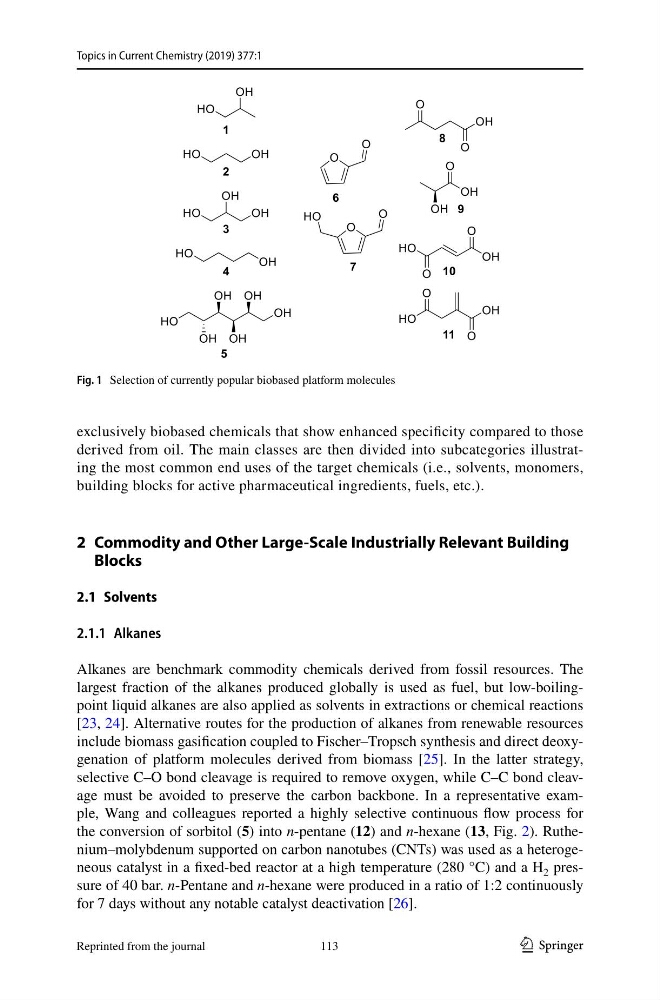
the conversion of sorbitol (5) into n‑pentane (12) and n‑hexane (13, Fig. 2). Ruthe‑
nium–molybdenum supported on carbon nanotubes (CNTs) was used as a heteroge‑
neous catalyst in a fixed‑bed reactor at a high temperature (280 °C) and a H 2 pres‑
sure of 40 bar. n‑Pentane and n‑hexane were produced in a ratio of 1:2 continuously
for 7 days without any notable catalyst deactivation [26].
Fig. 1 Selection of currently popular biobased platform molecules
113
Reprinted from the journal
Topics in Current Chemistry (2019) 377:1
exclusively biobased chemicals that show enhanced specificity compared to those
derived from oil. The main classes are then divided into subcategories illustrat‑
ing the most common end uses of the target chemicals (i.e., solvents, monomers,
building blocks for active pharmaceutical ingredients, fuels, etc.).
2 Commodity and Other Large‑Scale Industrially Relevant Building
Blocks
2.1 Solvents
2.1.1 Alkanes
Alkanes are benchmark commodity chemicals derived from fossil resources. The
largest fraction of the alkanes produced globally is used as fuel, but low‑boiling‑
point liquid alkanes are also applied as solvents in extractions or chemical reactions
[23, 24]. Alternative routes for the production of alkanes from renewable resources
include biomass gasification coupled to Fischer–Tropsch synthesis and direct deoxy‑
genation of platform molecules derived from biomass [25]. In the latter strategy,
selective C–O bond cleavage is required to remove oxygen, while C–C bond cleav‑
age must be avoided to preserve the carbon backbone. In a representative exam‑
ple, Wang and colleagues reported a highly selective continuous flow process for
the conversion of sorbitol (5) into n‑pentane (12) and n‑hexane (13, Fig. 2). Ruthe‑
nium–molybdenum supported on carbon nanotubes (CNTs) was used as a heteroge‑
neous catalyst in a fixed‑bed reactor at a high temperature (280 °C) and a H 2 pres‑
sure of 40 bar. n‑Pentane and n‑hexane were produced in a ratio of 1:2 continuously
for 7 days without any notable catalyst deactivation [26].
Fig. 1 Selection of currently popular biobased platform molecules
113
Reprinted from the journal