

1 3
Topics in Current Chemistry (2019) 377:2
applied successfully to develop a single process for a three‑step synthesis of arte‑
misinin from artemisinic acid.
The falling film microreactor was developed by the Institut für Mikrotechnik
(IMM, Mainz). The liquid phase flows through microchannels under gravity to form
a thin liquid layer, which is as thin as 20 µm in some instances. The gas input then
flows co‑ or counter‑currently to the liquid phase with specific phase interfaces of up
to 20,000 m
2
m
−3
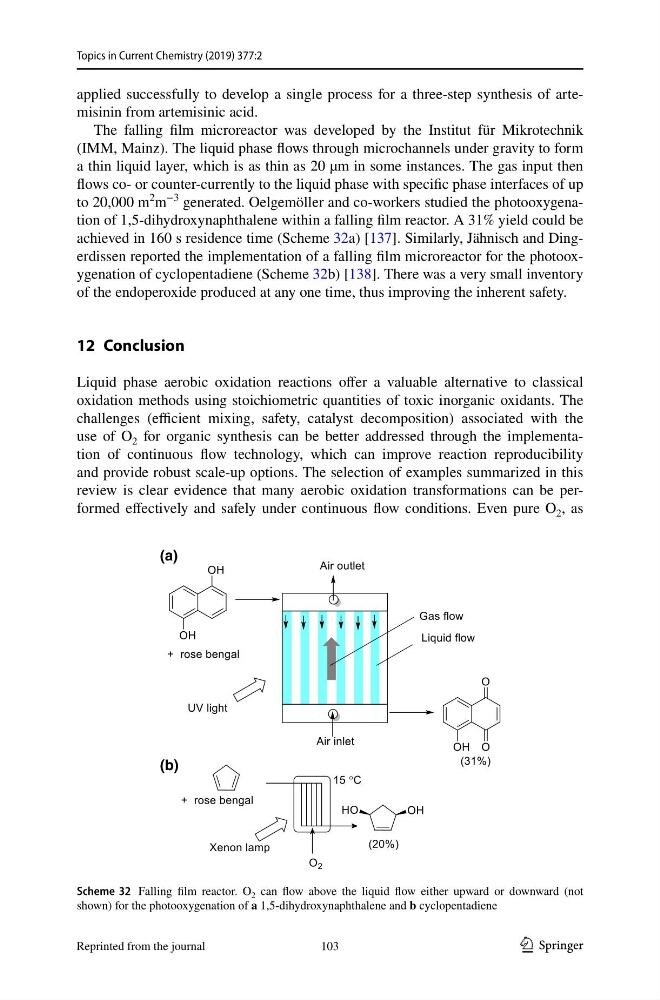
generated. Oelgemöller and co‑workers studied the photooxygena‑
tion of 1,5‑dihydroxynaphthalene within a falling film reactor. A 31% yield could be
achieved in 160 s residence time (Scheme 32a) [137]. Similarly, Jähnisch and Ding‑
erdissen reported the implementation of a falling film microreactor for the photoox‑
ygenation of cyclopentadiene (Scheme 32b) [138]. There was a very small inventory
of the endoperoxide produced at any one time, thus improving the inherent safety.
12 Conclusion
Liquid phase aerobic oxidation reactions offer a valuable alternative to classical
oxidation methods using stoichiometric quantities of toxic inorganic oxidants. The
challenges (efficient mixing, safety, catalyst decomposition) associated with the
use of O 2 for organic synthesis can be better addressed through the implementa‑
tion of continuous flow technology, which can improve reaction reproducibility
and provide robust scale‑up options. The selection of examples summarized in this
review is clear evidence that many aerobic oxidation transformations can be per‑
formed effectively and safely under continuous flow conditions. Even pure O 2 , as
(a)
(b)
Scheme 32 Falling film reactor. O 2 can flow above the liquid flow either upward or downward (not
shown) for the photooxygenation of a 1,5‑dihydroxynaphthalene and b cyclopentadiene
103
Reprinted from the journal
Topics in Current Chemistry (2019) 377:2
applied successfully to develop a single process for a three‑step synthesis of arte‑
misinin from artemisinic acid.
The falling film microreactor was developed by the Institut für Mikrotechnik
(IMM, Mainz). The liquid phase flows through microchannels under gravity to form
a thin liquid layer, which is as thin as 20 µm in some instances. The gas input then
flows co‑ or counter‑currently to the liquid phase with specific phase interfaces of up
to 20,000 m
2
m
−3
generated. Oelgemöller and co‑workers studied the photooxygena‑
tion of 1,5‑dihydroxynaphthalene within a falling film reactor. A 31% yield could be
achieved in 160 s residence time (Scheme 32a) [137]. Similarly, Jähnisch and Ding‑
erdissen reported the implementation of a falling film microreactor for the photoox‑
ygenation of cyclopentadiene (Scheme 32b) [138]. There was a very small inventory
of the endoperoxide produced at any one time, thus improving the inherent safety.
12 Conclusion
Liquid phase aerobic oxidation reactions offer a valuable alternative to classical
oxidation methods using stoichiometric quantities of toxic inorganic oxidants. The
challenges (efficient mixing, safety, catalyst decomposition) associated with the
use of O 2 for organic synthesis can be better addressed through the implementa‑
tion of continuous flow technology, which can improve reaction reproducibility
and provide robust scale‑up options. The selection of examples summarized in this
review is clear evidence that many aerobic oxidation transformations can be per‑
formed effectively and safely under continuous flow conditions. Even pure O 2 , as
(a)
(b)
Scheme 32 Falling film reactor. O 2 can flow above the liquid flow either upward or downward (not
shown) for the photooxygenation of a 1,5‑dihydroxynaphthalene and b cyclopentadiene
103
Reprinted from the journal