

ν abs ¼
ω
2
pe
ω 2 ν
h i
ð2:6:21Þ
It should be noted that the simple calculation results the same mathematical form
of the laser absorption rate as (2.6.13). Then, the final problem becomes how
accurately obtain the collision frequency given in (2.6.14). This can be also done
with relatively easy way as done in Sect. 2.4. It is, of course, obvious to keep in mind
that the precise theory given by Dawson and Oberman is the best way to calculate the
classical absorption of intense lasers.
2.7 Bremsstrahlung and Collisional Absorption
It is useful to note the relation between radiation emission from plasma due to the
Coulomb collision and the collisional absorption seen so far in plasma. The thermal
radiation from the optically thin plasma is called Bremsstrahlung. It is well-known
that the X-rays are generated when electron beams are irradiated on materials. The
physical process of Bremsstrahlung is that when a free electron orbit is modified by
an ion like Fig. 2.11, time change of electron current, namely, acceleration of orbit, is
induced. From (2.3.16), Larmor emission of radiation with broad-spectrum is
emitted from the electron, and the electron loses the corresponding energy after
the radiation emission.
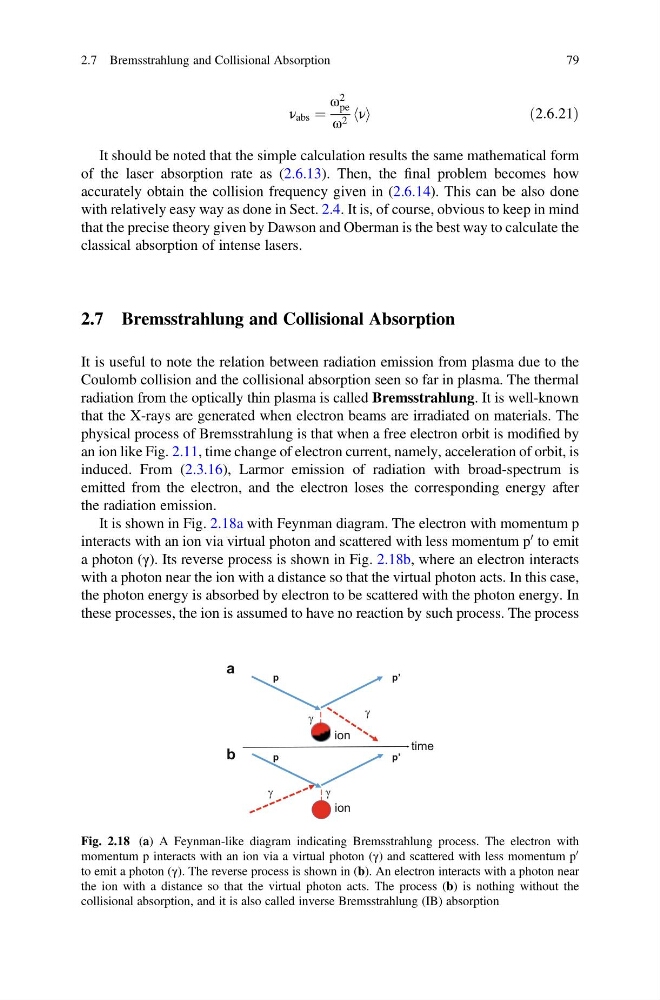
It is shown in Fig. 2.18a with Feynman diagram. The electron with momentum p
interacts with an ion via virtual photon and scattered with less momentum p
0 to emit
a photon (γ). Its reverse process is shown in Fig. 2.18b, where an electron interacts
with a photon near the ion with a distance so that the virtual photon acts. In this case,
the photon energy is absorbed by electron to be scattered with the photon energy. In
these processes, the ion is assumed to have no reaction by such process. The process
time
p
a
b
p’
p
p ’
ion
ion
g
g
g
g
Fig. 2.18 (a) A Feynman-like diagram indicating Bremsstrahlung process. The electron with
momentum p interacts with an ion via a virtual photon (γ) and scattered with less momentum p
0
to emit a photon (γ). The reverse process is shown in (b). An electron interacts with a photon near
the ion with a distance so that the virtual photon acts. The process (b) is nothing without the
collisional absorption, and it is also called inverse Bremsstrahlung (IB) absorption
2.7 Bremsstrahlung and Collisional Absorption
79
ω
2
pe
ω 2 ν
h i
ð2:6:21Þ
It should be noted that the simple calculation results the same mathematical form
of the laser absorption rate as (2.6.13). Then, the final problem becomes how
accurately obtain the collision frequency given in (2.6.14). This can be also done
with relatively easy way as done in Sect. 2.4. It is, of course, obvious to keep in mind
that the precise theory given by Dawson and Oberman is the best way to calculate the
classical absorption of intense lasers.
2.7 Bremsstrahlung and Collisional Absorption
It is useful to note the relation between radiation emission from plasma due to the
Coulomb collision and the collisional absorption seen so far in plasma. The thermal
radiation from the optically thin plasma is called Bremsstrahlung. It is well-known
that the X-rays are generated when electron beams are irradiated on materials. The
physical process of Bremsstrahlung is that when a free electron orbit is modified by
an ion like Fig. 2.11, time change of electron current, namely, acceleration of orbit, is
induced. From (2.3.16), Larmor emission of radiation with broad-spectrum is
emitted from the electron, and the electron loses the corresponding energy after
the radiation emission.
It is shown in Fig. 2.18a with Feynman diagram. The electron with momentum p
interacts with an ion via virtual photon and scattered with less momentum p
0 to emit
a photon (γ). Its reverse process is shown in Fig. 2.18b, where an electron interacts
with a photon near the ion with a distance so that the virtual photon acts. In this case,
the photon energy is absorbed by electron to be scattered with the photon energy. In
these processes, the ion is assumed to have no reaction by such process. The process
time
p
a
b
p’
p
p ’
ion
ion
g
g
g
g
Fig. 2.18 (a) A Feynman-like diagram indicating Bremsstrahlung process. The electron with
momentum p interacts with an ion via a virtual photon (γ) and scattered with less momentum p
0
to emit a photon (γ). The reverse process is shown in (b). An electron interacts with a photon near
the ion with a distance so that the virtual photon acts. The process (b) is nothing without the
collisional absorption, and it is also called inverse Bremsstrahlung (IB) absorption
2.7 Bremsstrahlung and Collisional Absorption
79