

2.6.4 Quasi-Linear Model of Absorption
Quasi-linear theory is widely used to include the first-order nonlinear effect to the
time evolution of the electron distribution function. The detail explanation is given
in, e.g., in [10]. The time average of the nonlinear product provides the diffusion
term with the energy density of fluctuating electric fields. Let us evaluate the
absorption rate with the use of the quasi-linear diffusion theory to the perturbation
due to laser oscillations of electrons.
Assuming that the collision frequency is given and starting with the Boltzmann
equation with Krook collision operator, try to derive the case including strong laser
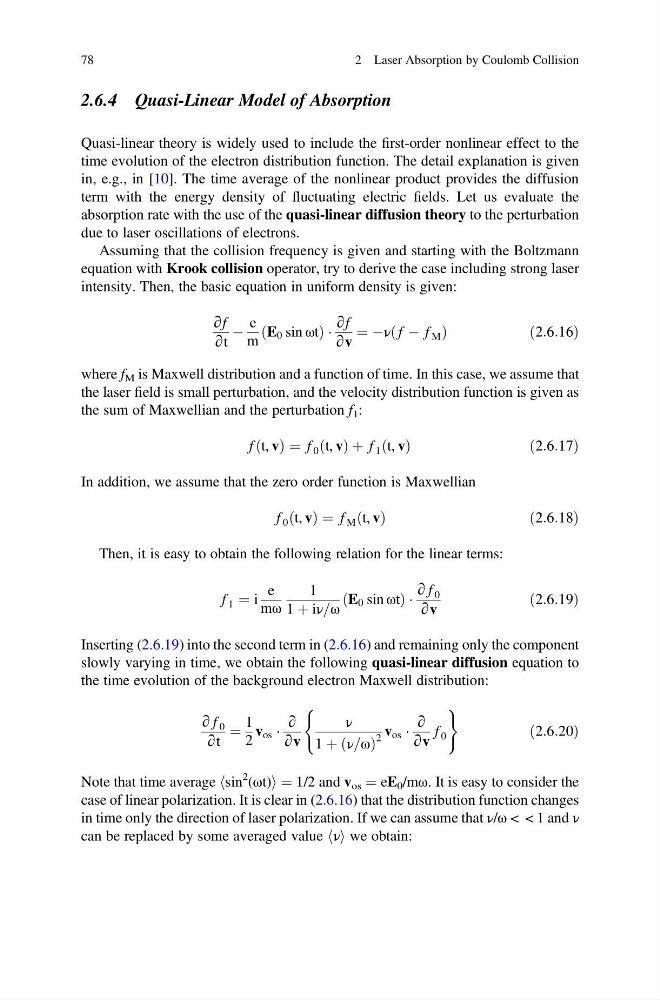
intensity. Then, the basic equation in uniform density is given:
∂f
∂t
À
e
m
E 0 sin ωt
ð
ÞÁ
∂f
∂v
¼ Àν f À f M
ð
Þ
ð 2:6:16Þ
where f M is Maxwell distribution and a function of time. In this case, we assume that
the laser field is small perturbation, and the velocity distribution function is given as
the sum of Maxwellian and the perturbation f 1 :
f t, v
ð Þ ¼ f 0 t, v
ð Þ þ f 1 t, v
ð Þ
ð2:6:17Þ
In addition, we assume that the zero order function is Maxwellian
f 0 t, v
ð Þ ¼ f M t, v
ð Þ
ð2:6:18Þ
Then, it is easy to obtain the following relation for the linear terms:
f 1 ¼ i
e
mω
1
1 þ iν=ω
E 0 sin ωt
ð
ÞÁ
∂ f 0
∂v
ð2:6:19Þ
Inserting (2.6.19) into the second term in (2.6.16) and remaining only the component
slowly varying in time, we obtain the following quasi-linear diffusion equation to
the time evolution of the background electron Maxwell distribution:
∂ f 0
∂t
¼
1
2
v os Á
∂
∂v
ν
1 þ ν=ω
ð
Þ
2
v os Á
∂
∂v
f 0
(
)
ð2:6:20Þ
Note that time average hsin
2 (ωt)i ¼ 1/2 and v os ¼ eE 0 /mω. It is easy to consider the
case of linear polarization. It is clear in (2.6.16) that the distribution function changes
in time only the direction of laser polarization. If we can assume that ν/ω < < 1 and ν
can be replaced by some averaged value hνi we obtain:
78
2 Laser Absorption by Coulomb Collision
Quasi-linear theory is widely used to include the first-order nonlinear effect to the
time evolution of the electron distribution function. The detail explanation is given
in, e.g., in [10]. The time average of the nonlinear product provides the diffusion
term with the energy density of fluctuating electric fields. Let us evaluate the
absorption rate with the use of the quasi-linear diffusion theory to the perturbation
due to laser oscillations of electrons.
Assuming that the collision frequency is given and starting with the Boltzmann
equation with Krook collision operator, try to derive the case including strong laser
intensity. Then, the basic equation in uniform density is given:
∂f
∂t
À
e
m
E 0 sin ωt
ð
ÞÁ
∂f
∂v
¼ Àν f À f M
ð
Þ
ð 2:6:16Þ
where f M is Maxwell distribution and a function of time. In this case, we assume that
the laser field is small perturbation, and the velocity distribution function is given as
the sum of Maxwellian and the perturbation f 1 :
f t, v
ð Þ ¼ f 0 t, v
ð Þ þ f 1 t, v
ð Þ
ð2:6:17Þ
In addition, we assume that the zero order function is Maxwellian
f 0 t, v
ð Þ ¼ f M t, v
ð Þ
ð2:6:18Þ
Then, it is easy to obtain the following relation for the linear terms:
f 1 ¼ i
e
mω
1
1 þ iν=ω
E 0 sin ωt
ð
ÞÁ
∂ f 0
∂v
ð2:6:19Þ
Inserting (2.6.19) into the second term in (2.6.16) and remaining only the component
slowly varying in time, we obtain the following quasi-linear diffusion equation to
the time evolution of the background electron Maxwell distribution:
∂ f 0
∂t
¼
1
2
v os Á
∂
∂v
ν
1 þ ν=ω
ð
Þ
2
v os Á
∂
∂v
f 0
(
)
ð2:6:20Þ
Note that time average hsin
2 (ωt)i ¼ 1/2 and v os ¼ eE 0 /mω. It is easy to consider the
case of linear polarization. It is clear in (2.6.16) that the distribution function changes
in time only the direction of laser polarization. If we can assume that ν/ω < < 1 and ν
can be replaced by some averaged value hνi we obtain:
78
2 Laser Absorption by Coulomb Collision