

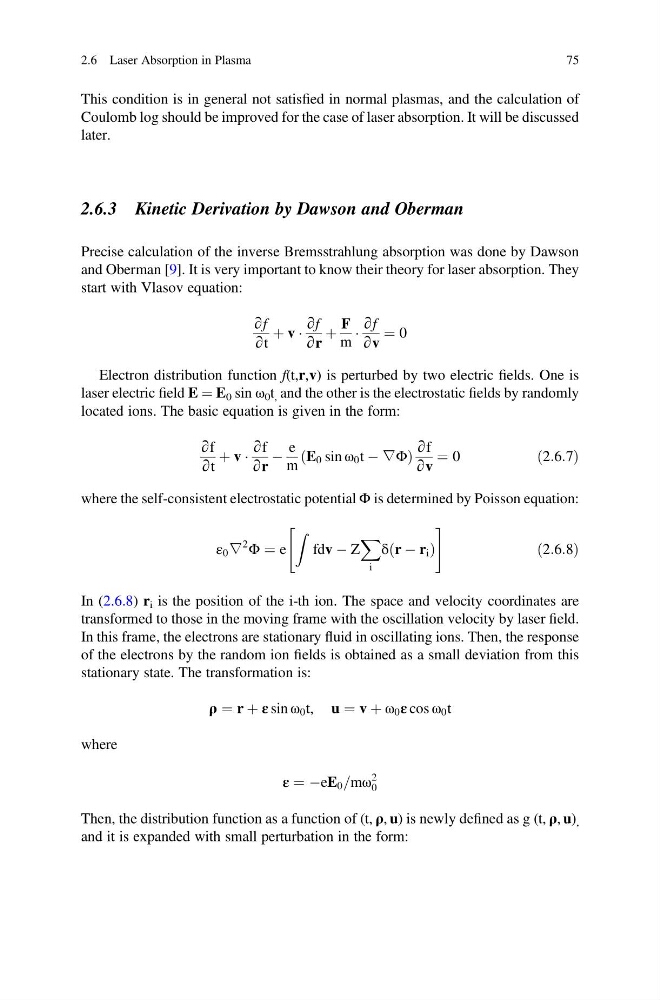
This condition is in general not satisfied in normal plasmas, and the calculation of
Coulomb log should be improved for the case of laser absorption. It will be discussed
later.
2.6.3 Kinetic Derivation by Dawson and Oberman
Precise calculation of the inverse Bremsstrahlung absorption was done by Dawson
and Oberman [9]. It is very important to know their theory for laser absorption. They
start with Vlasov equation:
∂f
∂t
þ v Á
∂f
∂r
þ
F
m
Á
∂f
∂v
¼ 0
Electron distribution function f(t,r,v) is perturbed by two electric fields. One is
laser electric field E ¼ E 0 sin ω 0 t , and the other is the electrostatic fields by randomly
located ions. The basic equation is given in the form:
∂f
∂t
þ v Á
∂f
∂r
À
e
m
E 0 sin ω 0 t À ∇Φ
ð
Þ
∂f
∂v
¼ 0
ð2:6:7Þ
where the self-consistent electrostatic potential Φ is determined by Poisson equation:
ε 0 ∇
2 Φ ¼ e
Z
fdv À Z
X
i
δ r À r i
ð
Þ
"
#
ð2:6:8Þ
In (2.6.8) r i is the position of the i-th ion. The space and velocity coordinates are
transformed to those in the moving frame with the oscillation velocity by laser field.
In this frame, the electrons are stationary fluid in oscillating ions. Then, the response
of the electrons by the random ion fields is obtained as a small deviation from this
stationary state. The transformation is:
ρ ¼ r þ ε sin ω 0 t, u ¼ v þ ω 0 ε cos ω 0 t
where
ε ¼ ÀeE 0 =mω
2
0
Then, the distribution function as a function of (t, ρ, u) is newly defined as g (t, ρ, u) ,
and it is expanded with small perturbation in the form:
2.6 Laser Absorption in Plasma
75
Coulomb log should be improved for the case of laser absorption. It will be discussed
later.
2.6.3 Kinetic Derivation by Dawson and Oberman
Precise calculation of the inverse Bremsstrahlung absorption was done by Dawson
and Oberman [9]. It is very important to know their theory for laser absorption. They
start with Vlasov equation:
∂f
∂t
þ v Á
∂f
∂r
þ
F
m
Á
∂f
∂v
¼ 0
Electron distribution function f(t,r,v) is perturbed by two electric fields. One is
laser electric field E ¼ E 0 sin ω 0 t , and the other is the electrostatic fields by randomly
located ions. The basic equation is given in the form:
∂f
∂t
þ v Á
∂f
∂r
À
e
m
E 0 sin ω 0 t À ∇Φ
ð
Þ
∂f
∂v
¼ 0
ð2:6:7Þ
where the self-consistent electrostatic potential Φ is determined by Poisson equation:
ε 0 ∇
2 Φ ¼ e
Z
fdv À Z
X
i
δ r À r i
ð
Þ
"
#
ð2:6:8Þ
In (2.6.8) r i is the position of the i-th ion. The space and velocity coordinates are
transformed to those in the moving frame with the oscillation velocity by laser field.
In this frame, the electrons are stationary fluid in oscillating ions. Then, the response
of the electrons by the random ion fields is obtained as a small deviation from this
stationary state. The transformation is:
ρ ¼ r þ ε sin ω 0 t, u ¼ v þ ω 0 ε cos ω 0 t
where
ε ¼ ÀeE 0 =mω
2
0
Then, the distribution function as a function of (t, ρ, u) is newly defined as g (t, ρ, u) ,
and it is expanded with small perturbation in the form:
2.6 Laser Absorption in Plasma
75