

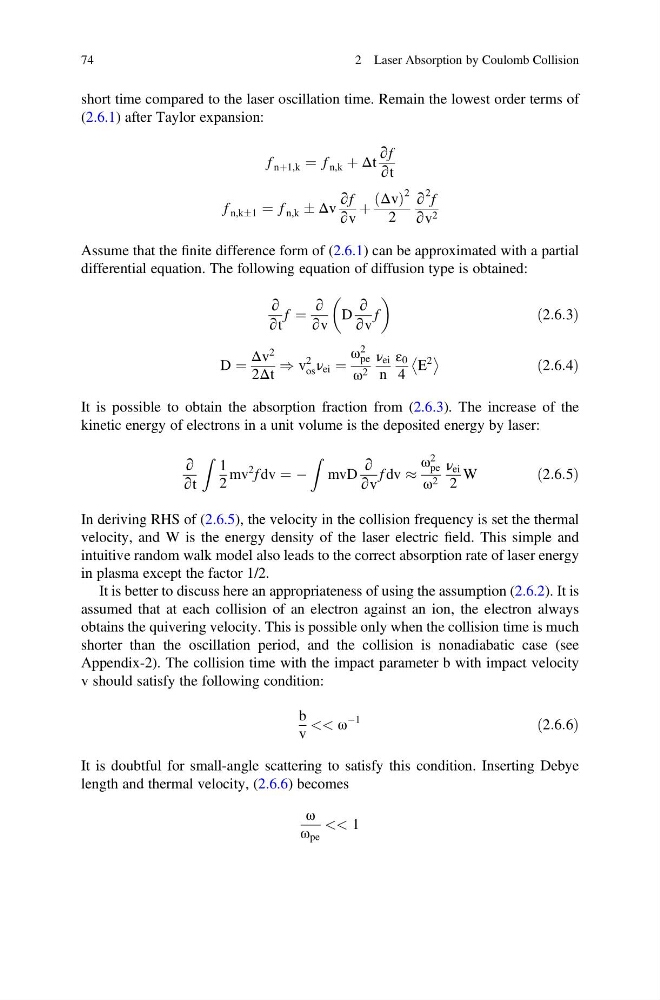
short time compared to the laser oscillation time. Remain the lowest order terms of
(2.6.1) after Taylor expansion:
f nþ1,k ¼ f n,k þ Δt
∂f
∂t
f n,kÆ1 ¼ f n,k Æ Δv
∂f
∂v
þ
Δv
ð Þ
2
2
∂
2 f
∂v 2
Assume that the finite difference form of (2.6.1) can be approximated with a partial
differential equation. The following equation of diffusion type is obtained:
∂
∂t
f ¼
∂
∂v
D
∂
∂v
f
ð2:6:3Þ
D ¼
Δv
2
2Δt
) v
2
os ν ei ¼
ω
2
pe
ω 2
ν ei
n
ε 0
4
E
2
ð2:6:4Þ
It is possible to obtain the absorption fraction from (2.6.3). The increase of the
kinetic energy of electrons in a unit volume is the deposited energy by laser:
∂
∂t
Z
1
2
mv
2 f dv ¼ À
Z
mvD
∂
∂v
f dv %
ω
2
pe
ω 2
ν ei
2
W
ð2:6:5Þ
In deriving RHS of (2.6.5), the velocity in the collision frequency is set the thermal
velocity, and W is the energy density of the laser electric field. This simple and
intuitive random walk model also leads to the correct absorption rate of laser energy
in plasma except the factor 1/2.
It is better to discuss here an appropriateness of using the assumption (2.6.2). It is
assumed that at each collision of an electron against an ion, the electron always
obtains the quivering velocity. This is possible only when the collision time is much
shorter than the oscillation period, and the collision is nonadiabatic case (see
Appendix-2). The collision time with the impact parameter b with impact velocity
v should satisfy the following condition:
b
v
<< ω
À1
ð2:6:6Þ
It is doubtful for small-angle scattering to satisfy this condition. Inserting Debye
length and thermal velocity, (2.6.6) becomes
ω
ω pe
<< 1
74
2 Laser Absorption by Coulomb Collision
(2.6.1) after Taylor expansion:
f nþ1,k ¼ f n,k þ Δt
∂f
∂t
f n,kÆ1 ¼ f n,k Æ Δv
∂f
∂v
þ
Δv
ð Þ
2
2
∂
2 f
∂v 2
Assume that the finite difference form of (2.6.1) can be approximated with a partial
differential equation. The following equation of diffusion type is obtained:
∂
∂t
f ¼
∂
∂v
D
∂
∂v
f
ð2:6:3Þ
D ¼
Δv
2
2Δt
) v
2
os ν ei ¼
ω
2
pe
ω 2
ν ei
n
ε 0
4
E
2
ð2:6:4Þ
It is possible to obtain the absorption fraction from (2.6.3). The increase of the
kinetic energy of electrons in a unit volume is the deposited energy by laser:
∂
∂t
Z
1
2
mv
2 f dv ¼ À
Z
mvD
∂
∂v
f dv %
ω
2
pe
ω 2
ν ei
2
W
ð2:6:5Þ
In deriving RHS of (2.6.5), the velocity in the collision frequency is set the thermal
velocity, and W is the energy density of the laser electric field. This simple and
intuitive random walk model also leads to the correct absorption rate of laser energy
in plasma except the factor 1/2.
It is better to discuss here an appropriateness of using the assumption (2.6.2). It is
assumed that at each collision of an electron against an ion, the electron always
obtains the quivering velocity. This is possible only when the collision time is much
shorter than the oscillation period, and the collision is nonadiabatic case (see
Appendix-2). The collision time with the impact parameter b with impact velocity
v should satisfy the following condition:
b
v
<< ω
À1
ð2:6:6Þ
It is doubtful for small-angle scattering to satisfy this condition. Inserting Debye
length and thermal velocity, (2.6.6) becomes
ω
ω pe
<< 1
74
2 Laser Absorption by Coulomb Collision