

∂
2
∂t 2 E À c
2
∇
2 E þ ω
2
pe E ¼ À
1
ε 0
∂j ext
∂t
ð2:5:2Þ
In the case without the external current in plasma, the plane electromagnetic field in
the form (2.5.2) propagating in a uniform plasma should satisfy the following
relation:
ω
2
¼ c
2 k
2
þ ω
2
pe
ð2:5:3Þ
This is dispersion relation of the electromagnetic waves in plasmas, and given k or
ω, the other one is not independent and should satisfy (2.5.3) in order for the wave to
propagate as a plane wave.
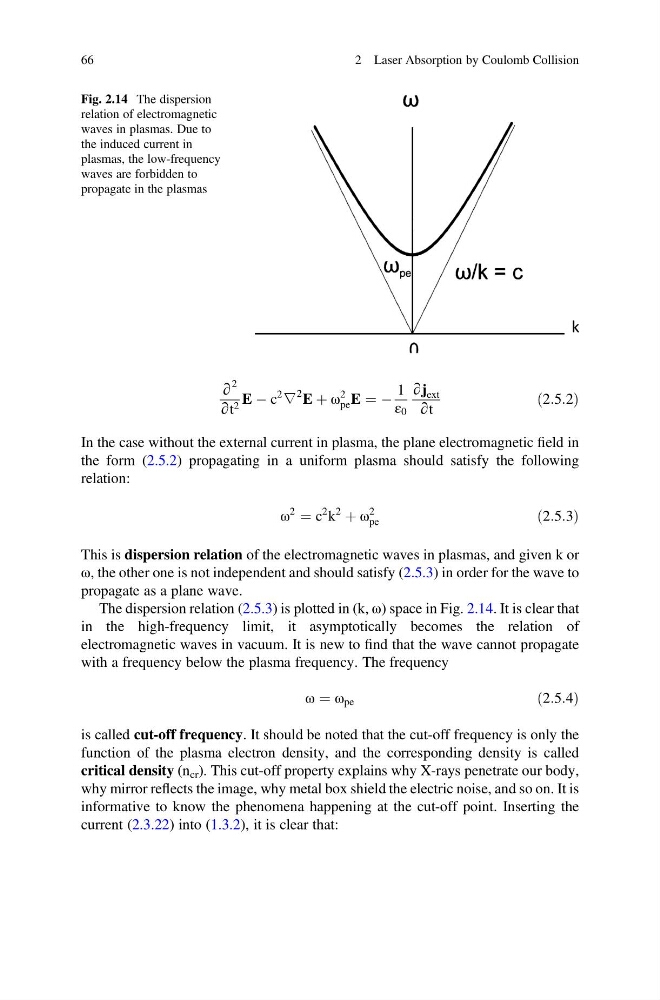
The dispersion relation (2.5.3) is plotted in (k, ω) space in Fig. 2.14. It is clear that
in the high-frequency limit, it asymptotically becomes the relation of
electromagnetic waves in vacuum. It is new to find that the wave cannot propagate
with a frequency below the plasma frequency. The frequency
ω ¼ ω pe
ð2:5:4Þ
is called cut-off frequency. It should be noted that the cut-off frequency is only the
function of the plasma electron density, and the corresponding density is called
critical density (n cr ). This cut-off property explains why X-rays penetrate our body,
why mirror reflects the image, why metal box shield the electric noise, and so on. It is
informative to know the phenomena happening at the cut-off point. Inserting the
current (2.3.22) into (1.3.2), it is clear that:
Fig. 2.14 The dispersion
relation of electromagnetic
waves in plasmas. Due to
the induced current in
plasmas, the low-frequency
waves are forbidden to
propagate in the plasmas
66
2 Laser Absorption by Coulomb Collision
2
∂t 2 E À c
2
∇
2 E þ ω
2
pe E ¼ À
1
ε 0
∂j ext
∂t
ð2:5:2Þ
In the case without the external current in plasma, the plane electromagnetic field in
the form (2.5.2) propagating in a uniform plasma should satisfy the following
relation:
ω
2
¼ c
2 k
2
þ ω
2
pe
ð2:5:3Þ
This is dispersion relation of the electromagnetic waves in plasmas, and given k or
ω, the other one is not independent and should satisfy (2.5.3) in order for the wave to
propagate as a plane wave.
The dispersion relation (2.5.3) is plotted in (k, ω) space in Fig. 2.14. It is clear that
in the high-frequency limit, it asymptotically becomes the relation of
electromagnetic waves in vacuum. It is new to find that the wave cannot propagate
with a frequency below the plasma frequency. The frequency
ω ¼ ω pe
ð2:5:4Þ
is called cut-off frequency. It should be noted that the cut-off frequency is only the
function of the plasma electron density, and the corresponding density is called
critical density (n cr ). This cut-off property explains why X-rays penetrate our body,
why mirror reflects the image, why metal box shield the electric noise, and so on. It is
informative to know the phenomena happening at the cut-off point. Inserting the
current (2.3.22) into (1.3.2), it is clear that:
Fig. 2.14 The dispersion
relation of electromagnetic
waves in plasmas. Due to
the induced current in
plasmas, the low-frequency
waves are forbidden to
propagate in the plasmas
66
2 Laser Absorption by Coulomb Collision