

m e v e þ m i v i ¼ m e v
0
e þ m i v
0
i
m e v e
2
þ m i v i
2
¼ m e v
0
e
À Á 2 þ m i v
0
i
À Á 2
ð2:4:28Þ
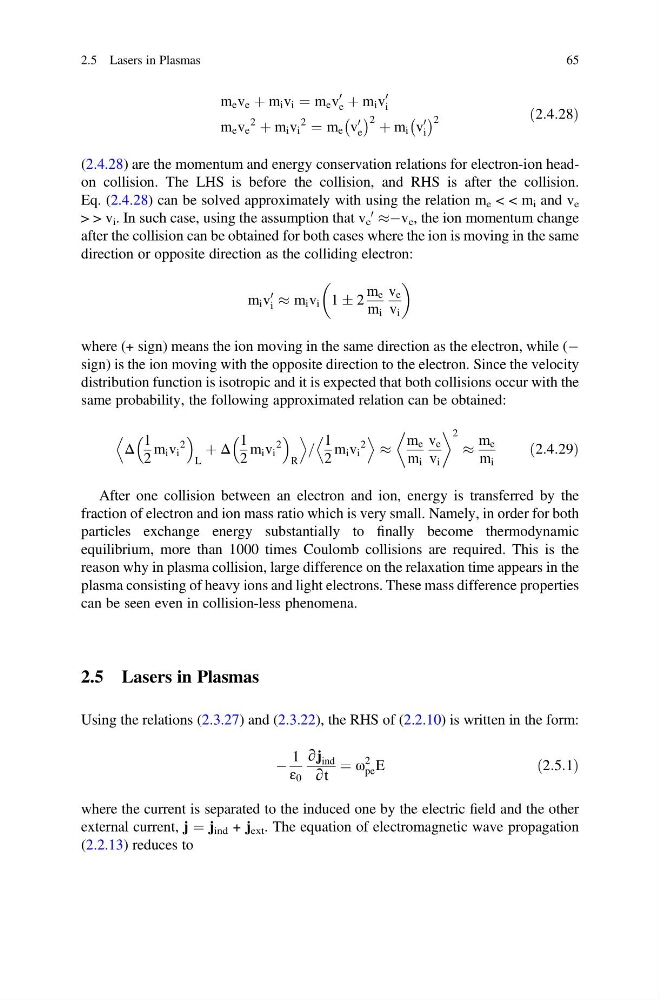
(2.4.28) are the momentum and energy conservation relations for electron-ion headon collision. The LHS is before the collision, and RHS is after the collision.
Eq. (2.4.28) can be solved approximately with using the relation m e < < m i and v e
> > v i . In such case, using the assumption that v e
0
%Àv e , the ion momentum change
after the collision can be obtained for both cases where the ion is moving in the same
direction or opposite direction as the colliding electron:
m i v
0
i % m i v i 1 Æ 2
m e
m i
v e
v i
where (+ sign) means the ion moving in the same direction as the electron, while (À
sign) is the ion moving with the opposite direction to the electron. Since the velocity
distribution function is isotropic and it is expected that both collisions occur with the
same probability, the following approximated relation can be obtained:
Δ
1
2
m i v i
2
L
þ Δ
1
2
m i v i
2
R
D
E
=
1
2
m i v i
2
D
E
%
m e
m i
v e
v i
(
) 2
%
m e
m i
ð2:4:29Þ
After one collision between an electron and ion, energy is transferred by the
fraction of electron and ion mass ratio which is very small. Namely, in order for both
particles exchange energy substantially to finally become thermodynamic
equilibrium, more than 1000 times Coulomb collisions are required. This is the
reason why in plasma collision, large difference on the relaxation time appears in the
plasma consisting of heavy ions and light electrons. These mass difference properties
can be seen even in collision-less phenomena.
2.5 Lasers in Plasmas
Using the relations (2.3.27) and (2.3.22), the RHS of (2.2.10) is written in the form:
À
1
ε 0
∂j ind
∂t
¼ ω
2
pe E
ð2:5:1Þ
where the current is separated to the induced one by the electric field and the other
external current, j ¼ j ind + j ext . The equation of electromagnetic wave propagation
(2.2.13) reduces to
2.5 Lasers in Plasmas
65
0
e þ m i v
0
i
m e v e
2
þ m i v i
2
¼ m e v
0
e
À Á 2 þ m i v
0
i
À Á 2
ð2:4:28Þ
(2.4.28) are the momentum and energy conservation relations for electron-ion headon collision. The LHS is before the collision, and RHS is after the collision.
Eq. (2.4.28) can be solved approximately with using the relation m e < < m i and v e
> > v i . In such case, using the assumption that v e
0
%Àv e , the ion momentum change
after the collision can be obtained for both cases where the ion is moving in the same
direction or opposite direction as the colliding electron:
m i v
0
i % m i v i 1 Æ 2
m e
m i
v e
v i
where (+ sign) means the ion moving in the same direction as the electron, while (À
sign) is the ion moving with the opposite direction to the electron. Since the velocity
distribution function is isotropic and it is expected that both collisions occur with the
same probability, the following approximated relation can be obtained:
Δ
1
2
m i v i
2
L
þ Δ
1
2
m i v i
2
R
D
E
=
1
2
m i v i
2
D
E
%
m e
m i
v e
v i
(
) 2
%
m e
m i
ð2:4:29Þ
After one collision between an electron and ion, energy is transferred by the
fraction of electron and ion mass ratio which is very small. Namely, in order for both
particles exchange energy substantially to finally become thermodynamic
equilibrium, more than 1000 times Coulomb collisions are required. This is the
reason why in plasma collision, large difference on the relaxation time appears in the
plasma consisting of heavy ions and light electrons. These mass difference properties
can be seen even in collision-less phenomena.
2.5 Lasers in Plasmas
Using the relations (2.3.27) and (2.3.22), the RHS of (2.2.10) is written in the form:
À
1
ε 0
∂j ind
∂t
¼ ω
2
pe E
ð2:5:1Þ
where the current is separated to the induced one by the electric field and the other
external current, j ¼ j ind + j ext . The equation of electromagnetic wave propagation
(2.2.13) reduces to
2.5 Lasers in Plasmas
65