

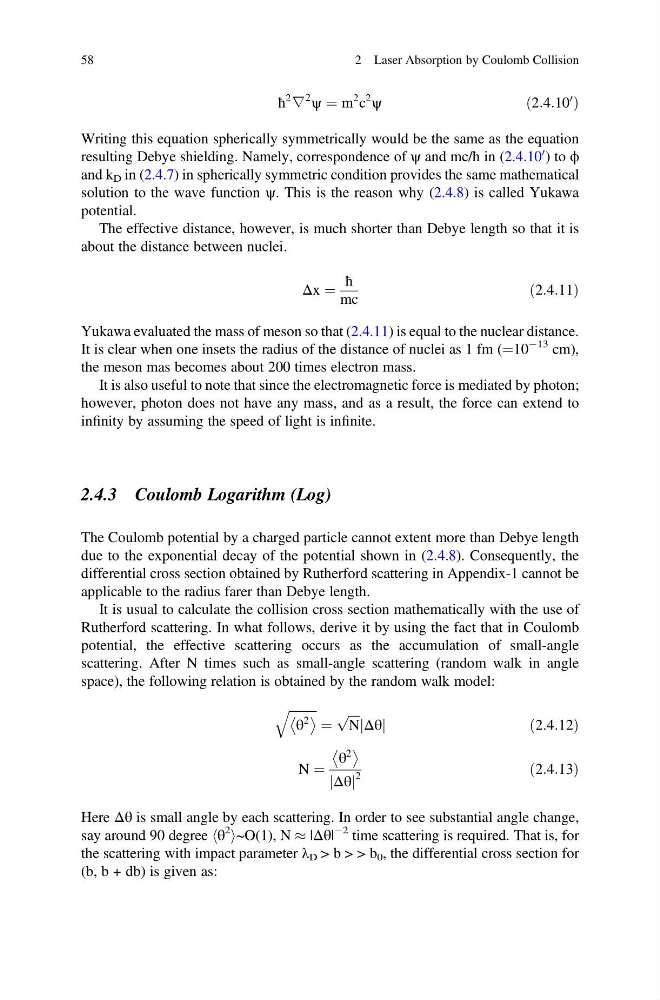
ħ
2
∇
2 ψ ¼ m
2 c
2
ψ
ð2:4:10
0
Þ
Writing this equation spherically symmetrically would be the same as the equation
resulting Debye shielding. Namely, correspondence of ψ and mc/ħ in (2.4.10
0 ) to ϕ
and k D in (2.4.7) in spherically symmetric condition provides the same mathematical
solution to the wave function ψ. This is the reason why (2.4.8) is called Yukawa
potential.
The effective distance, however, is much shorter than Debye length so that it is
about the distance between nuclei.
Δx ¼
ħ
mc
ð2:4:11Þ
Yukawa evaluated the mass of meson so that (2.4.11) is equal to the nuclear distance.
It is clear when one insets the radius of the distance of nuclei as 1 fm (¼10
À13 cm),
the meson mas becomes about 200 times electron mass.
It is also useful to note that since the electromagnetic force is mediated by photon;
however, photon does not have any mass, and as a result, the force can extend to
infinity by assuming the speed of light is infinite.
2.4.3 Coulomb Logarithm (Log)
The Coulomb potential by a charged particle cannot extent more than Debye length
due to the exponential decay of the potential shown in (2.4.8). Consequently, the
differential cross section obtained by Rutherford scattering in Appendix-1 cannot be
applicable to the radius farer than Debye length.
It is usual to calculate the collision cross section mathematically with the use of
Rutherford scattering. In what follows, derive it by using the fact that in Coulomb
potential, the effective scattering occurs as the accumulation of small-angle
scattering. After N times such as small-angle scattering (random walk in angle
space), the following relation is obtained by the random walk model:
ffiffiffiffiffiffiffiffiffi
θ
2
q
¼
ffiffiffi ffi
N
p Δθ
j j
ð2:4:12Þ
N ¼
θ
2
Δθ
j j
2
ð2:4:13Þ
Here Δθ is small angle by each scattering. In order to see substantial angle change,
say around 90 degree hθ
2
i~O(1), N % |Δθ|
À2 time scattering is required. That is, for
the scattering with impact parameter λ D > b > > b 0 , the differential cross section for
(b, b + db) is given as:
58
2 Laser Absorption by Coulomb Collision
2
∇
2 ψ ¼ m
2 c
2
ψ
ð2:4:10
0
Þ
Writing this equation spherically symmetrically would be the same as the equation
resulting Debye shielding. Namely, correspondence of ψ and mc/ħ in (2.4.10
0 ) to ϕ
and k D in (2.4.7) in spherically symmetric condition provides the same mathematical
solution to the wave function ψ. This is the reason why (2.4.8) is called Yukawa
potential.
The effective distance, however, is much shorter than Debye length so that it is
about the distance between nuclei.
Δx ¼
ħ
mc
ð2:4:11Þ
Yukawa evaluated the mass of meson so that (2.4.11) is equal to the nuclear distance.
It is clear when one insets the radius of the distance of nuclei as 1 fm (¼10
À13 cm),
the meson mas becomes about 200 times electron mass.
It is also useful to note that since the electromagnetic force is mediated by photon;
however, photon does not have any mass, and as a result, the force can extend to
infinity by assuming the speed of light is infinite.
2.4.3 Coulomb Logarithm (Log)
The Coulomb potential by a charged particle cannot extent more than Debye length
due to the exponential decay of the potential shown in (2.4.8). Consequently, the
differential cross section obtained by Rutherford scattering in Appendix-1 cannot be
applicable to the radius farer than Debye length.
It is usual to calculate the collision cross section mathematically with the use of
Rutherford scattering. In what follows, derive it by using the fact that in Coulomb
potential, the effective scattering occurs as the accumulation of small-angle
scattering. After N times such as small-angle scattering (random walk in angle
space), the following relation is obtained by the random walk model:
ffiffiffiffiffiffiffiffiffi
θ
2
q
¼
ffiffiffi ffi
N
p Δθ
j j
ð2:4:12Þ
N ¼
θ
2
Δθ
j j
2
ð2:4:13Þ
Here Δθ is small angle by each scattering. In order to see substantial angle change,
say around 90 degree hθ
2
i~O(1), N % |Δθ|
À2 time scattering is required. That is, for
the scattering with impact parameter λ D > b > > b 0 , the differential cross section for
(b, b + db) is given as:
58
2 Laser Absorption by Coulomb Collision