

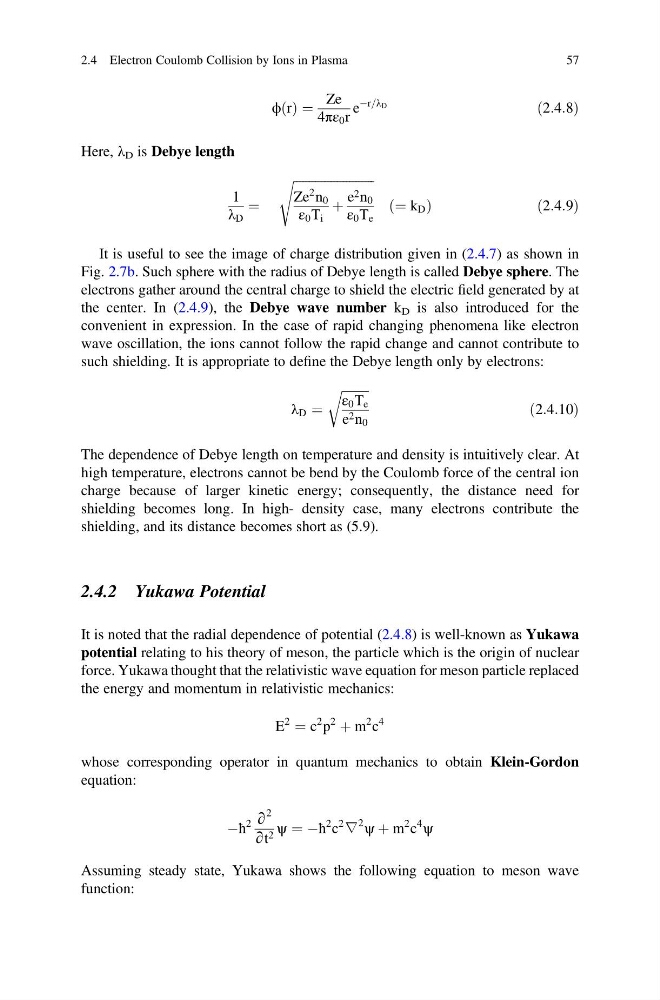
ϕ r
ð Þ ¼
Ze
4πε 0 r
e
Àr=λ D
ð2:4:8Þ
Here, λ D is Debye length
1
λ D
¼
ffiffiffiffiffiffiffiffiffiffiffiffiffiffiffiffiffiffiffiffiffiffiffiffiffiffi
Ze
2 n 0
ε 0 T i
þ
e 2 n 0
ε 0 T e
s
¼ k D
ð
Þ
ð2:4:9Þ
It is useful to see the image of charge distribution given in (2.4.7) as shown in
Fig. 2.7b. Such sphere with the radius of Debye length is called Debye sphere. The
electrons gather around the central charge to shield the electric field generated by at
the center. In (2.4.9), the Debye wave number k D is also introduced for the
convenient in expression. In the case of rapid changing phenomena like electron
wave oscillation, the ions cannot follow the rapid change and cannot contribute to
such shielding. It is appropriate to define the Debye length only by electrons:
λ D ¼
ffiffiffiffiffiffiffiffiffi
ε 0 T e
e 2 n 0
r
ð2:4:10Þ
The dependence of Debye length on temperature and density is intuitively clear. At
high temperature, electrons cannot be bend by the Coulomb force of the central ion
charge because of larger kinetic energy; consequently, the distance need for
shielding becomes long. In high- density case, many electrons contribute the
shielding, and its distance becomes short as (5.9).
2.4.2 Yukawa Potential
It is noted that the radial dependence of potential (2.4.8) is well-known as Yukawa
potential relating to his theory of meson, the particle which is the origin of nuclear
force. Yukawa thought that the relativistic wave equation for meson particle replaced
the energy and momentum in relativistic mechanics:
E
2
¼ c
2 p
2
þ m
2 c
4
whose corresponding operator in quantum mechanics to obtain Klein-Gordon
equation:
Àħ
2 ∂
2
∂t 2 ψ ¼ Àħ
2 c
2
∇
2
ψ þ m
2 c
4
ψ
Assuming steady state, Yukawa shows the following equation to meson wave
function:
2.4 Electron Coulomb Collision by Ions in Plasma
57
ð Þ ¼
Ze
4πε 0 r
e
Àr=λ D
ð2:4:8Þ
Here, λ D is Debye length
1
λ D
¼
ffiffiffiffiffiffiffiffiffiffiffiffiffiffiffiffiffiffiffiffiffiffiffiffiffiffi
Ze
2 n 0
ε 0 T i
þ
e 2 n 0
ε 0 T e
s
¼ k D
ð
Þ
ð2:4:9Þ
It is useful to see the image of charge distribution given in (2.4.7) as shown in
Fig. 2.7b. Such sphere with the radius of Debye length is called Debye sphere. The
electrons gather around the central charge to shield the electric field generated by at
the center. In (2.4.9), the Debye wave number k D is also introduced for the
convenient in expression. In the case of rapid changing phenomena like electron
wave oscillation, the ions cannot follow the rapid change and cannot contribute to
such shielding. It is appropriate to define the Debye length only by electrons:
λ D ¼
ffiffiffiffiffiffiffiffiffi
ε 0 T e
e 2 n 0
r
ð2:4:10Þ
The dependence of Debye length on temperature and density is intuitively clear. At
high temperature, electrons cannot be bend by the Coulomb force of the central ion
charge because of larger kinetic energy; consequently, the distance need for
shielding becomes long. In high- density case, many electrons contribute the
shielding, and its distance becomes short as (5.9).
2.4.2 Yukawa Potential
It is noted that the radial dependence of potential (2.4.8) is well-known as Yukawa
potential relating to his theory of meson, the particle which is the origin of nuclear
force. Yukawa thought that the relativistic wave equation for meson particle replaced
the energy and momentum in relativistic mechanics:
E
2
¼ c
2 p
2
þ m
2 c
4
whose corresponding operator in quantum mechanics to obtain Klein-Gordon
equation:
Àħ
2 ∂
2
∂t 2 ψ ¼ Àħ
2 c
2
∇
2
ψ þ m
2 c
4
ψ
Assuming steady state, Yukawa shows the following equation to meson wave
function:
2.4 Electron Coulomb Collision by Ions in Plasma
57