

J ¼ a
E
2
W
exp Àb
W
3=2
E
ð2:1:4Þ
where a and b are constants given in [1]. It is noted that with the increase of the
strength of electric field, the factor of the exponent in (2.1.4) increases very fast.
The work function is about several eV, and an electric field of E ¼ 10
6 V/cm is
required to extract large current. Such discharge is called cold cathode discharge or
electric field induced discharge. In addition, if there are fine protrusions on the
surface, the electric field in the vicinity thereof becomes strong. Then, the electron
emission from the protruding point occurs in a relatively low electric field. Like the
lightning rod, the electric field becomes stronger at the protruding point such as the
apex of the cone. Therefore, with the progress of nanotechnology, a method using a
cathode having many protruding structures came to be used.
Before finishing here, electron emission from the metal due to heating of the
metal surface is briefly explained. This phenomenon is called thermionic emission.
It is clear that the electron energy distribution in the metal expands to higher energy
levels suggested by Fermi-Dirac distribution, when the metal surface is heated by a
certain method. In order to obtain efficient emission of electrons, however, metal
temperature should be kept lower than the melting temperature that is lower than the
work function W.
A material having a high melting temperature and a low work function is suitable.
Tungsten is often used as a thermal electron source. The melting temperature is
3695 K degrees (0.32 eV), and the work function is 4.5 eV. Even the value of exp
(À4.5/0.32) ¼ 10
À6 , many thermionic electrons appear. By integrating the FermiDirac distribution for given temperature T, the thermal current density from the
metal surface with the positive energy is found to have the relation [1]:
J / T
2 exp À
W
T
ð2:1:5Þ
where T is in energy unit and Boltzmann constant is omitted.
U 1
U 2
E
U 3
C 1 =1
C 2
C 3
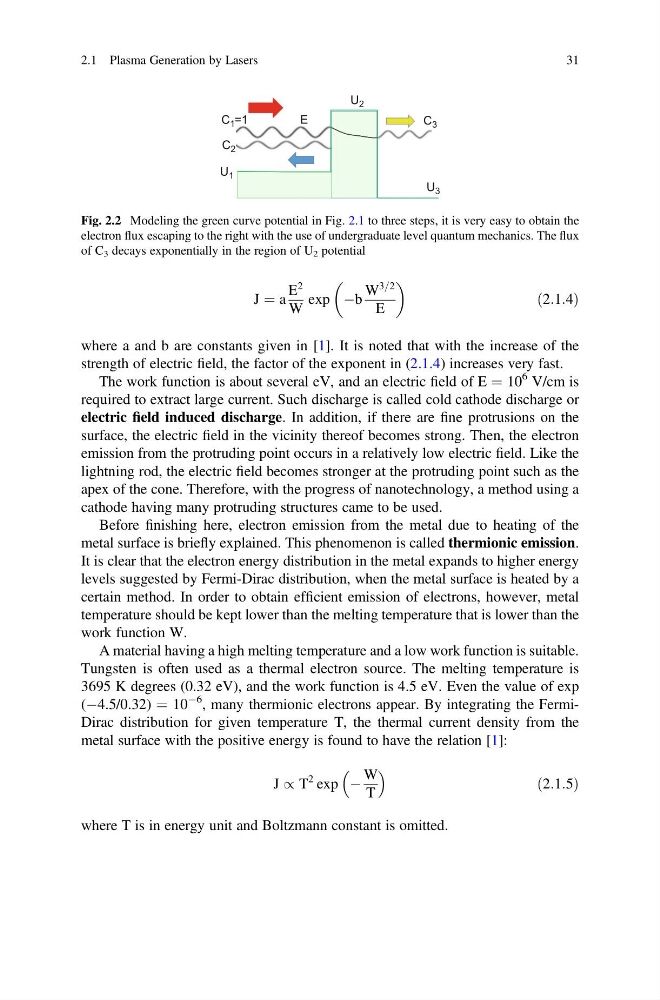
Fig. 2.2 Modeling the green curve potential in Fig. 2.1 to three steps, it is very easy to obtain the
electron flux escaping to the right with the use of undergraduate level quantum mechanics. The flux
of C 3 decays exponentially in the region of U 2 potential
2.1 Plasma Generation by Lasers
31
E
2
W
exp Àb
W
3=2
E
ð2:1:4Þ
where a and b are constants given in [1]. It is noted that with the increase of the
strength of electric field, the factor of the exponent in (2.1.4) increases very fast.
The work function is about several eV, and an electric field of E ¼ 10
6 V/cm is
required to extract large current. Such discharge is called cold cathode discharge or
electric field induced discharge. In addition, if there are fine protrusions on the
surface, the electric field in the vicinity thereof becomes strong. Then, the electron
emission from the protruding point occurs in a relatively low electric field. Like the
lightning rod, the electric field becomes stronger at the protruding point such as the
apex of the cone. Therefore, with the progress of nanotechnology, a method using a
cathode having many protruding structures came to be used.
Before finishing here, electron emission from the metal due to heating of the
metal surface is briefly explained. This phenomenon is called thermionic emission.
It is clear that the electron energy distribution in the metal expands to higher energy
levels suggested by Fermi-Dirac distribution, when the metal surface is heated by a
certain method. In order to obtain efficient emission of electrons, however, metal
temperature should be kept lower than the melting temperature that is lower than the
work function W.
A material having a high melting temperature and a low work function is suitable.
Tungsten is often used as a thermal electron source. The melting temperature is
3695 K degrees (0.32 eV), and the work function is 4.5 eV. Even the value of exp
(À4.5/0.32) ¼ 10
À6 , many thermionic electrons appear. By integrating the FermiDirac distribution for given temperature T, the thermal current density from the
metal surface with the positive energy is found to have the relation [1]:
J / T
2 exp À
W
T
ð2:1:5Þ
where T is in energy unit and Boltzmann constant is omitted.
U 1
U 2
E
U 3
C 1 =1
C 2
C 3
Fig. 2.2 Modeling the green curve potential in Fig. 2.1 to three steps, it is very easy to obtain the
electron flux escaping to the right with the use of undergraduate level quantum mechanics. The flux
of C 3 decays exponentially in the region of U 2 potential
2.1 Plasma Generation by Lasers
31