

U z
ð Þ ¼ Àf s
e
2
4πε 0 z
À eEz
ð2:1:1Þ
where f s is a surface factor and is taken to be 1/4 [1]. Note that this can be used for the
case of field-induced ionization of atoms as seen later soon. It is easy to calculate the
potential maximum U max and its position z m . For fs ¼ 1/4, they are:
U max ¼ À
e
2
ffiffiffiffiffiffi ffi
eE
πε 0
r
ð2:1:2Þ
z m ¼
ffiffiffiffiffiffiffiffiffiffiffiffiffiffi ffi
e
16πε 0 E
r
ð2:1:3Þ
If |U max | % W (¼ work function) is required as view of classical mechanics, it is
almost the same electric field of atomic binding energy, which is roughly E ~ E 0 /
(er B ), where E 0 and r B are the binding energy of hydrogen at the grand state and Bohr
radius, respectively. Inserting the constants, the critical electric field becomes
E ~ 10
9 [V/cm]. This is unrealistically higher value technically. It is clear that with
the help of the quantum tunneling effect, the electrons are extracted from the metal
by the field-induced emission mechanism.
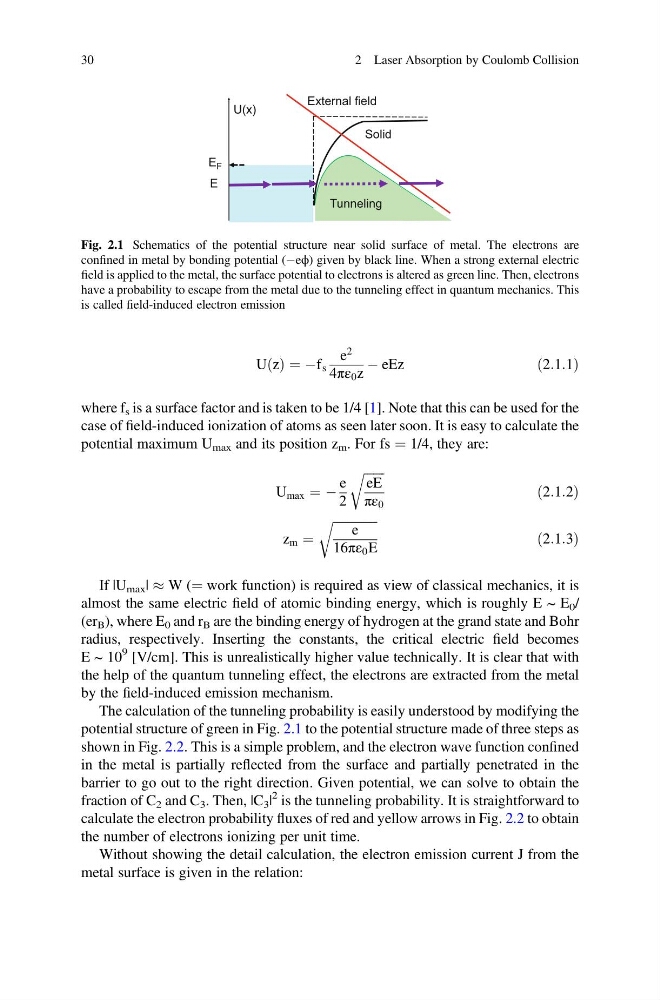
The calculation of the tunneling probability is easily understood by modifying the
potential structure of green in Fig. 2.1 to the potential structure made of three steps as
shown in Fig. 2.2. This is a simple problem, and the electron wave function confined
in the metal is partially reflected from the surface and partially penetrated in the
barrier to go out to the right direction. Given potential, we can solve to obtain the
fraction of C 2 and C 3 . Then, |C 3 |
2 is the tunneling probability. It is straightforward to
calculate the electron probability fluxes of red and yellow arrows in Fig. 2.2 to obtain
the number of electrons ionizing per unit time.
Without showing the detail calculation, the electron emission current J from the
metal surface is given in the relation:
E F
E
U(x)
Solid
External field
Tunneling
Fig. 2.1 Schematics of the potential structure near solid surface of metal. The electrons are
confined in metal by bonding potential (Àeϕ) given by black line. When a strong external electric
field is applied to the metal, the surface potential to electrons is altered as green line. Then, electrons
have a probability to escape from the metal due to the tunneling effect in quantum mechanics. This
is called field-induced electron emission
30
2 Laser Absorption by Coulomb Collision
ð Þ ¼ Àf s
e
2
4πε 0 z
À eEz
ð2:1:1Þ
where f s is a surface factor and is taken to be 1/4 [1]. Note that this can be used for the
case of field-induced ionization of atoms as seen later soon. It is easy to calculate the
potential maximum U max and its position z m . For fs ¼ 1/4, they are:
U max ¼ À
e
2
ffiffiffiffiffiffi ffi
eE
πε 0
r
ð2:1:2Þ
z m ¼
ffiffiffiffiffiffiffiffiffiffiffiffiffiffi ffi
e
16πε 0 E
r
ð2:1:3Þ
If |U max | % W (¼ work function) is required as view of classical mechanics, it is
almost the same electric field of atomic binding energy, which is roughly E ~ E 0 /
(er B ), where E 0 and r B are the binding energy of hydrogen at the grand state and Bohr
radius, respectively. Inserting the constants, the critical electric field becomes
E ~ 10
9 [V/cm]. This is unrealistically higher value technically. It is clear that with
the help of the quantum tunneling effect, the electrons are extracted from the metal
by the field-induced emission mechanism.
The calculation of the tunneling probability is easily understood by modifying the
potential structure of green in Fig. 2.1 to the potential structure made of three steps as
shown in Fig. 2.2. This is a simple problem, and the electron wave function confined
in the metal is partially reflected from the surface and partially penetrated in the
barrier to go out to the right direction. Given potential, we can solve to obtain the
fraction of C 2 and C 3 . Then, |C 3 |
2 is the tunneling probability. It is straightforward to
calculate the electron probability fluxes of red and yellow arrows in Fig. 2.2 to obtain
the number of electrons ionizing per unit time.
Without showing the detail calculation, the electron emission current J from the
metal surface is given in the relation:
E F
E
U(x)
Solid
External field
Tunneling
Fig. 2.1 Schematics of the potential structure near solid surface of metal. The electrons are
confined in metal by bonding potential (Àeϕ) given by black line. When a strong external electric
field is applied to the metal, the surface potential to electrons is altered as green line. Then, electrons
have a probability to escape from the metal due to the tunneling effect in quantum mechanics. This
is called field-induced electron emission
30
2 Laser Absorption by Coulomb Collision