
the negative direction in k space. Namely, the profile condenses near k ¼ 0;
consequently the profile becomes smooth in real p space. The second term is the
decay term exponentially, and the decay time is short for large k, but its time is of
course depends on the fractional index α.
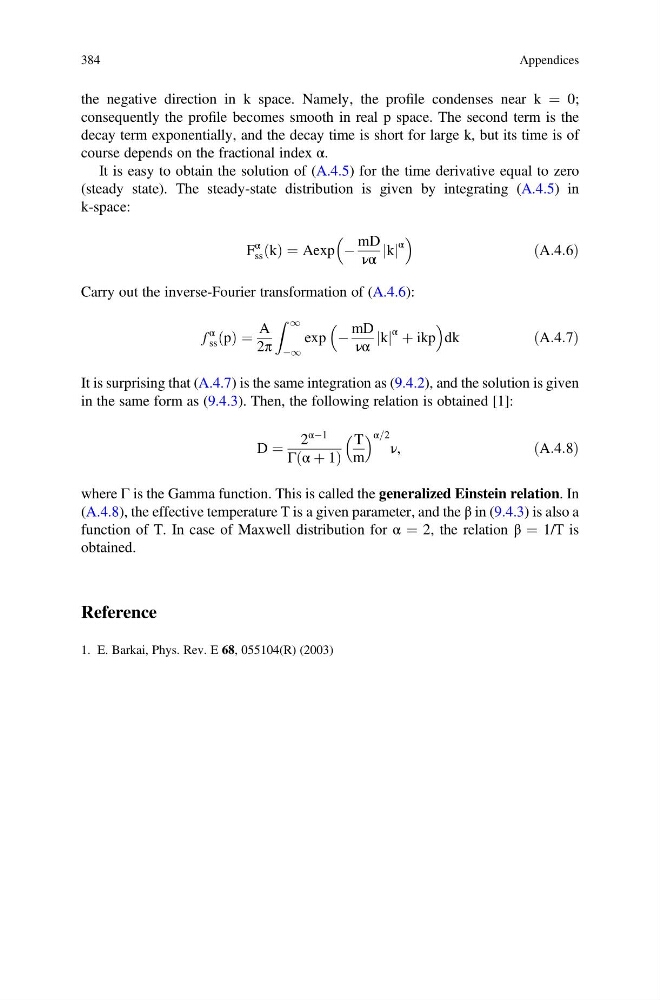
It is easy to obtain the solution of (A.4.5) for the time derivative equal to zero
(steady state). The steady-state distribution is given by integrating (A.4.5) in
k-space:
F
α
ss k
ð Þ ¼ Aexp À
mD
να
k
j j
α
ðA:4:6Þ
Carry out the inverse-Fourier transformation of (A.4.6):
f
α
ss p
ð Þ ¼
A
2π
Z 1
À1
exp À
mD
να
k
j j
α þ ikp
dk
ðA:4:7Þ
It is surprising that (A.4.7) is the same integration as (9.4.2), and the solution is given
in the same form as (9.4.3). Then, the following relation is obtained [1]:
D ¼
2
αÀ1
Γ α þ 1
ð
Þ
T
m
α=2
ν,
ðA:4:8Þ
where Γ is the Gamma function. This is called the generalized Einstein relation. In
(A.4.8), the effective temperature T is a given parameter, and the β in (9.4.3) is also a
function of T. In case of Maxwell distribution for α ¼ 2, the relation β ¼ 1/T is
obtained.
Reference
1. E. Barkai, Phys. Rev. E 68, 055104(R) (2003)
384
Appendices
consequently the profile becomes smooth in real p space. The second term is the
decay term exponentially, and the decay time is short for large k, but its time is of
course depends on the fractional index α.
It is easy to obtain the solution of (A.4.5) for the time derivative equal to zero
(steady state). The steady-state distribution is given by integrating (A.4.5) in
k-space:
F
α
ss k
ð Þ ¼ Aexp À
mD
να
k
j j
α
ðA:4:6Þ
Carry out the inverse-Fourier transformation of (A.4.6):
f
α
ss p
ð Þ ¼
A
2π
Z 1
À1
exp À
mD
να
k
j j
α þ ikp
dk
ðA:4:7Þ
It is surprising that (A.4.7) is the same integration as (9.4.2), and the solution is given
in the same form as (9.4.3). Then, the following relation is obtained [1]:
D ¼
2
αÀ1
Γ α þ 1
ð
Þ
T
m
α=2
ν,
ðA:4:8Þ
where Γ is the Gamma function. This is called the generalized Einstein relation. In
(A.4.8), the effective temperature T is a given parameter, and the β in (9.4.3) is also a
function of T. In case of Maxwell distribution for α ¼ 2, the relation β ¼ 1/T is
obtained.
Reference
1. E. Barkai, Phys. Rev. E 68, 055104(R) (2003)
384
Appendices
Précédent