

9.6 Fractal Index α = 0.8 in Big Tokamak Transports
It is well recognized that the energy confinement of magnetic confinement devices is
not classical, but plasma turbulence effect is dominant. This has been studied
intensively for a long time as the anomalous diffusion problem. There have been
trials to apply the Levy’s flight diffusion concept to analyze the anomalous diffusions by magneto-hydrodynamic turbulence (MHD turbulence). Joint European
Tokamak (JET) database is used to identify the fractional index α based on the
FFPE model [24]. The databases from JET and ITER-wall experiments were used
for obtaining the fractal index α in two-dimensional transport model. The analyzed
dataset contains 1256 samples from 868 different plasma shots.
In Fig. 9.15, an experimental profile of the electron pressure versus normalized
poloidal axis ρ p is plotted by black line. The electrons are heated near ρ p ¼ 0 by the
external sources. Then, the energy is transported toward the wall near ρ p ¼ 1. This is
a simple heat conduction problem for a given heat source, transport toward the wall,
and energy loss at ρ p ¼ 1. It is clear how α ¼ 0.8 model of FFPE well reproduced the
10
5
m i /m e = 25
Ions
Ions
Electrons
Ions
Electrons
Electrons
0
1000
1000
Time [ω pl
-1 ]
Time [ω pl
-1 ]
Time [ω pl
-1 ]
p = 3.0
p = 2.5
1.0 (a)
(b)
0.5
0.0
100
10
100
1000
2000
2000
s =10
-5
g 0 =15
g
avg m/g
0 m
1
g
max m/g
0 m
1
[g dN / d
g ]
e
[g dN / d
g ]
i
g i, g e m e /m i
g m ax α (ωp 1 t)
1/ 2
10
4
10
3
10
2
10
1
10
0
10
4
10
3
10
2
10
1
10
0
10
1
100
10 5
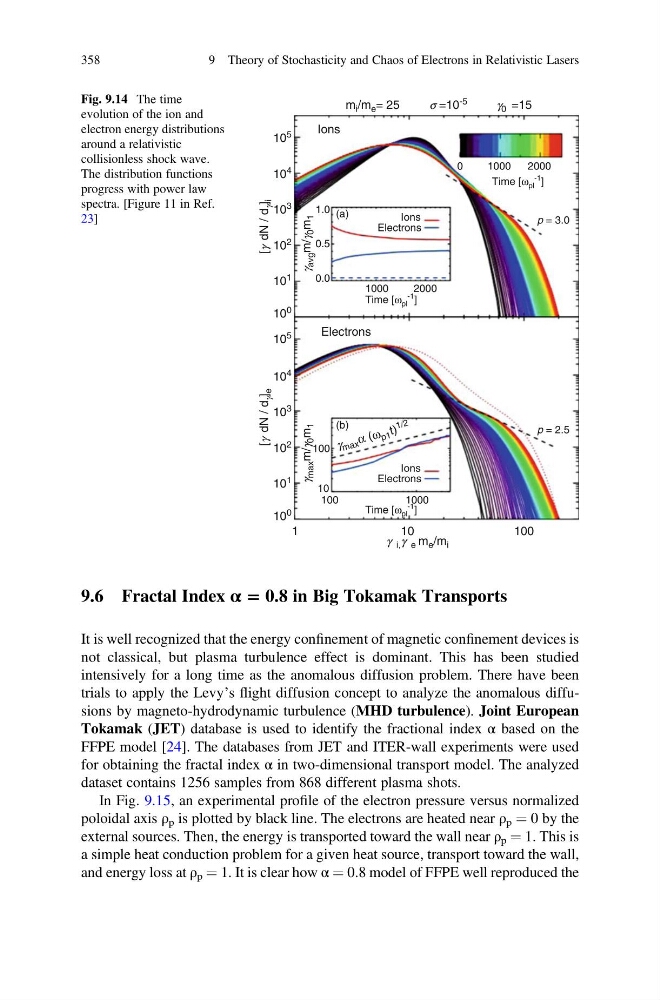
Fig. 9.14 The time
evolution of the ion and
electron energy distributions
around a relativistic
collisionless shock wave.
The distribution functions
progress with power law
spectra. [Figure 11 in Ref.
23]
358
9 Theory of Stochasticity and Chaos of Electrons in Relativistic Lasers
It is well recognized that the energy confinement of magnetic confinement devices is
not classical, but plasma turbulence effect is dominant. This has been studied
intensively for a long time as the anomalous diffusion problem. There have been
trials to apply the Levy’s flight diffusion concept to analyze the anomalous diffusions by magneto-hydrodynamic turbulence (MHD turbulence). Joint European
Tokamak (JET) database is used to identify the fractional index α based on the
FFPE model [24]. The databases from JET and ITER-wall experiments were used
for obtaining the fractal index α in two-dimensional transport model. The analyzed
dataset contains 1256 samples from 868 different plasma shots.
In Fig. 9.15, an experimental profile of the electron pressure versus normalized
poloidal axis ρ p is plotted by black line. The electrons are heated near ρ p ¼ 0 by the
external sources. Then, the energy is transported toward the wall near ρ p ¼ 1. This is
a simple heat conduction problem for a given heat source, transport toward the wall,
and energy loss at ρ p ¼ 1. It is clear how α ¼ 0.8 model of FFPE well reproduced the
10
5
m i /m e = 25
Ions
Ions
Electrons
Ions
Electrons
Electrons
0
1000
1000
Time [ω pl
-1 ]
Time [ω pl
-1 ]
Time [ω pl
-1 ]
p = 3.0
p = 2.5
1.0 (a)
(b)
0.5
0.0
100
10
100
1000
2000
2000
s =10
-5
g 0 =15
g
avg m/g
0 m
1
g
max m/g
0 m
1
[g dN / d
g ]
e
[g dN / d
g ]
i
g i, g e m e /m i
g m ax α (ωp 1 t)
1/ 2
10
4
10
3
10
2
10
1
10
0
10
4
10
3
10
2
10
1
10
0
10
1
100
10 5
Fig. 9.14 The time
evolution of the ion and
electron energy distributions
around a relativistic
collisionless shock wave.
The distribution functions
progress with power law
spectra. [Figure 11 in Ref.
23]
358
9 Theory of Stochasticity and Chaos of Electrons in Relativistic Lasers