

f E
ð Þ ¼
dN
dE
/ E
Àk
ð9:5:1Þ
The observation data fits well as follows:
k ¼ 2:7 for10
10 eV < E < 10
15 eV
ð9:5:2Þ
k ¼ 3:4 for10
15 eV < E < 10
19 eV
ð9:5:3Þ
The power k observed on the earth is the particle energy distribution arriving on the
detectors after an extremely long distance flight in the galaxy and in the space out of
the galaxy. The space is full of turbulence of magnetic field, and the spectra are
affected by transport process. So, roughly saying the power law in the cosmic ray
generation region is inferred to k ~ 2.
Relating to the physics of relativistic collisionless shocks, 2D PIC simulation has
been carried out [22]. The Lorentz factor γ sh of the shock wave is assumed to be
γ sh ¼ 40. The cyclotron motion of electrons and positrons in the downstream emits
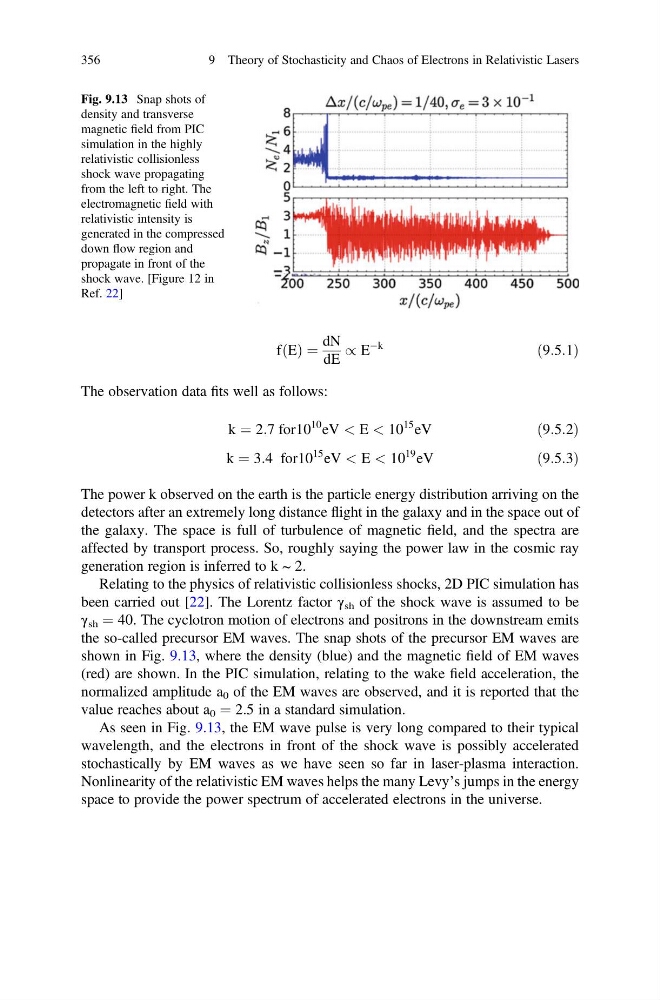
the so-called precursor EM waves. The snap shots of the precursor EM waves are
shown in Fig. 9.13, where the density (blue) and the magnetic field of EM waves
(red) are shown. In the PIC simulation, relating to the wake field acceleration, the
normalized amplitude a 0 of the EM waves are observed, and it is reported that the
value reaches about a 0 ¼ 2.5 in a standard simulation.
As seen in Fig. 9.13, the EM wave pulse is very long compared to their typical
wavelength, and the electrons in front of the shock wave is possibly accelerated
stochastically by EM waves as we have seen so far in laser-plasma interaction.
Nonlinearity of the relativistic EM waves helps the many Levy’s jumps in the energy
space to provide the power spectrum of accelerated electrons in the universe.
Fig. 9.13 Snap shots of
density and transverse
magnetic field from PIC
simulation in the highly
relativistic collisionless
shock wave propagating
from the left to right. The
electromagnetic field with
relativistic intensity is
generated in the compressed
down flow region and
propagate in front of the
shock wave. [Figure 12 in
Ref. 22]
356
9 Theory of Stochasticity and Chaos of Electrons in Relativistic Lasers
ð Þ ¼
dN
dE
/ E
Àk
ð9:5:1Þ
The observation data fits well as follows:
k ¼ 2:7 for10
10 eV < E < 10
15 eV
ð9:5:2Þ
k ¼ 3:4 for10
15 eV < E < 10
19 eV
ð9:5:3Þ
The power k observed on the earth is the particle energy distribution arriving on the
detectors after an extremely long distance flight in the galaxy and in the space out of
the galaxy. The space is full of turbulence of magnetic field, and the spectra are
affected by transport process. So, roughly saying the power law in the cosmic ray
generation region is inferred to k ~ 2.
Relating to the physics of relativistic collisionless shocks, 2D PIC simulation has
been carried out [22]. The Lorentz factor γ sh of the shock wave is assumed to be
γ sh ¼ 40. The cyclotron motion of electrons and positrons in the downstream emits
the so-called precursor EM waves. The snap shots of the precursor EM waves are
shown in Fig. 9.13, where the density (blue) and the magnetic field of EM waves
(red) are shown. In the PIC simulation, relating to the wake field acceleration, the
normalized amplitude a 0 of the EM waves are observed, and it is reported that the
value reaches about a 0 ¼ 2.5 in a standard simulation.
As seen in Fig. 9.13, the EM wave pulse is very long compared to their typical
wavelength, and the electrons in front of the shock wave is possibly accelerated
stochastically by EM waves as we have seen so far in laser-plasma interaction.
Nonlinearity of the relativistic EM waves helps the many Levy’s jumps in the energy
space to provide the power spectrum of accelerated electrons in the universe.
Fig. 9.13 Snap shots of
density and transverse
magnetic field from PIC
simulation in the highly
relativistic collisionless
shock wave propagating
from the left to right. The
electromagnetic field with
relativistic intensity is
generated in the compressed
down flow region and
propagate in front of the
shock wave. [Figure 12 in
Ref. 22]
356
9 Theory of Stochasticity and Chaos of Electrons in Relativistic Lasers