

the downstream of the shocks cannot catch up the relativistic shock to keep many
bouncing in the both regions before and after the shock front. Alternative models
have been proposed, and one of them is directly related to the laser-plasma interaction, namely, so-called wake field acceleration in relativistic plasmas [16, 20].
In the wake field acceleration, large amplitude plasma waves are generated by the
shock waves or else. It has been pointed out that the strong plasma waves can be
induced by the electromagnetic (EM) waves generated at the relativistic collisionless
shocks [21]. What became clear in the study so far in the book is that if the EM
waves produced by the relativistic shock are strong enough and its normalized
amplitude a 0 is larger than unity, the EM waves can directly accelerate the particles
in the universe. If this acceleration is highly stochastic and the energy jumps by
Levy’s flights are expected for a long time, power law spectrum of particle energy
may be reasonable to be produced near the relativistic shock waves.
9.5.1 Relativistic EM Wave Generation by Relativistic Shocks
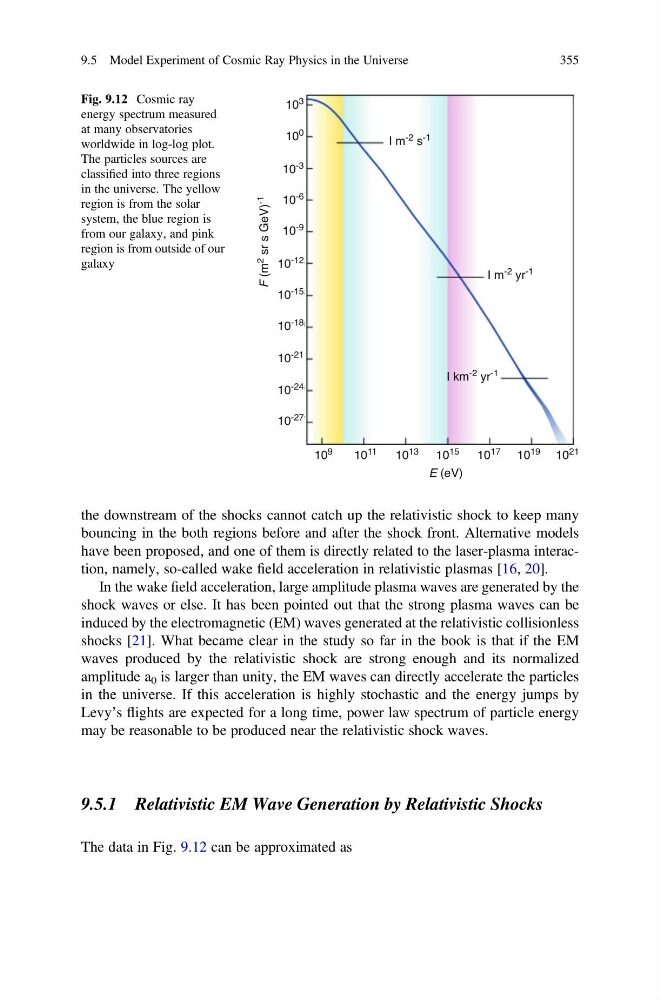
The data in Fig. 9.12 can be approximated as
10
3
10
0
10
-3
10
-6
10
-9
F (m
2
sr s GeV)
-1
10
-12
10 -15
I m
-2 yr
-1
I m -2 s -1
I km
-2 yr
-1
10
-18
10
-21
10
-24
10
-27
10
9
10
11
10
13
E (eV)
10 15 10
17
10
19
10
21
Fig. 9.12 Cosmic ray
energy spectrum measured
at many observatories
worldwide in log-log plot.
The particles sources are
classified into three regions
in the universe. The yellow
region is from the solar
system, the blue region is
from our galaxy, and pink
region is from outside of our
galaxy
9.5 Model Experiment of Cosmic Ray Physics in the Universe
355
bouncing in the both regions before and after the shock front. Alternative models
have been proposed, and one of them is directly related to the laser-plasma interaction, namely, so-called wake field acceleration in relativistic plasmas [16, 20].
In the wake field acceleration, large amplitude plasma waves are generated by the
shock waves or else. It has been pointed out that the strong plasma waves can be
induced by the electromagnetic (EM) waves generated at the relativistic collisionless
shocks [21]. What became clear in the study so far in the book is that if the EM
waves produced by the relativistic shock are strong enough and its normalized
amplitude a 0 is larger than unity, the EM waves can directly accelerate the particles
in the universe. If this acceleration is highly stochastic and the energy jumps by
Levy’s flights are expected for a long time, power law spectrum of particle energy
may be reasonable to be produced near the relativistic shock waves.
9.5.1 Relativistic EM Wave Generation by Relativistic Shocks
The data in Fig. 9.12 can be approximated as
10
3
10
0
10
-3
10
-6
10
-9
F (m
2
sr s GeV)
-1
10
-12
10 -15
I m
-2 yr
-1
I m -2 s -1
I km
-2 yr
-1
10
-18
10
-21
10
-24
10
-27
10
9
10
11
10
13
E (eV)
10 15 10
17
10
19
10
21
Fig. 9.12 Cosmic ray
energy spectrum measured
at many observatories
worldwide in log-log plot.
The particles sources are
classified into three regions
in the universe. The yellow
region is from the solar
system, the blue region is
from our galaxy, and pink
region is from outside of our
galaxy
9.5 Model Experiment of Cosmic Ray Physics in the Universe
355