

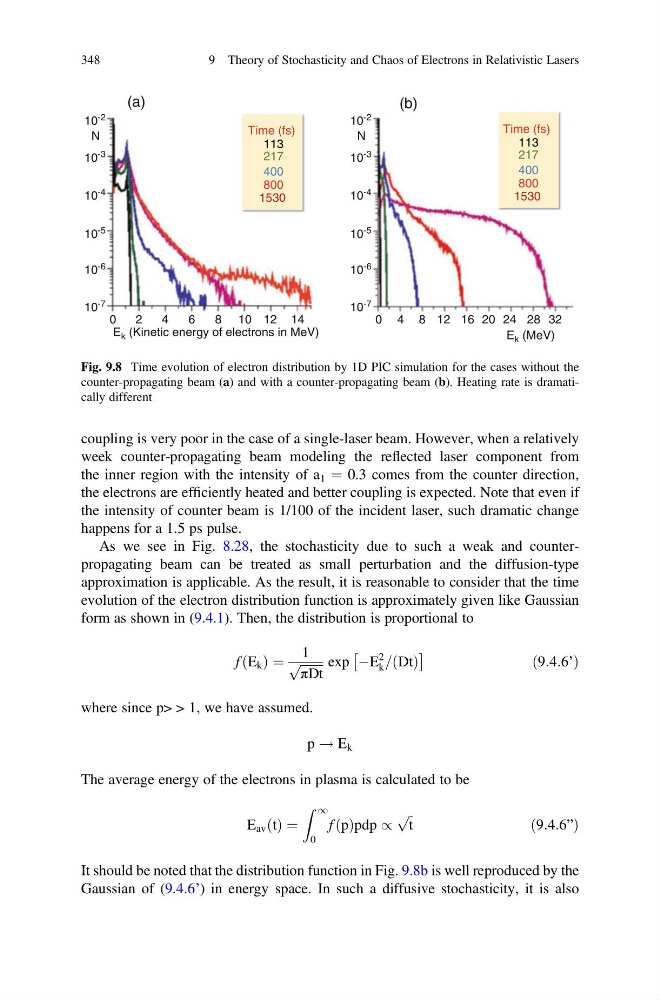
coupling is very poor in the case of a single-laser beam. However, when a relatively
week counter-propagating beam modeling the reflected laser component from
the inner region with the intensity of a 1 ¼ 0.3 comes from the counter direction,
the electrons are efficiently heated and better coupling is expected. Note that even if
the intensity of counter beam is 1/100 of the incident laser, such dramatic change
happens for a 1.5 ps pulse.
As we see in Fig. 8.28, the stochasticity due to such a weak and counterpropagating beam can be treated as small perturbation and the diffusion-type
approximation is applicable. As the result, it is reasonable to consider that the time
evolution of the electron distribution function is approximately given like Gaussian
form as shown in (9.4.1). Then, the distribution is proportional to
f E k
ð Þ ¼
1
ffiffiffiffiffiffiffi ffi
πDt
p
exp ÀE
2
k = Dt
ð Þ
Â
Ã
ð9:4:6’Þ
where since p> > 1, we have assumed.
p ! E k
The average energy of the electrons in plasma is calculated to be
E av t
ð Þ ¼
Z 1
0
f p
ð Þpdp /
ffi ffi
t
p
ð9:4:6”Þ
It should be noted that the distribution function in Fig. 9.8b is well reproduced by the
Gaussian of (9.4.6’) in energy space. In such a diffusive stochasticity, it is also
10
-2
10
-3
N
(a)
(b)
10
-4
10
-5
10
-6
10
-7
10
-2
10
-3
N
Time (fs)
113
217
400
800
1530
Time (fs)
113
217
400
800
1530
10
-4
10
-5
10
-6
10
-7
0
0
2
4
4 8 12 16 20 24 28 32
6
E k (Kinetic energy of electrons in MeV)
E k (MeV)
8 10 12 14
Fig. 9.8 Time evolution of electron distribution by 1D PIC simulation for the cases without the
counter-propagating beam (a) and with a counter-propagating beam (b). Heating rate is dramatically different
348
9 Theory of Stochasticity and Chaos of Electrons in Relativistic Lasers
week counter-propagating beam modeling the reflected laser component from
the inner region with the intensity of a 1 ¼ 0.3 comes from the counter direction,
the electrons are efficiently heated and better coupling is expected. Note that even if
the intensity of counter beam is 1/100 of the incident laser, such dramatic change
happens for a 1.5 ps pulse.
As we see in Fig. 8.28, the stochasticity due to such a weak and counterpropagating beam can be treated as small perturbation and the diffusion-type
approximation is applicable. As the result, it is reasonable to consider that the time
evolution of the electron distribution function is approximately given like Gaussian
form as shown in (9.4.1). Then, the distribution is proportional to
f E k
ð Þ ¼
1
ffiffiffiffiffiffiffi ffi
πDt
p
exp ÀE
2
k = Dt
ð Þ
Â
Ã
ð9:4:6’Þ
where since p> > 1, we have assumed.
p ! E k
The average energy of the electrons in plasma is calculated to be
E av t
ð Þ ¼
Z 1
0
f p
ð Þpdp /
ffi ffi
t
p
ð9:4:6”Þ
It should be noted that the distribution function in Fig. 9.8b is well reproduced by the
Gaussian of (9.4.6’) in energy space. In such a diffusive stochasticity, it is also
10
-2
10
-3
N
(a)
(b)
10
-4
10
-5
10
-6
10
-7
10
-2
10
-3
N
Time (fs)
113
217
400
800
1530
Time (fs)
113
217
400
800
1530
10
-4
10
-5
10
-6
10
-7
0
0
2
4
4 8 12 16 20 24 28 32
6
E k (Kinetic energy of electrons in MeV)
E k (MeV)
8 10 12 14
Fig. 9.8 Time evolution of electron distribution by 1D PIC simulation for the cases without the
counter-propagating beam (a) and with a counter-propagating beam (b). Heating rate is dramatically different
348
9 Theory of Stochasticity and Chaos of Electrons in Relativistic Lasers