

f
α p, t
ð Þ ¼
1
2π
Z 1
À1
exp ÀDt k
j j
α þ ikp
ð
Þ dk
ð9:4:2Þ
This is not integrable analytically except for the case with α ¼ 1 or 2. For a given Dt,
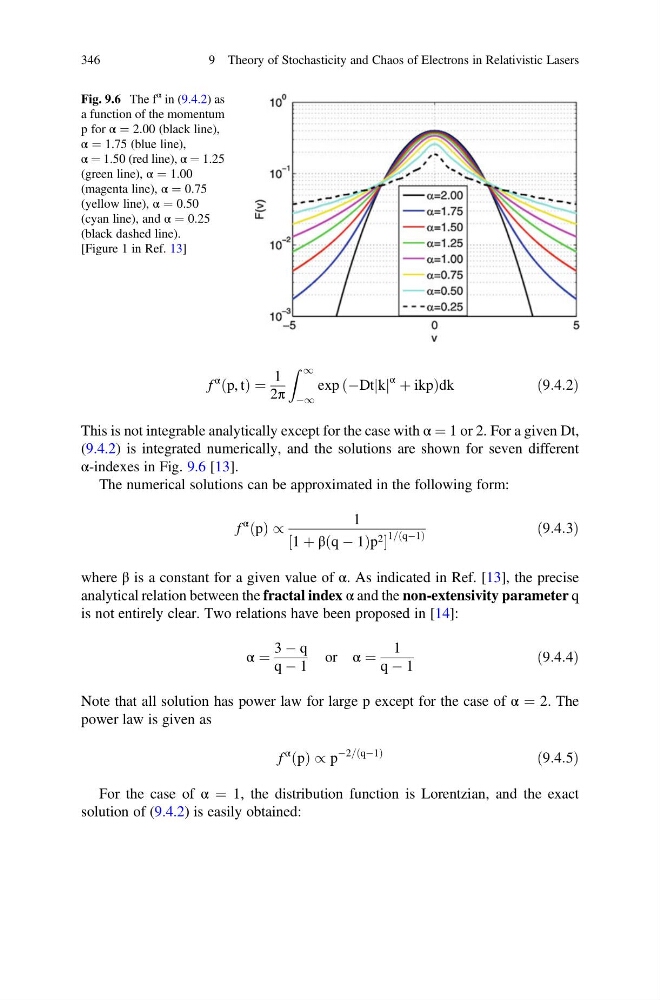
(9.4.2) is integrated numerically, and the solutions are shown for seven different
α-indexes in Fig. 9.6 [13].
The numerical solutions can be approximated in the following form:
f
α p
ð Þ /
1
1 þ β q À 1
ð
Þp 2
½
1= qÀ1
ð
Þ
ð9:4:3Þ
where β is a constant for a given value of α. As indicated in Ref. [13], the precise
analytical relation between the fractal index α and the non-extensivity parameter q
is not entirely clear. Two relations have been proposed in [14]:
α ¼
3 À q
q À 1
or α ¼
1
q À 1
ð9:4:4Þ
Note that all solution has power law for large p except for the case of α ¼ 2. The
power law is given as
f
α p
ð Þ / p
À2= qÀ1
ð
Þ
ð9:4:5Þ
For the case of α ¼ 1, the distribution function is Lorentzian, and the exact
solution of (9.4.2) is easily obtained:
Fig. 9.6 The f
α in (9.4.2) as
a function of the momentum
p for α ¼ 2.00 (black line),
α ¼ 1.75 (blue line),
α ¼ 1.50 (red line), α ¼ 1.25
(green line), α ¼ 1.00
(magenta line), α ¼ 0.75
(yellow line), α ¼ 0.50
(cyan line), and α ¼ 0.25
(black dashed line).
[Figure 1 in Ref. 13]
346
9 Theory of Stochasticity and Chaos of Electrons in Relativistic Lasers
α p, t
ð Þ ¼
1
2π
Z 1
À1
exp ÀDt k
j j
α þ ikp
ð
Þ dk
ð9:4:2Þ
This is not integrable analytically except for the case with α ¼ 1 or 2. For a given Dt,
(9.4.2) is integrated numerically, and the solutions are shown for seven different
α-indexes in Fig. 9.6 [13].
The numerical solutions can be approximated in the following form:
f
α p
ð Þ /
1
1 þ β q À 1
ð
Þp 2
½
1= qÀ1
ð
Þ
ð9:4:3Þ
where β is a constant for a given value of α. As indicated in Ref. [13], the precise
analytical relation between the fractal index α and the non-extensivity parameter q
is not entirely clear. Two relations have been proposed in [14]:
α ¼
3 À q
q À 1
or α ¼
1
q À 1
ð9:4:4Þ
Note that all solution has power law for large p except for the case of α ¼ 2. The
power law is given as
f
α p
ð Þ / p
À2= qÀ1
ð
Þ
ð9:4:5Þ
For the case of α ¼ 1, the distribution function is Lorentzian, and the exact
solution of (9.4.2) is easily obtained:
Fig. 9.6 The f
α in (9.4.2) as
a function of the momentum
p for α ¼ 2.00 (black line),
α ¼ 1.75 (blue line),
α ¼ 1.50 (red line), α ¼ 1.25
(green line), α ¼ 1.00
(magenta line), α ¼ 0.75
(yellow line), α ¼ 0.50
(cyan line), and α ¼ 0.25
(black dashed line).
[Figure 1 in Ref. 13]
346
9 Theory of Stochasticity and Chaos of Electrons in Relativistic Lasers