

Δp x
n
¼ ÀΔ
n cos ξ
γ
n
ð9:1:8Þ
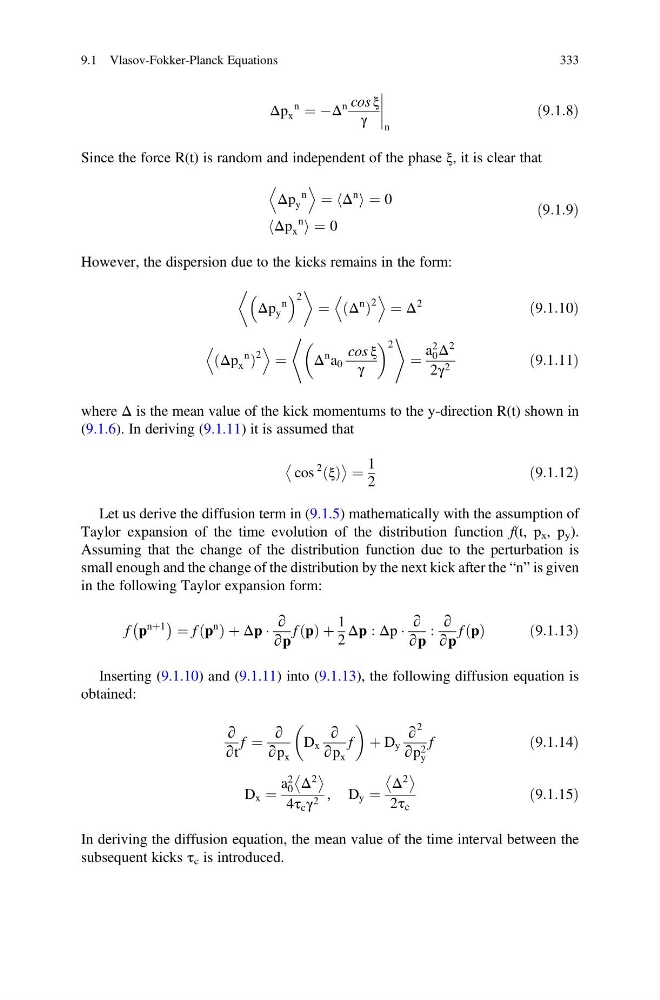
Since the force R(t) is random and independent of the phase ξ, it is clear that
Δp y
n
D
E
¼ Δ
n
h i ¼ 0
Δp x
n
h
i¼ 0
ð9:1:9Þ
However, the dispersion due to the kicks remains in the form:
Δp y
n
2
(
)
¼ Δ
n
ð Þ
2
D
E
¼ Δ
2
ð9:1:10Þ
Δp x
n
ð
Þ
2
D
E
¼
Δ
n a 0
cos ξ
γ
2
*
+
¼
a
2
0 Δ
2
2γ 2
ð9:1:11Þ
where Δ is the mean value of the kick momentums to the y-direction R(t) shown in
(9.1.6). In deriving (9.1.11) it is assumed that
cos
2
ξ
ð Þ
¼
1
2
ð9:1:12Þ
Let us derive the diffusion term in (9.1.5) mathematically with the assumption of
Taylor expansion of the time evolution of the distribution function f(t, p x , p y ).
Assuming that the change of the distribution function due to the perturbation is
small enough and the change of the distribution by the next kick after the “n” is given
in the following Taylor expansion form:
f p
nþ1
À
Á ¼ f p
n
ð Þ þ Δp Á
∂
∂p
f p
ð Þ þ
1
2
Δp : Δp Á
∂
∂p
:
∂
∂p
f p
ð Þ
ð9:1:13Þ
Inserting (9.1.10) and (9.1.11) into (9.1.13), the following diffusion equation is
obtained:
∂
∂t
f ¼
∂
∂p x
D x
∂
∂p x
f
þ D y
∂
2
∂p 2
y
f
ð9:1:14Þ
D x ¼
a
2
0 Δ
2
4τ c γ 2 , D y ¼
Δ
2
2τ c
ð9:1:15Þ
In deriving the diffusion equation, the mean value of the time interval between the
subsequent kicks τ c is introduced.
9.1 Vlasov-Fokker-Planck Equations
333
n
¼ ÀΔ
n cos ξ
γ
n
ð9:1:8Þ
Since the force R(t) is random and independent of the phase ξ, it is clear that
Δp y
n
D
E
¼ Δ
n
h i ¼ 0
Δp x
n
h
i¼ 0
ð9:1:9Þ
However, the dispersion due to the kicks remains in the form:
Δp y
n
2
(
)
¼ Δ
n
ð Þ
2
D
E
¼ Δ
2
ð9:1:10Þ
Δp x
n
ð
Þ
2
D
E
¼
Δ
n a 0
cos ξ
γ
2
*
+
¼
a
2
0 Δ
2
2γ 2
ð9:1:11Þ
where Δ is the mean value of the kick momentums to the y-direction R(t) shown in
(9.1.6). In deriving (9.1.11) it is assumed that
cos
2
ξ
ð Þ
¼
1
2
ð9:1:12Þ
Let us derive the diffusion term in (9.1.5) mathematically with the assumption of
Taylor expansion of the time evolution of the distribution function f(t, p x , p y ).
Assuming that the change of the distribution function due to the perturbation is
small enough and the change of the distribution by the next kick after the “n” is given
in the following Taylor expansion form:
f p
nþ1
À
Á ¼ f p
n
ð Þ þ Δp Á
∂
∂p
f p
ð Þ þ
1
2
Δp : Δp Á
∂
∂p
:
∂
∂p
f p
ð Þ
ð9:1:13Þ
Inserting (9.1.10) and (9.1.11) into (9.1.13), the following diffusion equation is
obtained:
∂
∂t
f ¼
∂
∂p x
D x
∂
∂p x
f
þ D y
∂
2
∂p 2
y
f
ð9:1:14Þ
D x ¼
a
2
0 Δ
2
4τ c γ 2 , D y ¼
Δ
2
2τ c
ð9:1:15Þ
In deriving the diffusion equation, the mean value of the time interval between the
subsequent kicks τ c is introduced.
9.1 Vlasov-Fokker-Planck Equations
333