

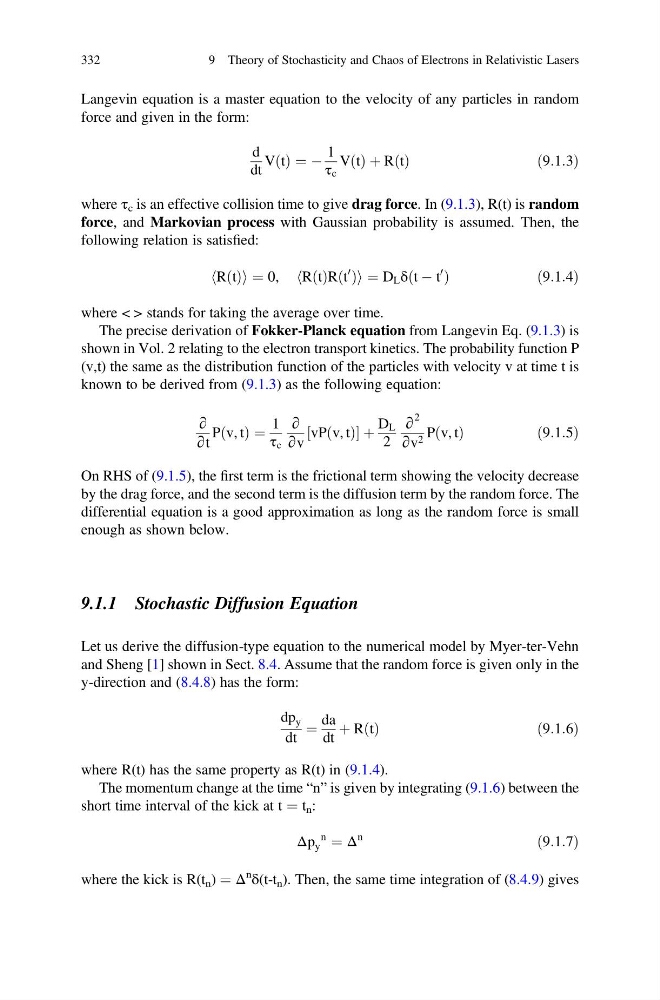
Langevin equation is a master equation to the velocity of any particles in random
force and given in the form:
d
dt
V t
ð Þ ¼ À
1
τ c
V t
ð Þ þ R t
ð Þ
ð9:1:3Þ
where τ c is an effective collision time to give drag force. In (9.1.3), R(t) is random
force, and Markovian process with Gaussian probability is assumed. Then, the
following relation is satisfied:
R t
ð Þ
h
i ¼ 0,
R t
ð ÞR t
0
ð Þ
h
i¼ D L δ t À t
0
ð
Þ
ð9:1:4Þ
where < > stands for taking the average over time.
The precise derivation of Fokker-Planck equation from Langevin Eq. (9.1.3) is
shown in Vol. 2 relating to the electron transport kinetics. The probability function P
(v,t) the same as the distribution function of the particles with velocity v at time t is
known to be derived from (9.1.3) as the following equation:
∂
∂t
P v, t
ð Þ ¼
1
τ c
∂
∂v
vP v, t
ð Þ
½
þ
D L
2
∂
2
∂v 2 P v, t
ð Þ
ð9:1:5Þ
On RHS of (9.1.5), the first term is the frictional term showing the velocity decrease
by the drag force, and the second term is the diffusion term by the random force. The
differential equation is a good approximation as long as the random force is small
enough as shown below.
9.1.1 Stochastic Diffusion Equation
Let us derive the diffusion-type equation to the numerical model by Myer-ter-Vehn
and Sheng [1] shown in Sect. 8.4. Assume that the random force is given only in the
y-direction and (8.4.8) has the form:
dp y
dt
¼
da
dt
þ R t
ð Þ
ð9:1:6Þ
where R(t) has the same property as R(t) in (9.1.4).
The momentum change at the time “n” is given by integrating (9.1.6) between the
short time interval of the kick at t ¼ t n :
Δp y
n
¼ Δ
n
ð9:1:7Þ
where the kick is R(t n ) ¼ Δ
n
δ(t-t n ). Then, the same time integration of (8.4.9) gives
332
9 Theory of Stochasticity and Chaos of Electrons in Relativistic Lasers
force and given in the form:
d
dt
V t
ð Þ ¼ À
1
τ c
V t
ð Þ þ R t
ð Þ
ð9:1:3Þ
where τ c is an effective collision time to give drag force. In (9.1.3), R(t) is random
force, and Markovian process with Gaussian probability is assumed. Then, the
following relation is satisfied:
R t
ð Þ
h
i ¼ 0,
R t
ð ÞR t
0
ð Þ
h
i¼ D L δ t À t
0
ð
Þ
ð9:1:4Þ
where < > stands for taking the average over time.
The precise derivation of Fokker-Planck equation from Langevin Eq. (9.1.3) is
shown in Vol. 2 relating to the electron transport kinetics. The probability function P
(v,t) the same as the distribution function of the particles with velocity v at time t is
known to be derived from (9.1.3) as the following equation:
∂
∂t
P v, t
ð Þ ¼
1
τ c
∂
∂v
vP v, t
ð Þ
½
þ
D L
2
∂
2
∂v 2 P v, t
ð Þ
ð9:1:5Þ
On RHS of (9.1.5), the first term is the frictional term showing the velocity decrease
by the drag force, and the second term is the diffusion term by the random force. The
differential equation is a good approximation as long as the random force is small
enough as shown below.
9.1.1 Stochastic Diffusion Equation
Let us derive the diffusion-type equation to the numerical model by Myer-ter-Vehn
and Sheng [1] shown in Sect. 8.4. Assume that the random force is given only in the
y-direction and (8.4.8) has the form:
dp y
dt
¼
da
dt
þ R t
ð Þ
ð9:1:6Þ
where R(t) has the same property as R(t) in (9.1.4).
The momentum change at the time “n” is given by integrating (9.1.6) between the
short time interval of the kick at t ¼ t n :
Δp y
n
¼ Δ
n
ð9:1:7Þ
where the kick is R(t n ) ¼ Δ
n
δ(t-t n ). Then, the same time integration of (8.4.9) gives
332
9 Theory of Stochasticity and Chaos of Electrons in Relativistic Lasers