

case, a laser is irradiated to thin plasma so that the laser passes through the plasma
and no reflection. The stochastic heating is not observed. In the second case, two
lasers are irradiated from both of front and rear. Then, stochastic heating is observed.
In the third case, thick plasma is used to reflect the incident laser. The stochastic
heating is also observed.
It is proposed that using such colliding lasers from two directions enhances the
hot electron temperature and is beneficial to target normal sheath acceleration of
protons [25].
8.7.4 Hot Electron Temperature Scaling
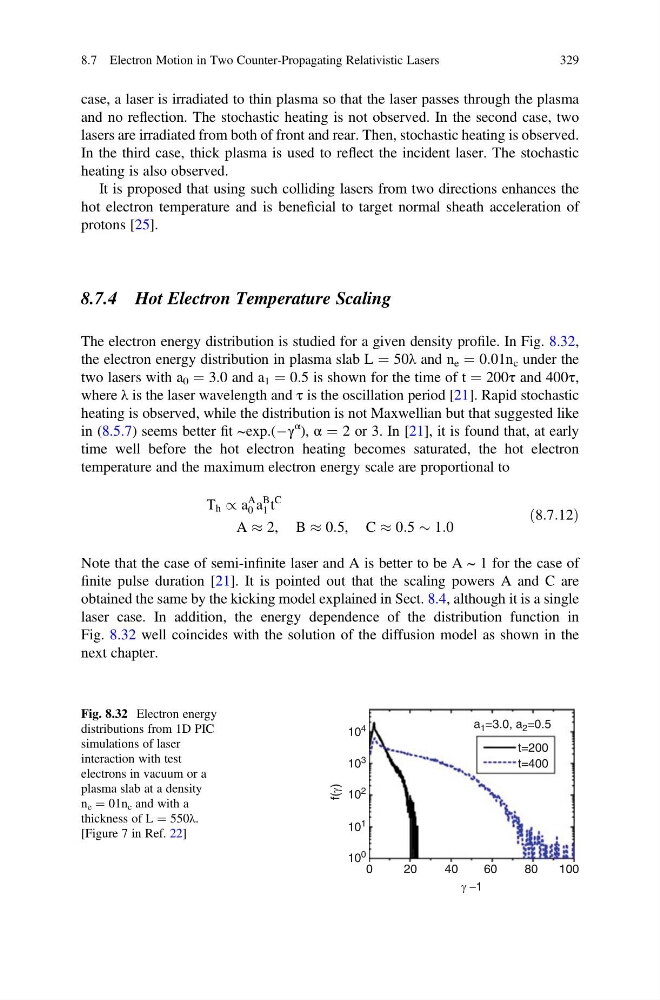
The electron energy distribution is studied for a given density profile. In Fig. 8.32,
the electron energy distribution in plasma slab L ¼ 50λ and n e ¼ 0.01n c under the
two lasers with a 0 ¼ 3.0 and a 1 ¼ 0.5 is shown for the time of t ¼ 200τ and 400τ,
where λ is the laser wavelength and τ is the oscillation period [21]. Rapid stochastic
heating is observed, while the distribution is not Maxwellian but that suggested like
in (8.5.7) seems better fit ~exp.(Àγ
α
), α ¼ 2 or 3. In [21], it is found that, at early
time well before the hot electron heating becomes saturated, the hot electron
temperature and the maximum electron energy scale are proportional to
T h / a
A
0 a
B
1 t
C
A % 2, B % 0:5, C % 0:5 $ 1:0
ð8:7:12Þ
Note that the case of semi-infinite laser and A is better to be A ~ 1 for the case of
finite pulse duration [21]. It is pointed out that the scaling powers A and C are
obtained the same by the kicking model explained in Sect. 8.4, although it is a single
laser case. In addition, the energy dependence of the distribution function in
Fig. 8.32 well coincides with the solution of the diffusion model as shown in the
next chapter.
10
4
10
3
10
2
10
1
10 0
0
20
40
60
80
100
a 1 =3.0, a 2 =0.5
t=200
t=400
f(γ)
γ −1
Fig. 8.32 Electron energy
distributions from 1D PIC
simulations of laser
interaction with test
electrons in vacuum or a
plasma slab at a density
n e ¼ 01n c and with a
thickness of L ¼ 550λ.
[Figure 7 in Ref. 22]
8.7 Electron Motion in Two Counter-Propagating Relativistic Lasers
329
and no reflection. The stochastic heating is not observed. In the second case, two
lasers are irradiated from both of front and rear. Then, stochastic heating is observed.
In the third case, thick plasma is used to reflect the incident laser. The stochastic
heating is also observed.
It is proposed that using such colliding lasers from two directions enhances the
hot electron temperature and is beneficial to target normal sheath acceleration of
protons [25].
8.7.4 Hot Electron Temperature Scaling
The electron energy distribution is studied for a given density profile. In Fig. 8.32,
the electron energy distribution in plasma slab L ¼ 50λ and n e ¼ 0.01n c under the
two lasers with a 0 ¼ 3.0 and a 1 ¼ 0.5 is shown for the time of t ¼ 200τ and 400τ,
where λ is the laser wavelength and τ is the oscillation period [21]. Rapid stochastic
heating is observed, while the distribution is not Maxwellian but that suggested like
in (8.5.7) seems better fit ~exp.(Àγ
α
), α ¼ 2 or 3. In [21], it is found that, at early
time well before the hot electron heating becomes saturated, the hot electron
temperature and the maximum electron energy scale are proportional to
T h / a
A
0 a
B
1 t
C
A % 2, B % 0:5, C % 0:5 $ 1:0
ð8:7:12Þ
Note that the case of semi-infinite laser and A is better to be A ~ 1 for the case of
finite pulse duration [21]. It is pointed out that the scaling powers A and C are
obtained the same by the kicking model explained in Sect. 8.4, although it is a single
laser case. In addition, the energy dependence of the distribution function in
Fig. 8.32 well coincides with the solution of the diffusion model as shown in the
next chapter.
10
4
10
3
10
2
10
1
10 0
0
20
40
60
80
100
a 1 =3.0, a 2 =0.5
t=200
t=400
f(γ)
γ −1
Fig. 8.32 Electron energy
distributions from 1D PIC
simulations of laser
interaction with test
electrons in vacuum or a
plasma slab at a density
n e ¼ 01n c and with a
thickness of L ¼ 550λ.
[Figure 7 in Ref. 22]
8.7 Electron Motion in Two Counter-Propagating Relativistic Lasers
329