

tends to be broken up to small filaments. This is already computed related to the
experiment shown in Fig. 7.19, and 3D PIC simulation shows that the laser beam is
broken up to several beamlets in the pre-formed plasma before approaching the solid
target surface [14]. However, the situation is more complicated whether
the filamentation instability finally breaks up the relativistic laser to filaments in
the low-density pre-formed plasma region or the filaments tend to coalescence due to
the additional factor appearing in the laser channel. Let us consider the effect of
electron acceleration and resultant magnetic field around the self-focused laser
channel.
In the same experiment, static magnetic field of 35 MG is also measured by use of
Faraday rotation technique [30]. It is well accepted that the magnetic field is
produced along the laser channel by 2D and 3D PIC simulations. In the
pre-formed plasma in front of solid targets, it is demonstrated that the absorption
is very much enhanced and most of the absorbed energy is used to generate the hot
electrons. Except for the JxB heating process, which theoretically concludes the hot
electron temperature is given by the ponderomotive scaling in (7.4.4), most of the
cases show the hot electron energy is higher than the JxB heating one. There should
be another efficient acceleration mechanism in laser-plasma interaction in the
pre-formed plasmas. Let us consider briefly the physics expected in the laser channel
in the pre-formed subcritical density plasmas.
When a relativistic laser is impinged from the vacuum to the pre-formed plasmas,
low-density electrons are pushed toward higher-density region as explained in
Chap. 6 by assuming one dimension. In the multi-dimensional case, the laser is
finite size, and the charge separation due to the moving of electrons in the laser
channel can be compensated by the electrons from the outside of the laser channel. If
the charge depletion due to the accelerated electrons with almost the velocity of V d in
(5.3.25) in the channel is compensated by the electrons from the outside, the hot
electrons with the velocity V d , namely,
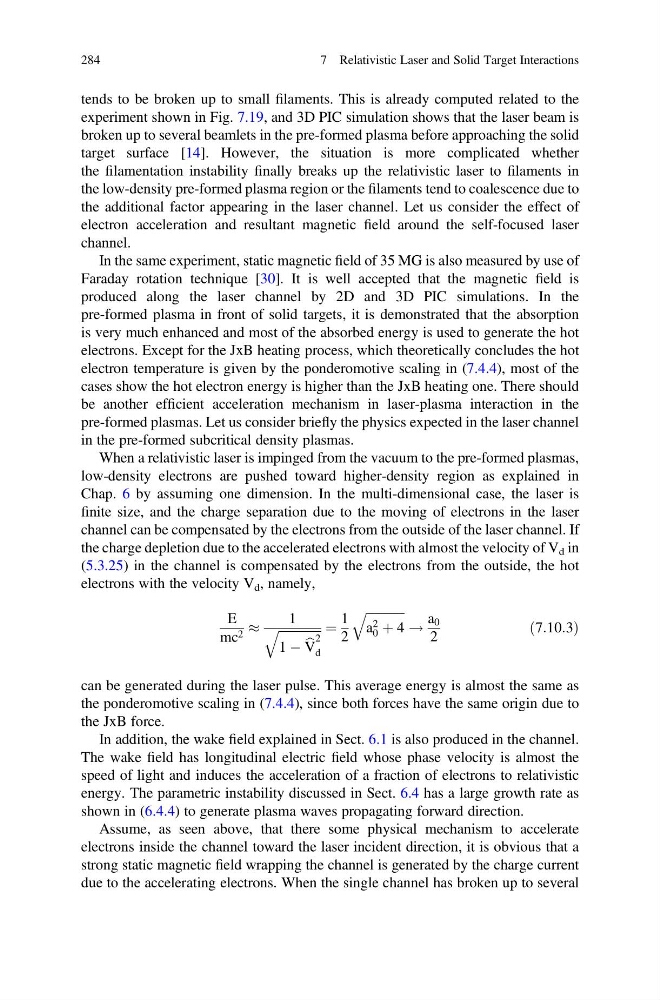
E
mc 2 %
1
ffiffiffiffiffiffiffiffiffiffiffiffiffiffi
1 À b
V
2
d
q
¼
1
2
ffiffiffiffiffiffiffiffiffiffiffiffi ffi
a 2
0 þ 4
q
!
a 0
2
ð7:10:3Þ
can be generated during the laser pulse. This average energy is almost the same as
the ponderomotive scaling in (7.4.4), since both forces have the same origin due to
the JxB force.
In addition, the wake field explained in Sect. 6.1 is also produced in the channel.
The wake field has longitudinal electric field whose phase velocity is almost the
speed of light and induces the acceleration of a fraction of electrons to relativistic
energy. The parametric instability discussed in Sect. 6.4 has a large growth rate as
shown in (6.4.4) to generate plasma waves propagating forward direction.
Assume, as seen above, that there some physical mechanism to accelerate
electrons inside the channel toward the laser incident direction, it is obvious that a
strong static magnetic field wrapping the channel is generated by the charge current
due to the accelerating electrons. When the single channel has broken up to several
284
7 Relativistic Laser and Solid Target Interactions
experiment shown in Fig. 7.19, and 3D PIC simulation shows that the laser beam is
broken up to several beamlets in the pre-formed plasma before approaching the solid
target surface [14]. However, the situation is more complicated whether
the filamentation instability finally breaks up the relativistic laser to filaments in
the low-density pre-formed plasma region or the filaments tend to coalescence due to
the additional factor appearing in the laser channel. Let us consider the effect of
electron acceleration and resultant magnetic field around the self-focused laser
channel.
In the same experiment, static magnetic field of 35 MG is also measured by use of
Faraday rotation technique [30]. It is well accepted that the magnetic field is
produced along the laser channel by 2D and 3D PIC simulations. In the
pre-formed plasma in front of solid targets, it is demonstrated that the absorption
is very much enhanced and most of the absorbed energy is used to generate the hot
electrons. Except for the JxB heating process, which theoretically concludes the hot
electron temperature is given by the ponderomotive scaling in (7.4.4), most of the
cases show the hot electron energy is higher than the JxB heating one. There should
be another efficient acceleration mechanism in laser-plasma interaction in the
pre-formed plasmas. Let us consider briefly the physics expected in the laser channel
in the pre-formed subcritical density plasmas.
When a relativistic laser is impinged from the vacuum to the pre-formed plasmas,
low-density electrons are pushed toward higher-density region as explained in
Chap. 6 by assuming one dimension. In the multi-dimensional case, the laser is
finite size, and the charge separation due to the moving of electrons in the laser
channel can be compensated by the electrons from the outside of the laser channel. If
the charge depletion due to the accelerated electrons with almost the velocity of V d in
(5.3.25) in the channel is compensated by the electrons from the outside, the hot
electrons with the velocity V d , namely,
E
mc 2 %
1
ffiffiffiffiffiffiffiffiffiffiffiffiffiffi
1 À b
V
2
d
q
¼
1
2
ffiffiffiffiffiffiffiffiffiffiffiffi ffi
a 2
0 þ 4
q
!
a 0
2
ð7:10:3Þ
can be generated during the laser pulse. This average energy is almost the same as
the ponderomotive scaling in (7.4.4), since both forces have the same origin due to
the JxB force.
In addition, the wake field explained in Sect. 6.1 is also produced in the channel.
The wake field has longitudinal electric field whose phase velocity is almost the
speed of light and induces the acceleration of a fraction of electrons to relativistic
energy. The parametric instability discussed in Sect. 6.4 has a large growth rate as
shown in (6.4.4) to generate plasma waves propagating forward direction.
Assume, as seen above, that there some physical mechanism to accelerate
electrons inside the channel toward the laser incident direction, it is obvious that a
strong static magnetic field wrapping the channel is generated by the charge current
due to the accelerating electrons. When the single channel has broken up to several
284
7 Relativistic Laser and Solid Target Interactions