

like counter stream with the hot electrons. It is well-known that such counter
streaming in collisionless plasma induces a plasma instability called as Weibel
instability. The detail of Weibel instability will be shown later. Simply saying,
such counter stream is unstable to small perturbation of the magnetic field in the
direction perpendicular to the flow velocities. The kinetic energy of the both flows is
converted to the energy of magnetic field until a nonlinear saturation terminates
Weibel instability.
It is informative to show a schematic picture showing the physical mechanism of
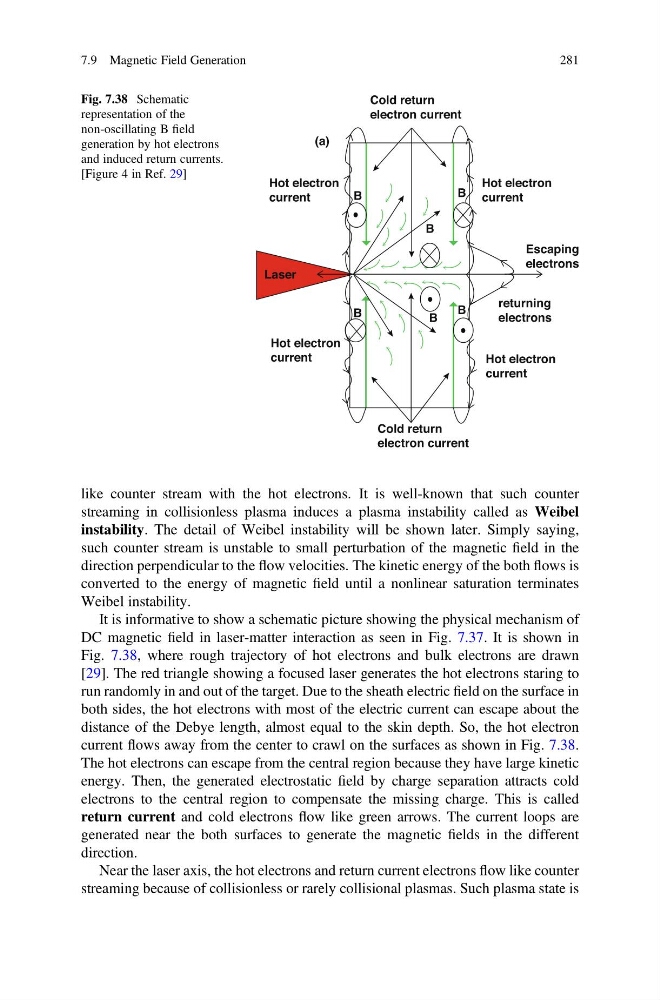
DC magnetic field in laser-matter interaction as seen in Fig. 7.37. It is shown in
Fig. 7.38, where rough trajectory of hot electrons and bulk electrons are drawn
[29]. The red triangle showing a focused laser generates the hot electrons staring to
run randomly in and out of the target. Due to the sheath electric field on the surface in
both sides, the hot electrons with most of the electric current can escape about the
distance of the Debye length, almost equal to the skin depth. So, the hot electron
current flows away from the center to crawl on the surfaces as shown in Fig. 7.38.
The hot electrons can escape from the central region because they have large kinetic
energy. Then, the generated electrostatic field by charge separation attracts cold
electrons to the central region to compensate the missing charge. This is called
return current and cold electrons flow like green arrows. The current loops are
generated near the both surfaces to generate the magnetic fields in the different
direction.
Near the laser axis, the hot electrons and return current electrons flow like counter
streaming because of collisionless or rarely collisional plasmas. Such plasma state is
Hot electron
current
Hot electron
current
Cold return
electron current
Cold return
electron current
Hot electron
current
Laser
Hot electron
current
B
(a)
B
B
B
B
B
Escaping
electrons
returning
electrons
Fig. 7.38 Schematic
representation of the
non-oscillating B field
generation by hot electrons
and induced return currents.
[Figure 4 in Ref. 29]
7.9 Magnetic Field Generation
281
streaming in collisionless plasma induces a plasma instability called as Weibel
instability. The detail of Weibel instability will be shown later. Simply saying,
such counter stream is unstable to small perturbation of the magnetic field in the
direction perpendicular to the flow velocities. The kinetic energy of the both flows is
converted to the energy of magnetic field until a nonlinear saturation terminates
Weibel instability.
It is informative to show a schematic picture showing the physical mechanism of
DC magnetic field in laser-matter interaction as seen in Fig. 7.37. It is shown in
Fig. 7.38, where rough trajectory of hot electrons and bulk electrons are drawn
[29]. The red triangle showing a focused laser generates the hot electrons staring to
run randomly in and out of the target. Due to the sheath electric field on the surface in
both sides, the hot electrons with most of the electric current can escape about the
distance of the Debye length, almost equal to the skin depth. So, the hot electron
current flows away from the center to crawl on the surfaces as shown in Fig. 7.38.
The hot electrons can escape from the central region because they have large kinetic
energy. Then, the generated electrostatic field by charge separation attracts cold
electrons to the central region to compensate the missing charge. This is called
return current and cold electrons flow like green arrows. The current loops are
generated near the both surfaces to generate the magnetic fields in the different
direction.
Near the laser axis, the hot electrons and return current electrons flow like counter
streaming because of collisionless or rarely collisional plasmas. Such plasma state is
Hot electron
current
Hot electron
current
Cold return
electron current
Cold return
electron current
Hot electron
current
Laser
Hot electron
current
B
(a)
B
B
B
B
B
Escaping
electrons
returning
electrons
Fig. 7.38 Schematic
representation of the
non-oscillating B field
generation by hot electrons
and induced return currents.
[Figure 4 in Ref. 29]
7.9 Magnetic Field Generation
281