

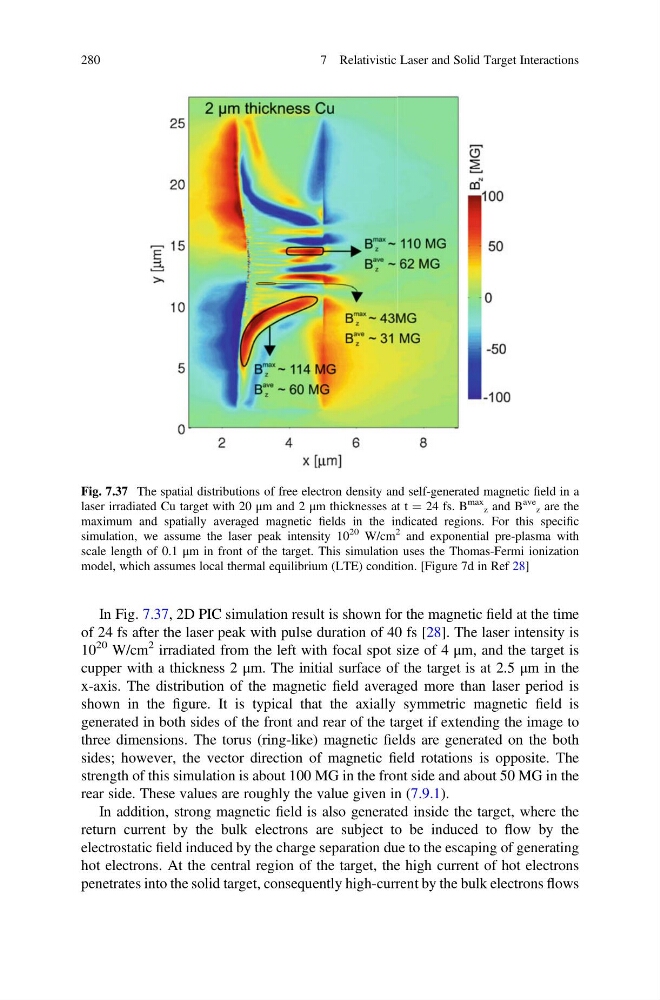
In Fig. 7.37, 2D PIC simulation result is shown for the magnetic field at the time
of 24 fs after the laser peak with pulse duration of 40 fs [28]. The laser intensity is
10
20 W/cm
2 irradiated from the left with focal spot size of 4 μm, and the target is
cupper with a thickness 2 μm. The initial surface of the target is at 2.5 μm in the
x-axis. The distribution of the magnetic field averaged more than laser period is
shown in the figure. It is typical that the axially symmetric magnetic field is
generated in both sides of the front and rear of the target if extending the image to
three dimensions. The torus (ring-like) magnetic fields are generated on the both
sides; however, the vector direction of magnetic field rotations is opposite. The
strength of this simulation is about 100 MG in the front side and about 50 MG in the
rear side. These values are roughly the value given in (7.9.1).
In addition, strong magnetic field is also generated inside the target, where the
return current by the bulk electrons are subject to be induced to flow by the
electrostatic field induced by the charge separation due to the escaping of generating
hot electrons. At the central region of the target, the high current of hot electrons
penetrates into the solid target, consequently high-current by the bulk electrons flows
Fig. 7.37 The spatial distributions of free electron density and self-generated magnetic field in a
laser irradiated Cu target with 20 μm and 2 μm thicknesses at t ¼ 24 fs. B
max
z and B
ave
z are the
maximum and spatially averaged magnetic fields in the indicated regions. For this specific
simulation, we assume the laser peak intensity 10
20 W/cm
2 and exponential pre-plasma with
scale length of 0.1 μm in front of the target. This simulation uses the Thomas-Fermi ionization
model, which assumes local thermal equilibrium (LTE) condition. [Figure 7d in Ref 28]
280
7 Relativistic Laser and Solid Target Interactions
of 24 fs after the laser peak with pulse duration of 40 fs [28]. The laser intensity is
10
20 W/cm
2 irradiated from the left with focal spot size of 4 μm, and the target is
cupper with a thickness 2 μm. The initial surface of the target is at 2.5 μm in the
x-axis. The distribution of the magnetic field averaged more than laser period is
shown in the figure. It is typical that the axially symmetric magnetic field is
generated in both sides of the front and rear of the target if extending the image to
three dimensions. The torus (ring-like) magnetic fields are generated on the both
sides; however, the vector direction of magnetic field rotations is opposite. The
strength of this simulation is about 100 MG in the front side and about 50 MG in the
rear side. These values are roughly the value given in (7.9.1).
In addition, strong magnetic field is also generated inside the target, where the
return current by the bulk electrons are subject to be induced to flow by the
electrostatic field induced by the charge separation due to the escaping of generating
hot electrons. At the central region of the target, the high current of hot electrons
penetrates into the solid target, consequently high-current by the bulk electrons flows
Fig. 7.37 The spatial distributions of free electron density and self-generated magnetic field in a
laser irradiated Cu target with 20 μm and 2 μm thicknesses at t ¼ 24 fs. B
max
z and B
ave
z are the
maximum and spatially averaged magnetic fields in the indicated regions. For this specific
simulation, we assume the laser peak intensity 10
20 W/cm
2 and exponential pre-plasma with
scale length of 0.1 μm in front of the target. This simulation uses the Thomas-Fermi ionization
model, which assumes local thermal equilibrium (LTE) condition. [Figure 7d in Ref 28]
280
7 Relativistic Laser and Solid Target Interactions