

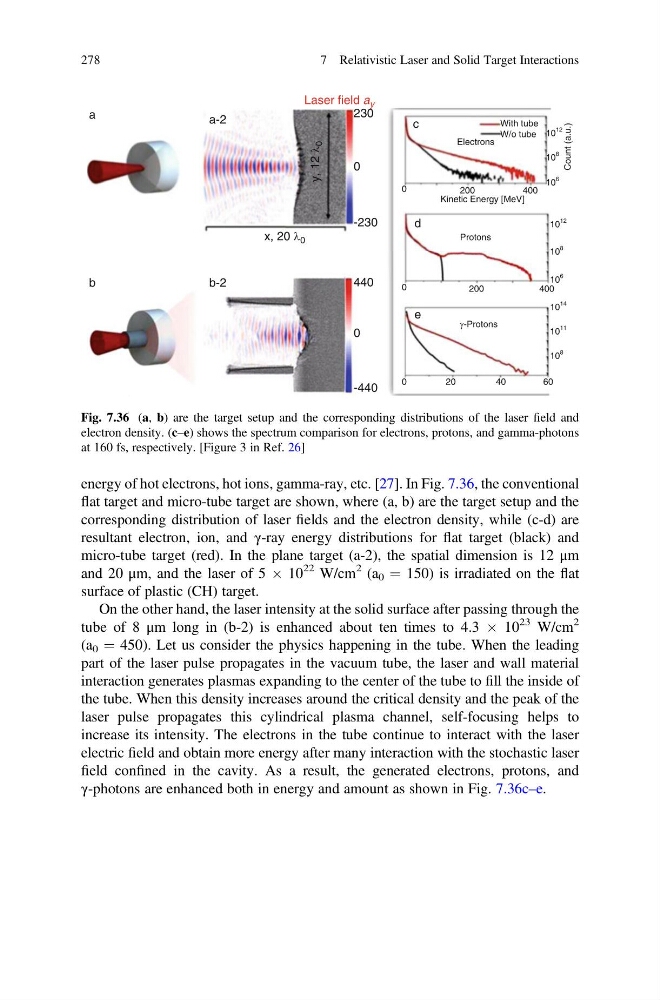
energy of hot electrons, hot ions, gamma-ray, etc. [27]. In Fig. 7.36, the conventional
flat target and micro-tube target are shown, where (a, b) are the target setup and the
corresponding distribution of laser fields and the electron density, while (c-d) are
resultant electron, ion, and γ-ray energy distributions for flat target (black) and
micro-tube target (red). In the plane target (a-2), the spatial dimension is 12 μm
and 20 μm, and the laser of 5 Â 10
22 W/cm
2 (a 0 ¼ 150) is irradiated on the flat
surface of plastic (CH) target.
On the other hand, the laser intensity at the solid surface after passing through the
tube of 8 μm long in (b-2) is enhanced about ten times to 4.3 Â 10
23 W/cm
2
(a 0 ¼ 450). Let us consider the physics happening in the tube. When the leading
part of the laser pulse propagates in the vacuum tube, the laser and wall material
interaction generates plasmas expanding to the center of the tube to fill the inside of
the tube. When this density increases around the critical density and the peak of the
laser pulse propagates this cylindrical plasma channel, self-focusing helps to
increase its intensity. The electrons in the tube continue to interact with the laser
electric field and obtain more energy after many interaction with the stochastic laser
field confined in the cavity. As a result, the generated electrons, protons, and
γ-photons are enhanced both in energy and amount as shown in Fig. 7.36c–e.
a
a-2
230
Laser field a y
-230
-440
440
0
x, 20 λ 0
y, 12
λ
0
0
c
d
e
0
200
Electrons
Protons
γ-Protons
Count (a.u.)
Kinetic Energy [MeV]
With tube
W/o tube
400
0
0
200
20
40
60
400
10
12
10
8
10
6
10
12
10
8
10
6
10
14
10
11
10
8
b
b - 2
Fig. 7.36 (a, b) are the target setup and the corresponding distributions of the laser field and
electron density. (c–e) shows the spectrum comparison for electrons, protons, and gamma-photons
at 160 fs, respectively. [Figure 3 in Ref. 26]
278
7 Relativistic Laser and Solid Target Interactions
flat target and micro-tube target are shown, where (a, b) are the target setup and the
corresponding distribution of laser fields and the electron density, while (c-d) are
resultant electron, ion, and γ-ray energy distributions for flat target (black) and
micro-tube target (red). In the plane target (a-2), the spatial dimension is 12 μm
and 20 μm, and the laser of 5 Â 10
22 W/cm
2 (a 0 ¼ 150) is irradiated on the flat
surface of plastic (CH) target.
On the other hand, the laser intensity at the solid surface after passing through the
tube of 8 μm long in (b-2) is enhanced about ten times to 4.3 Â 10
23 W/cm
2
(a 0 ¼ 450). Let us consider the physics happening in the tube. When the leading
part of the laser pulse propagates in the vacuum tube, the laser and wall material
interaction generates plasmas expanding to the center of the tube to fill the inside of
the tube. When this density increases around the critical density and the peak of the
laser pulse propagates this cylindrical plasma channel, self-focusing helps to
increase its intensity. The electrons in the tube continue to interact with the laser
electric field and obtain more energy after many interaction with the stochastic laser
field confined in the cavity. As a result, the generated electrons, protons, and
γ-photons are enhanced both in energy and amount as shown in Fig. 7.36c–e.
a
a-2
230
Laser field a y
-230
-440
440
0
x, 20 λ 0
y, 12
λ
0
0
c
d
e
0
200
Electrons
Protons
γ-Protons
Count (a.u.)
Kinetic Energy [MeV]
With tube
W/o tube
400
0
0
200
20
40
60
400
10
12
10
8
10
6
10
12
10
8
10
6
10
14
10
11
10
8
b
b - 2
Fig. 7.36 (a, b) are the target setup and the corresponding distributions of the laser field and
electron density. (c–e) shows the spectrum comparison for electrons, protons, and gamma-photons
at 160 fs, respectively. [Figure 3 in Ref. 26]
278
7 Relativistic Laser and Solid Target Interactions