

Let us see the physics demonstrated by 2D PIC simulation. In Fig. 7.33, laser
electric field distributions are plotted for (a) 1 Â 10
17 W/cm
2 (a 0 ¼ 0.24) and
(b) 2 Â 10
18 W/cm
2 (a 0 ¼ 1.2) cases at the same time when the irradiated laser
intensity is the half of the peak intensity in the front half of the pulse. The vacuum
space between pillars is 2.5 μm, and the thickness of the pillar is 1.5 μm. The figure is
stretched to the direction of y and the length of the pillars is 30 μm. The
corresponding electron density profiles are plotted in (c) and (d), respectively. It is
clear that in the space we don’t see much of electrons in the low-intensity case (c) so
that the laser fields almost freely propagate in the space. On the other hand, at higher
intensity in (d), the electrons with the density less than the critical density are filled in
the space; consequently the laser field propagates under the affection of phase
modification and absorption by the electrons in space.
The advantage of the micro-pillar target is that the accelerated electrons are
confined in the inside of the pillar structure and do not escape, because highdensity ion charge confined the electrons produced in the space region. This has
been demonstrated in Fig. 7.34, where three time snap shots of hot electrons
(E > 100 keV) are plotted. The laser intensity is 2 Â 10
18 W/cm
2 (a 0 ¼ 1.2) and
its pulse duration is 500 fs. The three times in Fig. 7.34 are (a) À450 fs, (b) À250 fs,
and (c) 0 fs (intensity peak). The sheath electric field surrounding each pillar surface
attracts the electrons in the space to the inside of the pillar and keeps them inside the
pillars by the same sheath field. In Fig. 7.34, it is seen that the hot electron density is
higher in the pillar structure compared to the space as clear in (c).
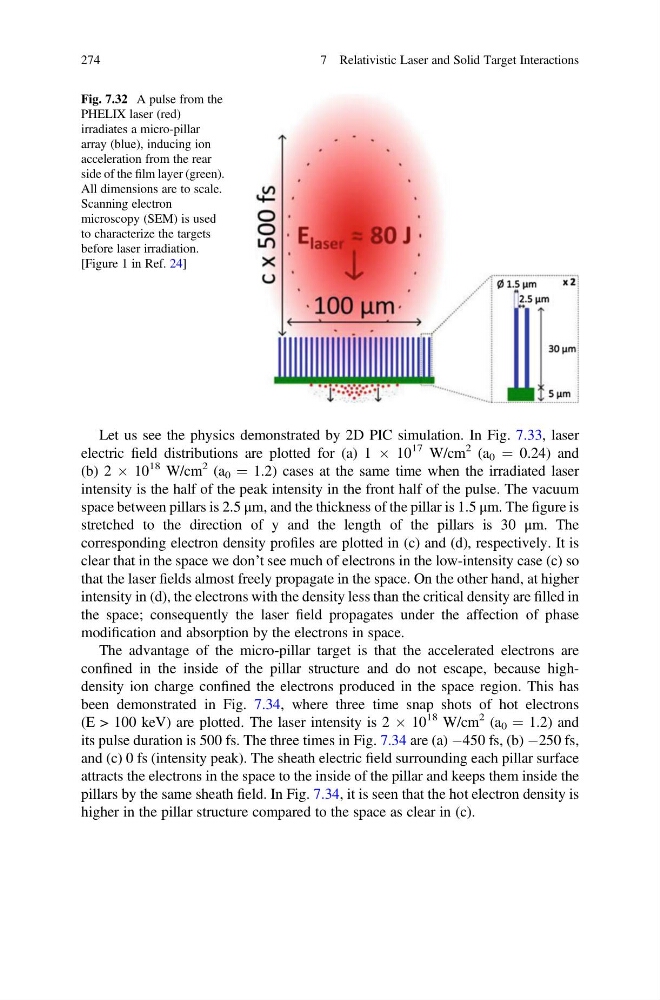
Fig. 7.32 A pulse from the
PHELIX laser (red)
irradiates a micro-pillar
array (blue), inducing ion
acceleration from the rear
side of the film layer (green).
All dimensions are to scale.
Scanning electron
microscopy (SEM) is used
to characterize the targets
before laser irradiation.
[Figure 1 in Ref. 24]
274
7 Relativistic Laser and Solid Target Interactions
electric field distributions are plotted for (a) 1 Â 10
17 W/cm
2 (a 0 ¼ 0.24) and
(b) 2 Â 10
18 W/cm
2 (a 0 ¼ 1.2) cases at the same time when the irradiated laser
intensity is the half of the peak intensity in the front half of the pulse. The vacuum
space between pillars is 2.5 μm, and the thickness of the pillar is 1.5 μm. The figure is
stretched to the direction of y and the length of the pillars is 30 μm. The
corresponding electron density profiles are plotted in (c) and (d), respectively. It is
clear that in the space we don’t see much of electrons in the low-intensity case (c) so
that the laser fields almost freely propagate in the space. On the other hand, at higher
intensity in (d), the electrons with the density less than the critical density are filled in
the space; consequently the laser field propagates under the affection of phase
modification and absorption by the electrons in space.
The advantage of the micro-pillar target is that the accelerated electrons are
confined in the inside of the pillar structure and do not escape, because highdensity ion charge confined the electrons produced in the space region. This has
been demonstrated in Fig. 7.34, where three time snap shots of hot electrons
(E > 100 keV) are plotted. The laser intensity is 2 Â 10
18 W/cm
2 (a 0 ¼ 1.2) and
its pulse duration is 500 fs. The three times in Fig. 7.34 are (a) À450 fs, (b) À250 fs,
and (c) 0 fs (intensity peak). The sheath electric field surrounding each pillar surface
attracts the electrons in the space to the inside of the pillar and keeps them inside the
pillars by the same sheath field. In Fig. 7.34, it is seen that the hot electron density is
higher in the pillar structure compared to the space as clear in (c).
Fig. 7.32 A pulse from the
PHELIX laser (red)
irradiates a micro-pillar
array (blue), inducing ion
acceleration from the rear
side of the film layer (green).
All dimensions are to scale.
Scanning electron
microscopy (SEM) is used
to characterize the targets
before laser irradiation.
[Figure 1 in Ref. 24]
274
7 Relativistic Laser and Solid Target Interactions