

η ab %
I þ À I À
I þ
¼
I þ þ I À
ð
ÞÀ2I À
I þ þ I À
ð
ÞÀI À
ð7:5:4Þ
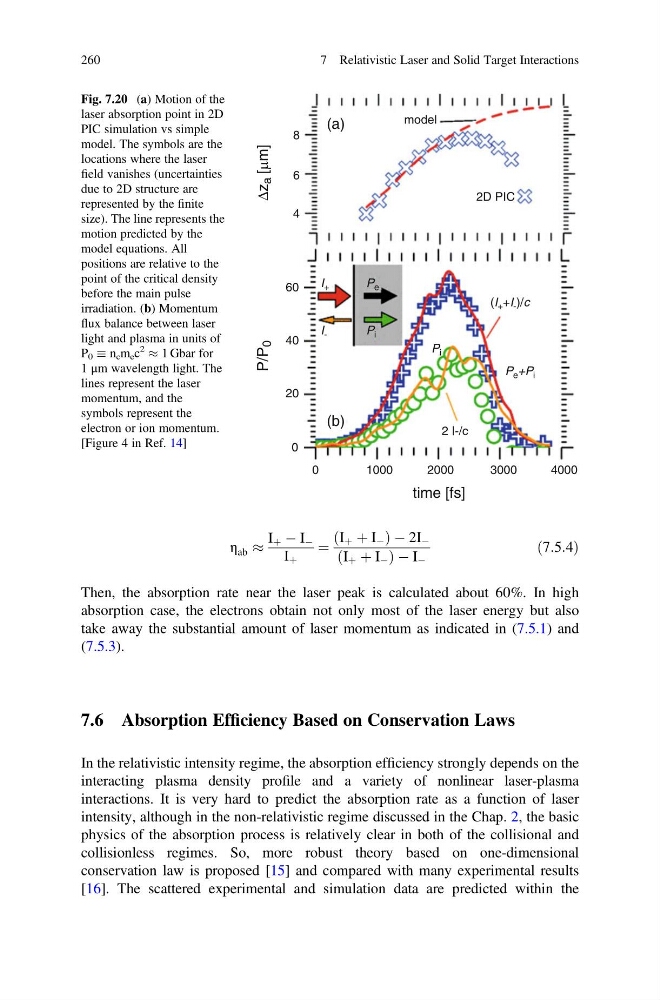
Then, the absorption rate near the laser peak is calculated about 60%. In high
absorption case, the electrons obtain not only most of the laser energy but also
take away the substantial amount of laser momentum as indicated in (7.5.1) and
(7.5.3).
7.6 Absorption Efficiency Based on Conservation Laws
In the relativistic intensity regime, the absorption efficiency strongly depends on the
interacting plasma density profile and a variety of nonlinear laser-plasma
interactions. It is very hard to predict the absorption rate as a function of laser
intensity, although in the non-relativistic regime discussed in the Chap. 2, the basic
physics of the absorption process is relatively clear in both of the collisional and
collisionless regimes. So, more robust theory based on one-dimensional
conservation law is proposed [15] and compared with many experimental results
[16]. The scattered experimental and simulation data are predicted within the
8
(a)
model
2D PIC
(I + +I - )/c
I +
P e
P i
P i
2 |-/c
P e +P i
I -
(b)
60
40
20
0
0
1000
time [fs]
P/P
0
Δz
a [μm]
2000
3000
4000
6
4
Fig. 7.20 (a) Motion of the
laser absorption point in 2D
PIC simulation vs simple
model. The symbols are the
locations where the laser
field vanishes (uncertainties
due to 2D structure are
represented by the finite
size). The line represents the
motion predicted by the
model equations. All
positions are relative to the
point of the critical density
before the main pulse
irradiation. (b) Momentum
flux balance between laser
light and plasma in units of
P 0 n c m e c
2 % 1 Gbar for
1 μm wavelength light. The
lines represent the laser
momentum, and the
symbols represent the
electron or ion momentum.
[Figure 4 in Ref. 14]
260
7 Relativistic Laser and Solid Target Interactions
I þ À I À
I þ
¼
I þ þ I À
ð
ÞÀ2I À
I þ þ I À
ð
ÞÀI À
ð7:5:4Þ
Then, the absorption rate near the laser peak is calculated about 60%. In high
absorption case, the electrons obtain not only most of the laser energy but also
take away the substantial amount of laser momentum as indicated in (7.5.1) and
(7.5.3).
7.6 Absorption Efficiency Based on Conservation Laws
In the relativistic intensity regime, the absorption efficiency strongly depends on the
interacting plasma density profile and a variety of nonlinear laser-plasma
interactions. It is very hard to predict the absorption rate as a function of laser
intensity, although in the non-relativistic regime discussed in the Chap. 2, the basic
physics of the absorption process is relatively clear in both of the collisional and
collisionless regimes. So, more robust theory based on one-dimensional
conservation law is proposed [15] and compared with many experimental results
[16]. The scattered experimental and simulation data are predicted within the
8
(a)
model
2D PIC
(I + +I - )/c
I +
P e
P i
P i
2 |-/c
P e +P i
I -
(b)
60
40
20
0
0
1000
time [fs]
P/P
0
Δz
a [μm]
2000
3000
4000
6
4
Fig. 7.20 (a) Motion of the
laser absorption point in 2D
PIC simulation vs simple
model. The symbols are the
locations where the laser
field vanishes (uncertainties
due to 2D structure are
represented by the finite
size). The line represents the
motion predicted by the
model equations. All
positions are relative to the
point of the critical density
before the main pulse
irradiation. (b) Momentum
flux balance between laser
light and plasma in units of
P 0 n c m e c
2 % 1 Gbar for
1 μm wavelength light. The
lines represent the laser
momentum, and the
symbols represent the
electron or ion momentum.
[Figure 4 in Ref. 14]
260
7 Relativistic Laser and Solid Target Interactions