

and re-circulating acceleration in the interaction region, difference of the spectra for
a short pulse heating has been simulated. In Fig. 7.11b the resultant spectra for the
same condition as Fig. 7.11a except for the laser pulse length being 30 fs are shown.
The same spectra are obtained, since there is not enough time for re-circulation of
high-energy electrons in the target even for the larger laser-focusing diameter.
The re-circulation of high-energy electrons are simulated with 1D PIC code to
compare with the experimental data of relatively long pulse (3 ps) at intensity of
2.3 Â 10
18 W/cm
2 [10]. The experiment has been done with LFEX laser consisting of
four beams of 200 J/beam and 1.5 ps pulse duration. The purpose of the experiment
is to demonstrate higher energy and higher efficiency of multi-tens MeV proton
beam production. The energy increase of proton beam is caused by the energy
increase of hot electrons. In order to enhance the hot electron temperature via the
re-circulation heating, two beams are combined with a delay to form the flattop peak
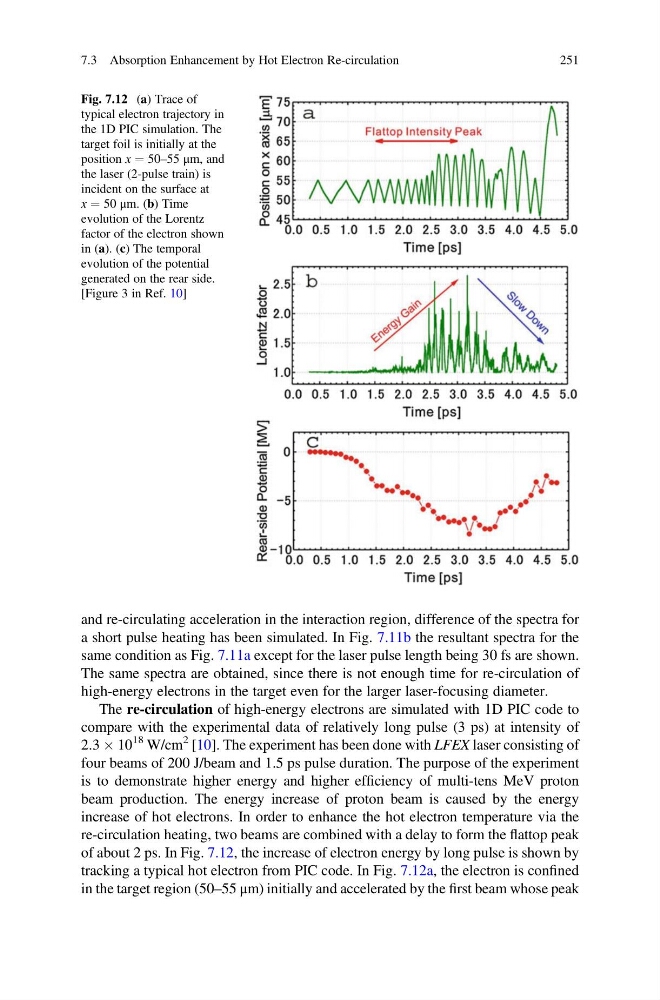
of about 2 ps. In Fig. 7.12, the increase of electron energy by long pulse is shown by
tracking a typical hot electron from PIC code. In Fig. 7.12a, the electron is confined
in the target region (50–55 μm) initially and accelerated by the first beam whose peak
Fig. 7.12 (a) Trace of
typical electron trajectory in
the 1D PIC simulation. The
target foil is initially at the
position x ¼ 50–55 μm, and
the laser (2-pulse train) is
incident on the surface at
x ¼ 50 μm. (b) Time
evolution of the Lorentz
factor of the electron shown
in (a). (c) The temporal
evolution of the potential
generated on the rear side.
[Figure 3 in Ref. 10]
7.3 Absorption Enhancement by Hot Electron Re-circulation
251
a short pulse heating has been simulated. In Fig. 7.11b the resultant spectra for the
same condition as Fig. 7.11a except for the laser pulse length being 30 fs are shown.
The same spectra are obtained, since there is not enough time for re-circulation of
high-energy electrons in the target even for the larger laser-focusing diameter.
The re-circulation of high-energy electrons are simulated with 1D PIC code to
compare with the experimental data of relatively long pulse (3 ps) at intensity of
2.3 Â 10
18 W/cm
2 [10]. The experiment has been done with LFEX laser consisting of
four beams of 200 J/beam and 1.5 ps pulse duration. The purpose of the experiment
is to demonstrate higher energy and higher efficiency of multi-tens MeV proton
beam production. The energy increase of proton beam is caused by the energy
increase of hot electrons. In order to enhance the hot electron temperature via the
re-circulation heating, two beams are combined with a delay to form the flattop peak
of about 2 ps. In Fig. 7.12, the increase of electron energy by long pulse is shown by
tracking a typical hot electron from PIC code. In Fig. 7.12a, the electron is confined
in the target region (50–55 μm) initially and accelerated by the first beam whose peak
Fig. 7.12 (a) Trace of
typical electron trajectory in
the 1D PIC simulation. The
target foil is initially at the
position x ¼ 50–55 μm, and
the laser (2-pulse train) is
incident on the surface at
x ¼ 50 μm. (b) Time
evolution of the Lorentz
factor of the electron shown
in (a). (c) The temporal
evolution of the potential
generated on the rear side.
[Figure 3 in Ref. 10]
7.3 Absorption Enhancement by Hot Electron Re-circulation
251