

λ s %
ffiffiffiffi ffi
γ 0
p
c
ω p0
¼
ffiffiffiffi ffi
γ 0
p ρ s
ð6:6:5Þ
It is noted that the skin depth is extended by the relativistic effect compared to the
non-relativistic plasma skin depth ρ s ¼ c/ω p0 .
The magnetic field in the solid region is easily obtained as
B z ¼
∂A
∂x
¼
m
e
∂a
∂x
ð6:6:6Þ
Note that RHS in (6.6.6) is continuous at the sharp boundary x ¼ 0 and the magnetic
field also continuously changes across the boundary; however, the derivative is in
general not continuous due to a surface current.
It is noted that to obtain the field structure from the vacuum to the solid region, it
is necessary to solve wave equation including the phase of the waves. As an
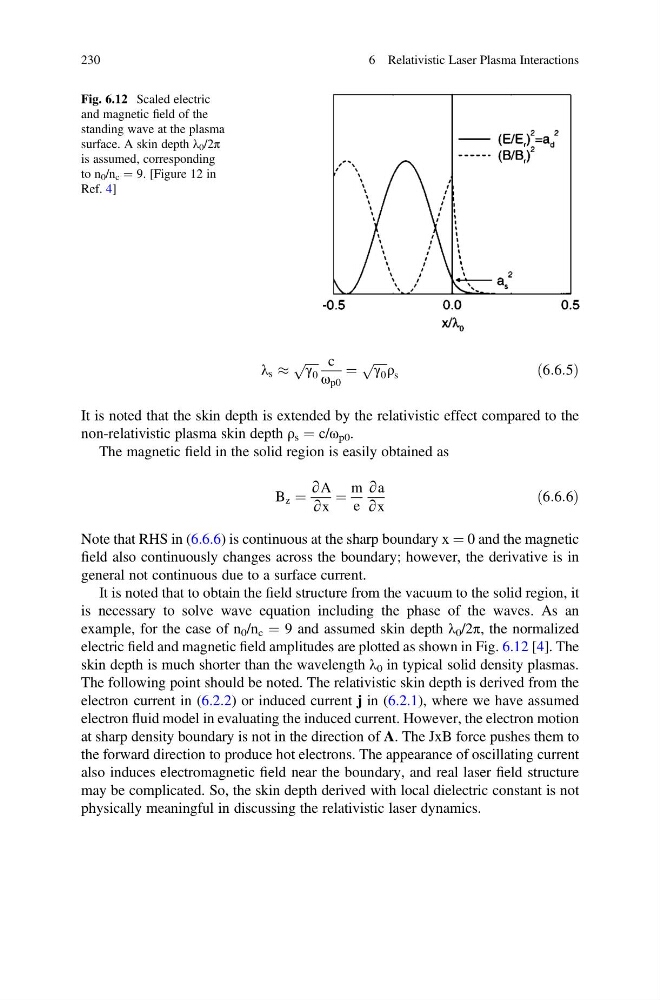
example, for the case of n 0 /n c ¼ 9 and assumed skin depth λ 0 /2π, the normalized
electric field and magnetic field amplitudes are plotted as shown in Fig. 6.12 [4]. The
skin depth is much shorter than the wavelength λ 0 in typical solid density plasmas.
The following point should be noted. The relativistic skin depth is derived from the
electron current in (6.2.2) or induced current j in (6.2.1), where we have assumed
electron fluid model in evaluating the induced current. However, the electron motion
at sharp density boundary is not in the direction of A. The JxB force pushes them to
the forward direction to produce hot electrons. The appearance of oscillating current
also induces electromagnetic field near the boundary, and real laser field structure
may be complicated. So, the skin depth derived with local dielectric constant is not
physically meaningful in discussing the relativistic laser dynamics.
Fig. 6.12 Scaled electric
and magnetic field of the
standing wave at the plasma
surface. A skin depth λ 0 /2π
is assumed, corresponding
to n 0 /n c ¼ 9. [Figure 12 in
Ref. 4]
230
6 Relativistic Laser Plasma Interactions
ffiffiffiffi ffi
γ 0
p
c
ω p0
¼
ffiffiffiffi ffi
γ 0
p ρ s
ð6:6:5Þ
It is noted that the skin depth is extended by the relativistic effect compared to the
non-relativistic plasma skin depth ρ s ¼ c/ω p0 .
The magnetic field in the solid region is easily obtained as
B z ¼
∂A
∂x
¼
m
e
∂a
∂x
ð6:6:6Þ
Note that RHS in (6.6.6) is continuous at the sharp boundary x ¼ 0 and the magnetic
field also continuously changes across the boundary; however, the derivative is in
general not continuous due to a surface current.
It is noted that to obtain the field structure from the vacuum to the solid region, it
is necessary to solve wave equation including the phase of the waves. As an
example, for the case of n 0 /n c ¼ 9 and assumed skin depth λ 0 /2π, the normalized
electric field and magnetic field amplitudes are plotted as shown in Fig. 6.12 [4]. The
skin depth is much shorter than the wavelength λ 0 in typical solid density plasmas.
The following point should be noted. The relativistic skin depth is derived from the
electron current in (6.2.2) or induced current j in (6.2.1), where we have assumed
electron fluid model in evaluating the induced current. However, the electron motion
at sharp density boundary is not in the direction of A. The JxB force pushes them to
the forward direction to produce hot electrons. The appearance of oscillating current
also induces electromagnetic field near the boundary, and real laser field structure
may be complicated. So, the skin depth derived with local dielectric constant is not
physically meaningful in discussing the relativistic laser dynamics.
Fig. 6.12 Scaled electric
and magnetic field of the
standing wave at the plasma
surface. A skin depth λ 0 /2π
is assumed, corresponding
to n 0 /n c ¼ 9. [Figure 12 in
Ref. 4]
230
6 Relativistic Laser Plasma Interactions