

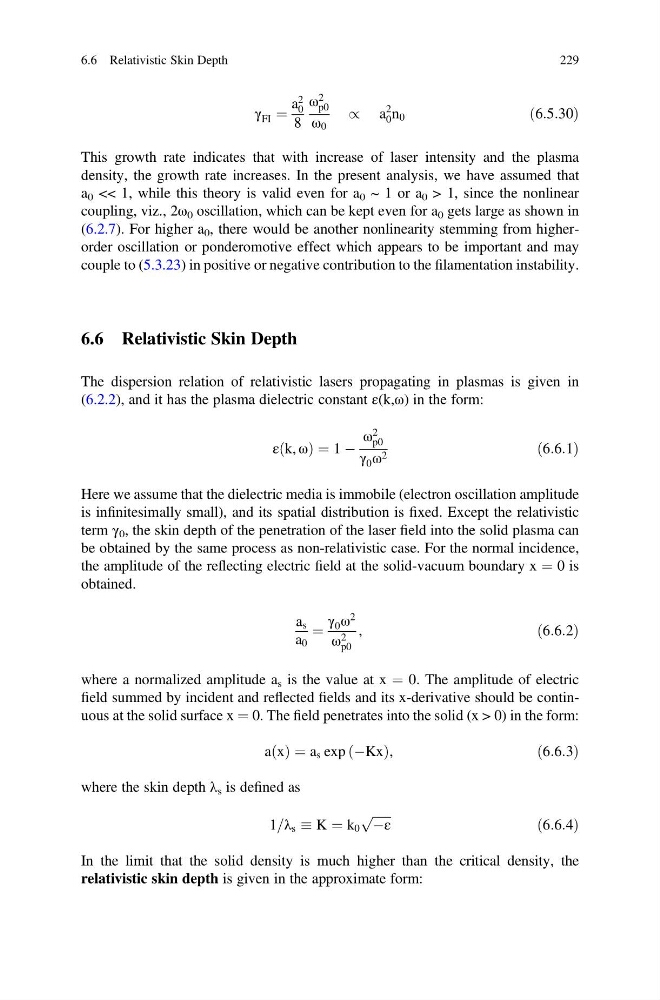
γ FI ¼
a
2
0
8
ω
2
p0
ω 0
/ a
2
0 n 0
ð6:5:30Þ
This growth rate indicates that with increase of laser intensity and the plasma
density, the growth rate increases. In the present analysis, we have assumed that
a 0 << 1, while this theory is valid even for a 0 ~ 1 or a 0 > 1, since the nonlinear
coupling, viz., 2ω 0 oscillation, which can be kept even for a 0 gets large as shown in
(6.2.7). For higher a 0 , there would be another nonlinearity stemming from higherorder oscillation or ponderomotive effect which appears to be important and may
couple to (5.3.23) in positive or negative contribution to the filamentation instability.
6.6 Relativistic Skin Depth
The dispersion relation of relativistic lasers propagating in plasmas is given in
(6.2.2), and it has the plasma dielectric constant ε(k,ω) in the form:
ε k, ω
ð
Þ ¼ 1 À
ω
2
p0
γ 0 ω 2
ð6:6:1Þ
Here we assume that the dielectric media is immobile (electron oscillation amplitude
is infinitesimally small), and its spatial distribution is fixed. Except the relativistic
term γ 0 , the skin depth of the penetration of the laser field into the solid plasma can
be obtained by the same process as non-relativistic case. For the normal incidence,
the amplitude of the reflecting electric field at the solid-vacuum boundary x ¼ 0 is
obtained.
a s
a 0
¼
γ 0 ω
2
ω 2
p0
,
ð6:6:2Þ
where a normalized amplitude a s is the value at x ¼ 0. The amplitude of electric
field summed by incident and reflected fields and its x-derivative should be continuous at the solid surface x ¼ 0. The field penetrates into the solid (x > 0) in the form:
a x
ð Þ ¼ a s exp ÀKx
ð
Þ,
ð6:6:3Þ
where the skin depth λ s is defined as
1=λ s K ¼ k 0
ffiffiffiffiffiffi
Àε
p
ð6:6:4Þ
In the limit that the solid density is much higher than the critical density, the
relativistic skin depth is given in the approximate form:
6.6 Relativistic Skin Depth
229
a
2
0
8
ω
2
p0
ω 0
/ a
2
0 n 0
ð6:5:30Þ
This growth rate indicates that with increase of laser intensity and the plasma
density, the growth rate increases. In the present analysis, we have assumed that
a 0 << 1, while this theory is valid even for a 0 ~ 1 or a 0 > 1, since the nonlinear
coupling, viz., 2ω 0 oscillation, which can be kept even for a 0 gets large as shown in
(6.2.7). For higher a 0 , there would be another nonlinearity stemming from higherorder oscillation or ponderomotive effect which appears to be important and may
couple to (5.3.23) in positive or negative contribution to the filamentation instability.
6.6 Relativistic Skin Depth
The dispersion relation of relativistic lasers propagating in plasmas is given in
(6.2.2), and it has the plasma dielectric constant ε(k,ω) in the form:
ε k, ω
ð
Þ ¼ 1 À
ω
2
p0
γ 0 ω 2
ð6:6:1Þ
Here we assume that the dielectric media is immobile (electron oscillation amplitude
is infinitesimally small), and its spatial distribution is fixed. Except the relativistic
term γ 0 , the skin depth of the penetration of the laser field into the solid plasma can
be obtained by the same process as non-relativistic case. For the normal incidence,
the amplitude of the reflecting electric field at the solid-vacuum boundary x ¼ 0 is
obtained.
a s
a 0
¼
γ 0 ω
2
ω 2
p0
,
ð6:6:2Þ
where a normalized amplitude a s is the value at x ¼ 0. The amplitude of electric
field summed by incident and reflected fields and its x-derivative should be continuous at the solid surface x ¼ 0. The field penetrates into the solid (x > 0) in the form:
a x
ð Þ ¼ a s exp ÀKx
ð
Þ,
ð6:6:3Þ
where the skin depth λ s is defined as
1=λ s K ¼ k 0
ffiffiffiffiffiffi
Àε
p
ð6:6:4Þ
In the limit that the solid density is much higher than the critical density, the
relativistic skin depth is given in the approximate form:
6.6 Relativistic Skin Depth
229