

Of course, higher-frequency components are also generated, for example, as the
anti-Stokes waves generated via Raman scattering and the other nonlinear coupling
with the wake plasma waves. It is noted that HHG described previously is not seen in
such system where plasmas are highly nonlinear and electrons are in chaotic
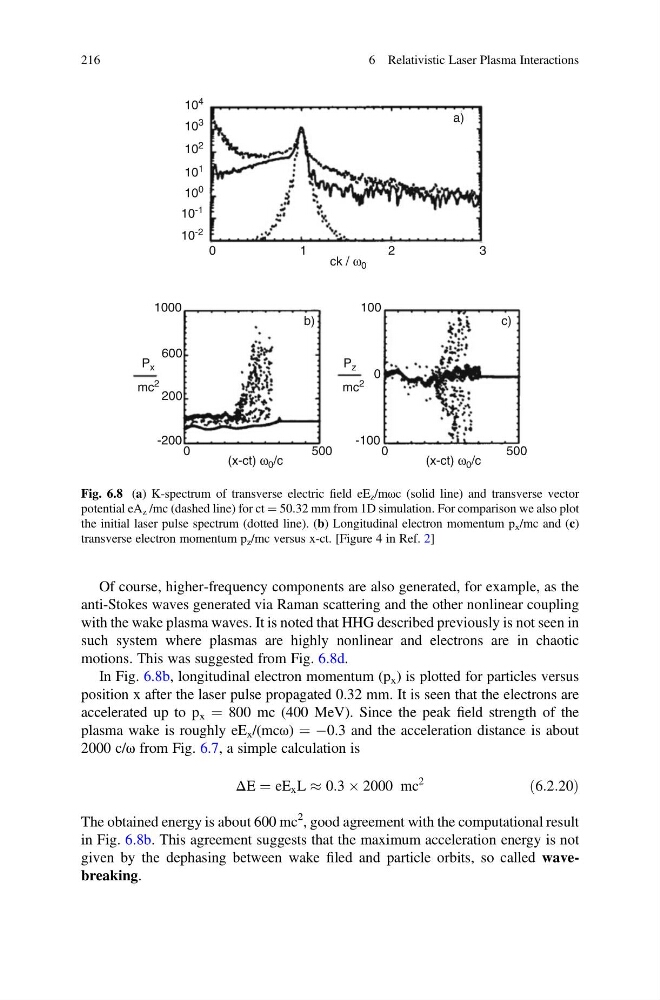
motions. This was suggested from Fig. 6.8d.
In Fig. 6.8b, longitudinal electron momentum (p x ) is plotted for particles versus
position x after the laser pulse propagated 0.32 mm. It is seen that the electrons are
accelerated up to p x ¼ 800 mc (400 MeV). Since the peak field strength of the
plasma wake is roughly eE x /(mcω) ¼ À0.3 and the acceleration distance is about
2000 c/ω from Fig. 6.7, a simple calculation is
ΔE ¼ eE x L % 0:3 Â 2000 mc
2
ð6:2:20Þ
The obtained energy is about 600 mc
2 , good agreement with the computational result
in Fig. 6.8b. This agreement suggests that the maximum acceleration energy is not
given by the dephasing between wake filed and particle orbits, so called wavebreaking.
10 4
10 3
10 2
10 1
10 0
10 -1
10 -2
0
0
500
(x-ct) ω 0 /c
(x-ct) ω 0 /c
ck / ω 0
500
1000
600
P x
P z
100
-100
0
0
200
mc 2
mc 2
-200
1
2
3
a)
b)
c)
Fig. 6.8 (a) K-spectrum of transverse electric field eE z /mωc (solid line) and transverse vector
potential eA z /mc (dashed line) for ct ¼ 50.32 mm from 1D simulation. For comparison we also plot
the initial laser pulse spectrum (dotted line). (b) Longitudinal electron momentum p x /mc and (c)
transverse electron momentum p z /mc versus x-ct. [Figure 4 in Ref. 2]
216
6 Relativistic Laser Plasma Interactions
anti-Stokes waves generated via Raman scattering and the other nonlinear coupling
with the wake plasma waves. It is noted that HHG described previously is not seen in
such system where plasmas are highly nonlinear and electrons are in chaotic
motions. This was suggested from Fig. 6.8d.
In Fig. 6.8b, longitudinal electron momentum (p x ) is plotted for particles versus
position x after the laser pulse propagated 0.32 mm. It is seen that the electrons are
accelerated up to p x ¼ 800 mc (400 MeV). Since the peak field strength of the
plasma wake is roughly eE x /(mcω) ¼ À0.3 and the acceleration distance is about
2000 c/ω from Fig. 6.7, a simple calculation is
ΔE ¼ eE x L % 0:3 Â 2000 mc
2
ð6:2:20Þ
The obtained energy is about 600 mc
2 , good agreement with the computational result
in Fig. 6.8b. This agreement suggests that the maximum acceleration energy is not
given by the dephasing between wake filed and particle orbits, so called wavebreaking.
10 4
10 3
10 2
10 1
10 0
10 -1
10 -2
0
0
500
(x-ct) ω 0 /c
(x-ct) ω 0 /c
ck / ω 0
500
1000
600
P x
P z
100
-100
0
0
200
mc 2
mc 2
-200
1
2
3
a)
b)
c)
Fig. 6.8 (a) K-spectrum of transverse electric field eE z /mωc (solid line) and transverse vector
potential eA z /mc (dashed line) for ct ¼ 50.32 mm from 1D simulation. For comparison we also plot
the initial laser pulse spectrum (dotted line). (b) Longitudinal electron momentum p x /mc and (c)
transverse electron momentum p z /mc versus x-ct. [Figure 4 in Ref. 2]
216
6 Relativistic Laser Plasma Interactions