

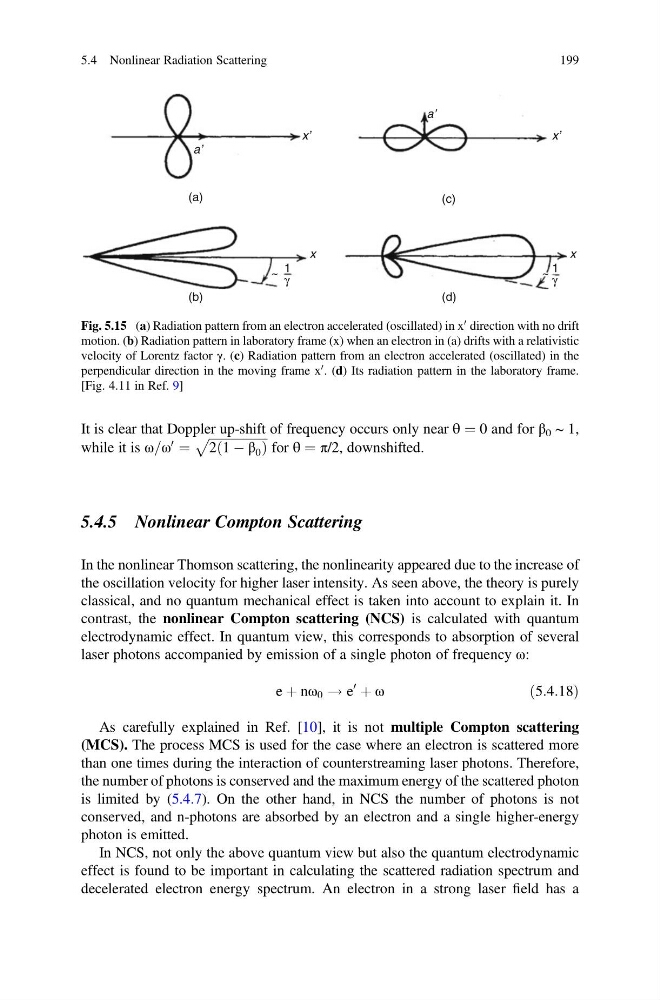
It is clear that Doppler up-shift of frequency occurs only near θ ¼ 0 and for β 0 ~ 1,
while it is ω=ω
0
¼
ffiffiffiffiffiffiffiffiffiffiffiffiffiffiffiffiffiffiffi
2 1 À β 0
ð
Þ
p
for θ ¼ π/2, downshifted.
5.4.5 Nonlinear Compton Scattering
In the nonlinear Thomson scattering, the nonlinearity appeared due to the increase of
the oscillation velocity for higher laser intensity. As seen above, the theory is purely
classical, and no quantum mechanical effect is taken into account to explain it. In
contrast, the nonlinear Compton scattering (NCS) is calculated with quantum
electrodynamic effect. In quantum view, this corresponds to absorption of several
laser photons accompanied by emission of a single photon of frequency ω:
e þ nω 0 ! e
0
þ ω
ð5:4:18Þ
As carefully explained in Ref. [10], it is not multiple Compton scattering
(MCS). The process MCS is used for the case where an electron is scattered more
than one times during the interaction of counterstreaming laser photons. Therefore,
the number of photons is conserved and the maximum energy of the scattered photon
is limited by (5.4.7). On the other hand, in NCS the number of photons is not
conserved, and n-photons are absorbed by an electron and a single higher-energy
photon is emitted.
In NCS, not only the above quantum view but also the quantum electrodynamic
effect is found to be important in calculating the scattered radiation spectrum and
decelerated electron energy spectrum. An electron in a strong laser field has a
(a)
a’
a’
(b)
(d)
(c)
x
x
1
γ
1
γ
~
~
x’
x’
Fig. 5.15 (a) Radiation pattern from an electron accelerated (oscillated) in x
0 direction with no drift
motion. (b) Radiation pattern in laboratory frame (x) when an electron in (a) drifts with a relativistic
velocity of Lorentz factor γ. (c) Radiation pattern from an electron accelerated (oscillated) in the
perpendicular direction in the moving frame x
0 . (d) Its radiation pattern in the laboratory frame.
[Fig. 4.11 in Ref. 9]
5.4 Nonlinear Radiation Scattering
199
while it is ω=ω
0
¼
ffiffiffiffiffiffiffiffiffiffiffiffiffiffiffiffiffiffiffi
2 1 À β 0
ð
Þ
p
for θ ¼ π/2, downshifted.
5.4.5 Nonlinear Compton Scattering
In the nonlinear Thomson scattering, the nonlinearity appeared due to the increase of
the oscillation velocity for higher laser intensity. As seen above, the theory is purely
classical, and no quantum mechanical effect is taken into account to explain it. In
contrast, the nonlinear Compton scattering (NCS) is calculated with quantum
electrodynamic effect. In quantum view, this corresponds to absorption of several
laser photons accompanied by emission of a single photon of frequency ω:
e þ nω 0 ! e
0
þ ω
ð5:4:18Þ
As carefully explained in Ref. [10], it is not multiple Compton scattering
(MCS). The process MCS is used for the case where an electron is scattered more
than one times during the interaction of counterstreaming laser photons. Therefore,
the number of photons is conserved and the maximum energy of the scattered photon
is limited by (5.4.7). On the other hand, in NCS the number of photons is not
conserved, and n-photons are absorbed by an electron and a single higher-energy
photon is emitted.
In NCS, not only the above quantum view but also the quantum electrodynamic
effect is found to be important in calculating the scattered radiation spectrum and
decelerated electron energy spectrum. An electron in a strong laser field has a
(a)
a’
a’
(b)
(d)
(c)
x
x
1
γ
1
γ
~
~
x’
x’
Fig. 5.15 (a) Radiation pattern from an electron accelerated (oscillated) in x
0 direction with no drift
motion. (b) Radiation pattern in laboratory frame (x) when an electron in (a) drifts with a relativistic
velocity of Lorentz factor γ. (c) Radiation pattern from an electron accelerated (oscillated) in the
perpendicular direction in the moving frame x
0 . (d) Its radiation pattern in the laboratory frame.
[Fig. 4.11 in Ref. 9]
5.4 Nonlinear Radiation Scattering
199