

physics related to relativistic plasma, nonlinear physics of wide range of photon
energy, and so on. Since the construction of the CPA laser is not so expensive and
laser is also compact compared to the high-power laser, many groups in the world
now study the physics at extreme condition with the use of such lasers. The 2018
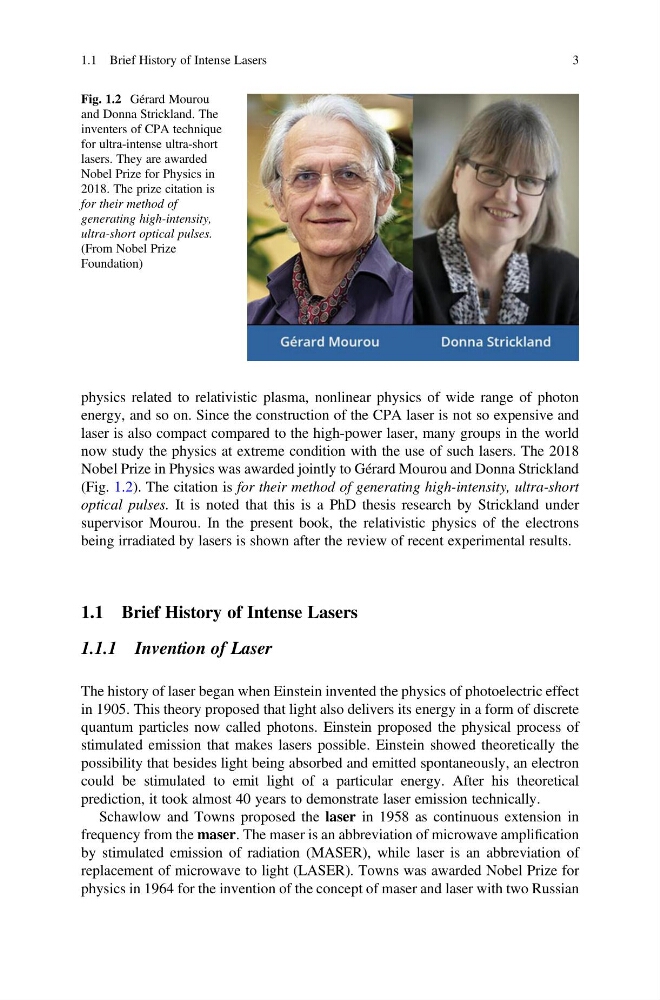
Nobel Prize in Physics was awarded jointly to Gérard Mourou and Donna Strickland
(Fig. 1.2). The citation is for their method of generating high-intensity, ultra-short
optical pulses. It is noted that this is a PhD thesis research by Strickland under
supervisor Mourou. In the present book, the relativistic physics of the electrons
being irradiated by lasers is shown after the review of recent experimental results.
1.1 Brief History of Intense Lasers
1.1.1 Invention of Laser
The history of laser began when Einstein invented the physics of photoelectric effect
in 1905. This theory proposed that light also delivers its energy in a form of discrete
quantum particles now called photons. Einstein proposed the physical process of
stimulated emission that makes lasers possible. Einstein showed theoretically the
possibility that besides light being absorbed and emitted spontaneously, an electron
could be stimulated to emit light of a particular energy. After his theoretical
prediction, it took almost 40 years to demonstrate laser emission technically.
Schawlow and Towns proposed the laser in 1958 as continuous extension in
frequency from the maser. The maser is an abbreviation of microwave amplification
by stimulated emission of radiation (MASER), while laser is an abbreviation of
replacement of microwave to light (LASER). Towns was awarded Nobel Prize for
physics in 1964 for the invention of the concept of maser and laser with two Russian
Fig. 1.2 Gérard Mourou
and Donna Strickland. The
inventers of CPA technique
for ultra-intense ultra-short
lasers. They are awarded
Nobel Prize for Physics in
2018. The prize citation is
for their method of
generating high-intensity,
ultra-short optical pulses.
(From Nobel Prize
Foundation)
1.1 Brief History of Intense Lasers
3
energy, and so on. Since the construction of the CPA laser is not so expensive and
laser is also compact compared to the high-power laser, many groups in the world
now study the physics at extreme condition with the use of such lasers. The 2018
Nobel Prize in Physics was awarded jointly to Gérard Mourou and Donna Strickland
(Fig. 1.2). The citation is for their method of generating high-intensity, ultra-short
optical pulses. It is noted that this is a PhD thesis research by Strickland under
supervisor Mourou. In the present book, the relativistic physics of the electrons
being irradiated by lasers is shown after the review of recent experimental results.
1.1 Brief History of Intense Lasers
1.1.1 Invention of Laser
The history of laser began when Einstein invented the physics of photoelectric effect
in 1905. This theory proposed that light also delivers its energy in a form of discrete
quantum particles now called photons. Einstein proposed the physical process of
stimulated emission that makes lasers possible. Einstein showed theoretically the
possibility that besides light being absorbed and emitted spontaneously, an electron
could be stimulated to emit light of a particular energy. After his theoretical
prediction, it took almost 40 years to demonstrate laser emission technically.
Schawlow and Towns proposed the laser in 1958 as continuous extension in
frequency from the maser. The maser is an abbreviation of microwave amplification
by stimulated emission of radiation (MASER), while laser is an abbreviation of
replacement of microwave to light (LASER). Towns was awarded Nobel Prize for
physics in 1964 for the invention of the concept of maser and laser with two Russian
Fig. 1.2 Gérard Mourou
and Donna Strickland. The
inventers of CPA technique
for ultra-intense ultra-short
lasers. They are awarded
Nobel Prize for Physics in
2018. The prize citation is
for their method of
generating high-intensity,
ultra-short optical pulses.
(From Nobel Prize
Foundation)
1.1 Brief History of Intense Lasers
3