

to relatively slow expansion velocity. The generated pressure is around 100 Mbar
(10
8 atmospheric pressure), and the plasma with temperature of about keV (10
7 K)
expands to the vacuum, and a strong shock wave is produced to the inside of the
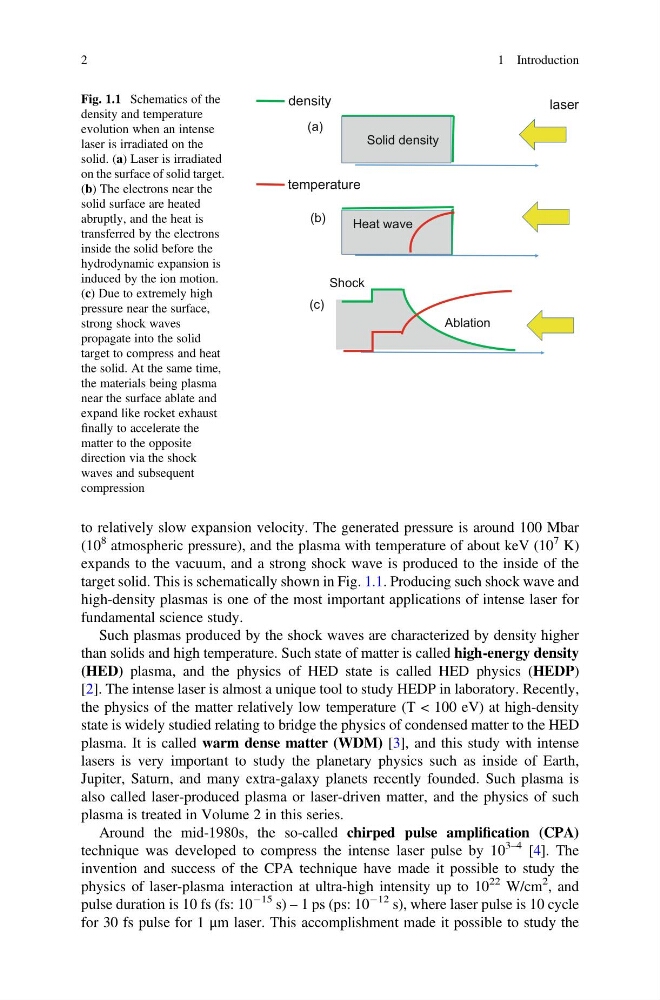
target solid. This is schematically shown in Fig. 1.1. Producing such shock wave and
high-density plasmas is one of the most important applications of intense laser for
fundamental science study.
Such plasmas produced by the shock waves are characterized by density higher
than solids and high temperature. Such state of matter is called high-energy density
(HED) plasma, and the physics of HED state is called HED physics (HEDP)
[2]. The intense laser is almost a unique tool to study HEDP in laboratory. Recently,
the physics of the matter relatively low temperature (T < 100 eV) at high-density
state is widely studied relating to bridge the physics of condensed matter to the HED
plasma. It is called warm dense matter (WDM) [3], and this study with intense
lasers is very important to study the planetary physics such as inside of Earth,
Jupiter, Saturn, and many extra-galaxy planets recently founded. Such plasma is
also called laser-produced plasma or laser-driven matter, and the physics of such
plasma is treated in Volume 2 in this series.
Around the mid-1980s, the so-called chirped pulse amplification (CPA)
technique was developed to compress the intense laser pulse by 10
3–4 [4]. The
invention and success of the CPA technique have made it possible to study the
physics of laser-plasma interaction at ultra-high intensity up to 10
22 W/cm
2 , and
pulse duration is 10 fs (fs: 10
À15 s) – 1 ps (ps: 10
À12 s), where laser pulse is 10 cycle
for 30 fs pulse for 1 μm laser. This accomplishment made it possible to study the
density
temperature
laser
Ablation
Shock
Solid density
Heat wave
(a)
(b)
(c)
Fig. 1.1 Schematics of the
density and temperature
evolution when an intense
laser is irradiated on the
solid. (a) Laser is irradiated
on the surface of solid target.
(b) The electrons near the
solid surface are heated
abruptly, and the heat is
transferred by the electrons
inside the solid before the
hydrodynamic expansion is
induced by the ion motion.
(c) Due to extremely high
pressure near the surface,
strong shock waves
propagate into the solid
target to compress and heat
the solid. At the same time,
the materials being plasma
near the surface ablate and
expand like rocket exhaust
finally to accelerate the
matter to the opposite
direction via the shock
waves and subsequent
compression
2
1 Introduction
(10
8 atmospheric pressure), and the plasma with temperature of about keV (10
7 K)
expands to the vacuum, and a strong shock wave is produced to the inside of the
target solid. This is schematically shown in Fig. 1.1. Producing such shock wave and
high-density plasmas is one of the most important applications of intense laser for
fundamental science study.
Such plasmas produced by the shock waves are characterized by density higher
than solids and high temperature. Such state of matter is called high-energy density
(HED) plasma, and the physics of HED state is called HED physics (HEDP)
[2]. The intense laser is almost a unique tool to study HEDP in laboratory. Recently,
the physics of the matter relatively low temperature (T < 100 eV) at high-density
state is widely studied relating to bridge the physics of condensed matter to the HED
plasma. It is called warm dense matter (WDM) [3], and this study with intense
lasers is very important to study the planetary physics such as inside of Earth,
Jupiter, Saturn, and many extra-galaxy planets recently founded. Such plasma is
also called laser-produced plasma or laser-driven matter, and the physics of such
plasma is treated in Volume 2 in this series.
Around the mid-1980s, the so-called chirped pulse amplification (CPA)
technique was developed to compress the intense laser pulse by 10
3–4 [4]. The
invention and success of the CPA technique have made it possible to study the
physics of laser-plasma interaction at ultra-high intensity up to 10
22 W/cm
2 , and
pulse duration is 10 fs (fs: 10
À15 s) – 1 ps (ps: 10
À12 s), where laser pulse is 10 cycle
for 30 fs pulse for 1 μm laser. This accomplishment made it possible to study the
density
temperature
laser
Ablation
Shock
Solid density
Heat wave
(a)
(b)
(c)
Fig. 1.1 Schematics of the
density and temperature
evolution when an intense
laser is irradiated on the
solid. (a) Laser is irradiated
on the surface of solid target.
(b) The electrons near the
solid surface are heated
abruptly, and the heat is
transferred by the electrons
inside the solid before the
hydrodynamic expansion is
induced by the ion motion.
(c) Due to extremely high
pressure near the surface,
strong shock waves
propagate into the solid
target to compress and heat
the solid. At the same time,
the materials being plasma
near the surface ablate and
expand like rocket exhaust
finally to accelerate the
matter to the opposite
direction via the shock
waves and subsequent
compression
2
1 Introduction