

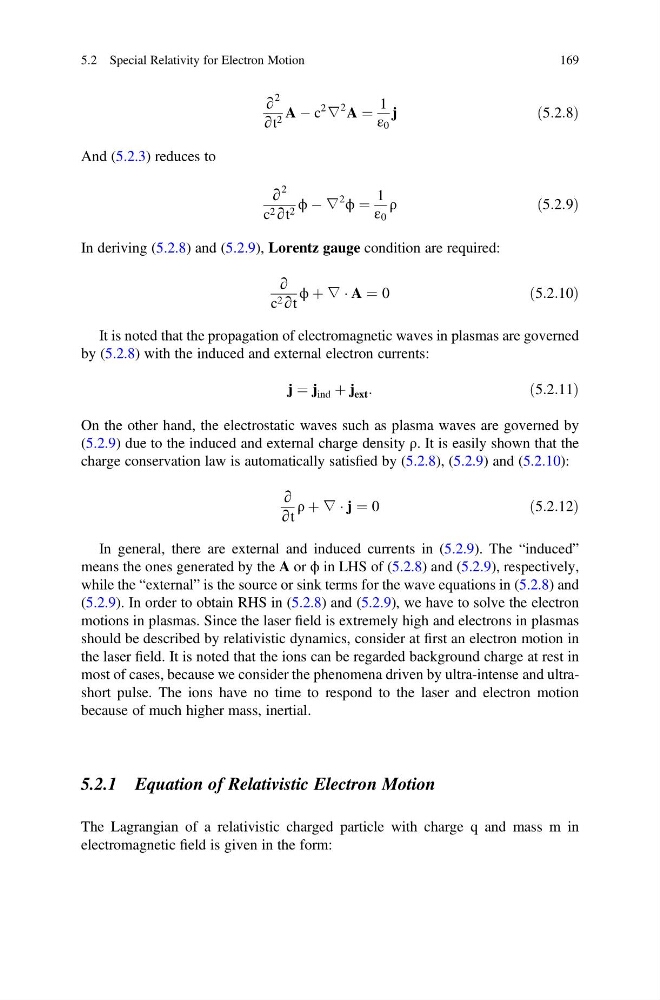
∂
2
∂t 2 A À c
2
∇
2 A ¼
1
ε 0
j
ð5:2:8Þ
And (5.2.3) reduces to
∂
2
c 2 ∂t 2 ϕ À ∇
2 ϕ ¼
1
ε 0
ρ
ð5:2:9Þ
In deriving (5.2.8) and (5.2.9), Lorentz gauge condition are required:
∂
c 2 ∂t
ϕ þ ∇ Á A ¼ 0
ð5:2:10Þ
It is noted that the propagation of electromagnetic waves in plasmas are governed
by (5.2.8) with the induced and external electron currents:
j ¼ j ind þ j ext :
ð5:2:11Þ
On the other hand, the electrostatic waves such as plasma waves are governed by
(5.2.9) due to the induced and external charge density ρ. It is easily shown that the
charge conservation law is automatically satisfied by (5.2.8), (5.2.9) and (5.2.10):
∂
∂t
ρ þ ∇ Á j ¼ 0
ð5:2:12Þ
In general, there are external and induced currents in (5.2.9). The “induced”
means the ones generated by the A or ϕ in LHS of (5.2.8) and (5.2.9), respectively,
while the “external” is the source or sink terms for the wave equations in (5.2.8) and
(5.2.9). In order to obtain RHS in (5.2.8) and (5.2.9), we have to solve the electron
motions in plasmas. Since the laser field is extremely high and electrons in plasmas
should be described by relativistic dynamics, consider at first an electron motion in
the laser field. It is noted that the ions can be regarded background charge at rest in
most of cases, because we consider the phenomena driven by ultra-intense and ultrashort pulse. The ions have no time to respond to the laser and electron motion
because of much higher mass, inertial.
5.2.1 Equation of Relativistic Electron Motion
The Lagrangian of a relativistic charged particle with charge q and mass m in
electromagnetic field is given in the form:
5.2 Special Relativity for Electron Motion
169
2
∂t 2 A À c
2
∇
2 A ¼
1
ε 0
j
ð5:2:8Þ
And (5.2.3) reduces to
∂
2
c 2 ∂t 2 ϕ À ∇
2 ϕ ¼
1
ε 0
ρ
ð5:2:9Þ
In deriving (5.2.8) and (5.2.9), Lorentz gauge condition are required:
∂
c 2 ∂t
ϕ þ ∇ Á A ¼ 0
ð5:2:10Þ
It is noted that the propagation of electromagnetic waves in plasmas are governed
by (5.2.8) with the induced and external electron currents:
j ¼ j ind þ j ext :
ð5:2:11Þ
On the other hand, the electrostatic waves such as plasma waves are governed by
(5.2.9) due to the induced and external charge density ρ. It is easily shown that the
charge conservation law is automatically satisfied by (5.2.8), (5.2.9) and (5.2.10):
∂
∂t
ρ þ ∇ Á j ¼ 0
ð5:2:12Þ
In general, there are external and induced currents in (5.2.9). The “induced”
means the ones generated by the A or ϕ in LHS of (5.2.8) and (5.2.9), respectively,
while the “external” is the source or sink terms for the wave equations in (5.2.8) and
(5.2.9). In order to obtain RHS in (5.2.8) and (5.2.9), we have to solve the electron
motions in plasmas. Since the laser field is extremely high and electrons in plasmas
should be described by relativistic dynamics, consider at first an electron motion in
the laser field. It is noted that the ions can be regarded background charge at rest in
most of cases, because we consider the phenomena driven by ultra-intense and ultrashort pulse. The ions have no time to respond to the laser and electron motion
because of much higher mass, inertial.
5.2.1 Equation of Relativistic Electron Motion
The Lagrangian of a relativistic charged particle with charge q and mass m in
electromagnetic field is given in the form:
5.2 Special Relativity for Electron Motion
169